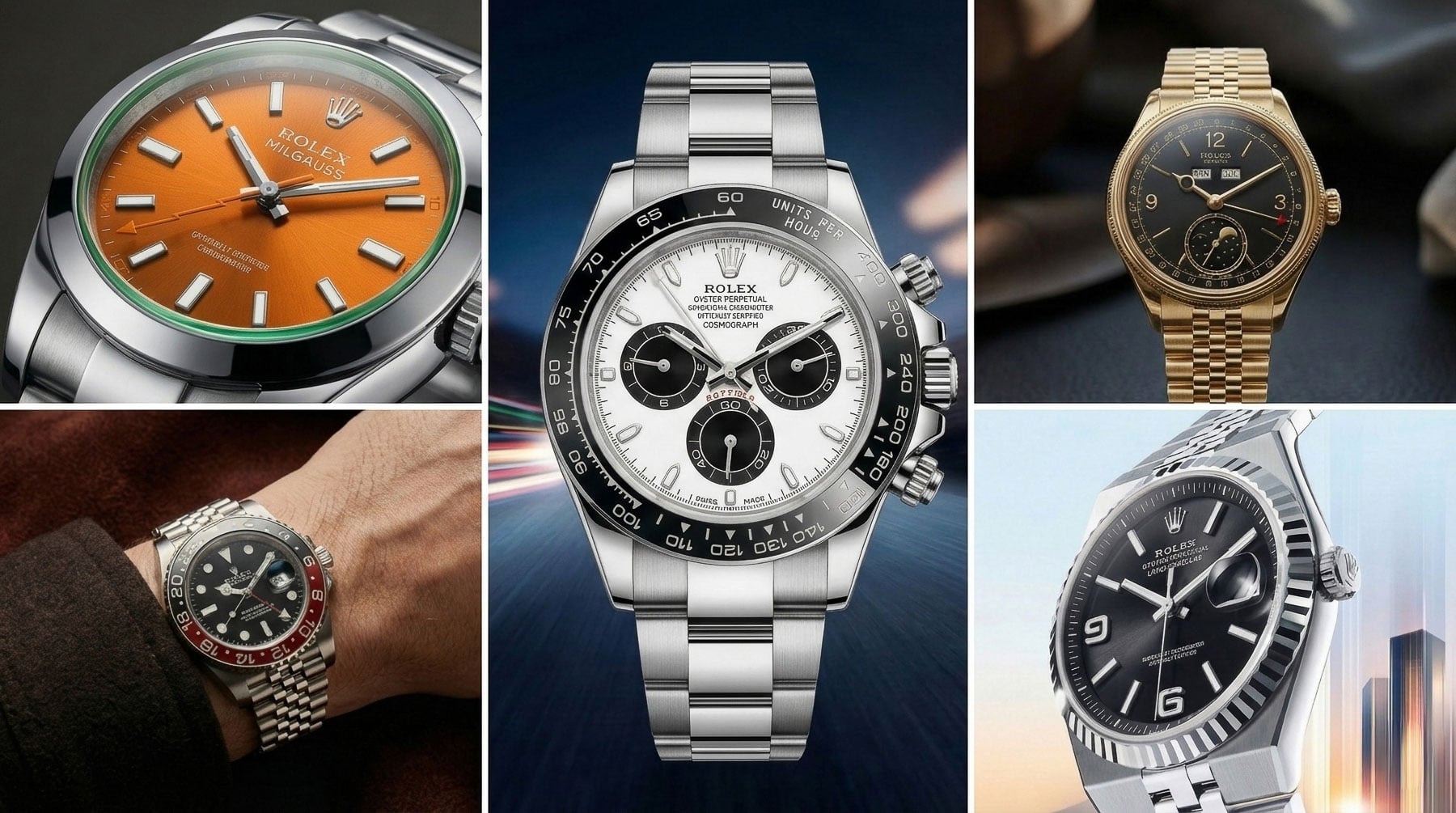
The Milgauss was launched in 1956, the same year as the Day-Date, but for an entirely different audience: physicists, electrical engineers, and medical technicians who worked around strong magnetic fields and whose ordinary mechanical watches were rendered unreadable. The original ref. 6541 achieved a 1,000 gauss magnetic-field resistance specification (the name is a contraction of "1,000 gauss"; mille + gauss) by enclosing the movement in a soft-iron Faraday cage: an inner shell of magnetic-permeable material that channels the field around the movement rather than through it. Rolex tested early prototypes at CERN, the European nuclear research lab in Geneva, and Milgaussses were issued to CERN engineers as part of the validation programme.
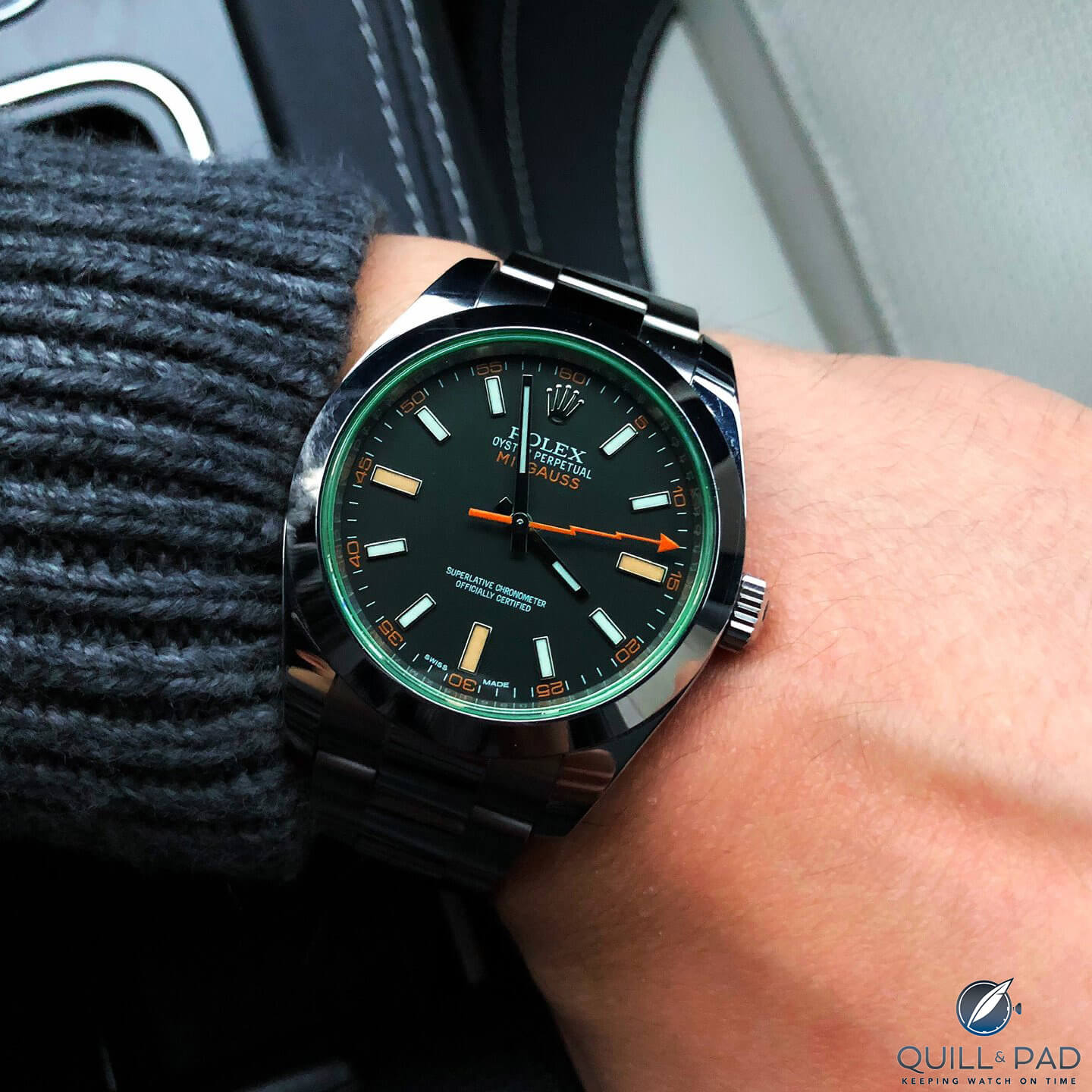
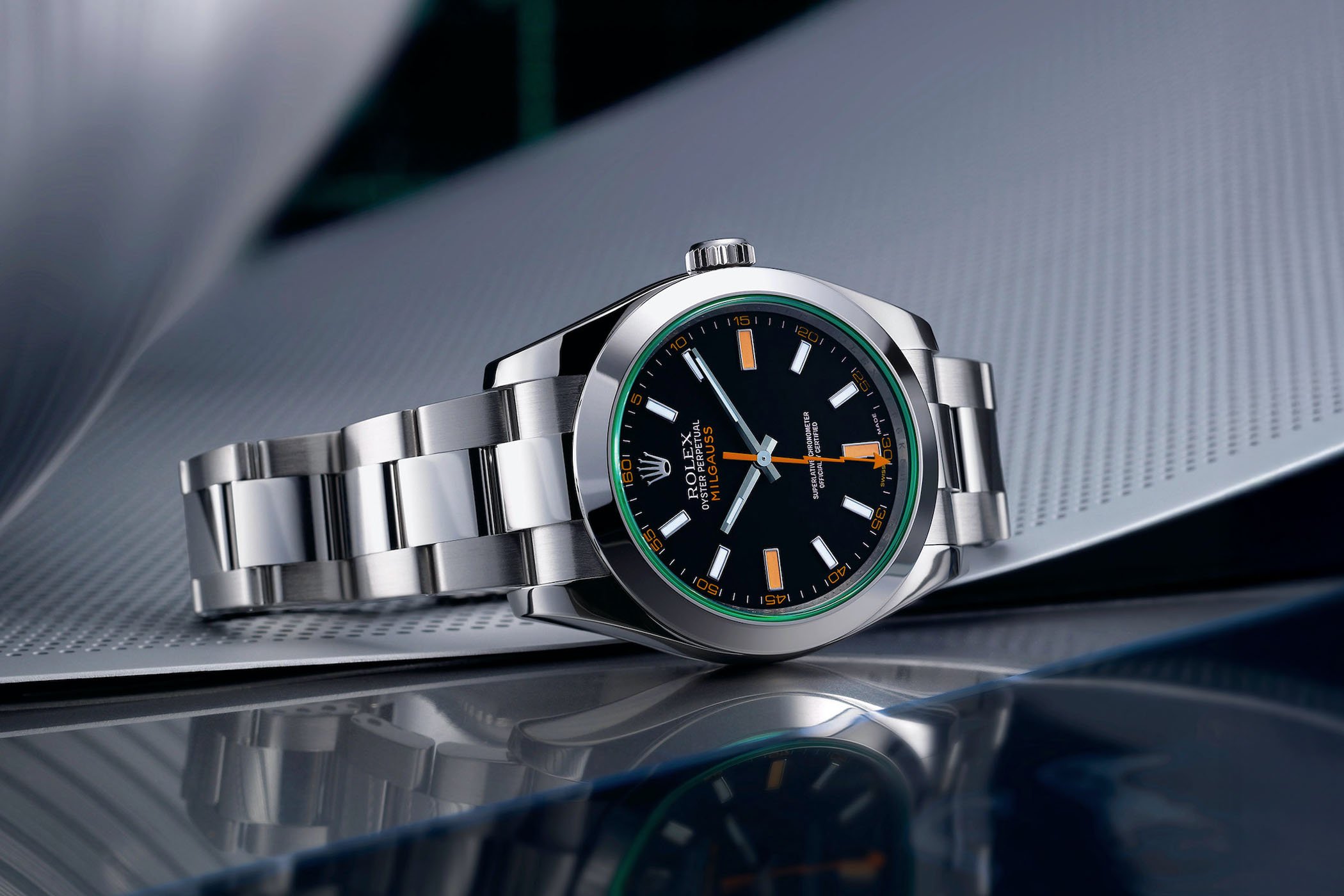
The 1956 ref. 6541 had a rotating bezel (later removed) and a distinctive lightning-bolt seconds hand, intentionally referencing the watch's electromagnetic context. It sold poorly. The replacement ref. 1019 (1960-1988) was a more conservative cleaner-faced Milgauss with a regular straight seconds hand, plain bezel, and an even smaller production run. After three decades of mediocre commercial reception, Rolex discontinued the Milgauss in 1988, and the model was absent from the catalogue for nearly two decades.
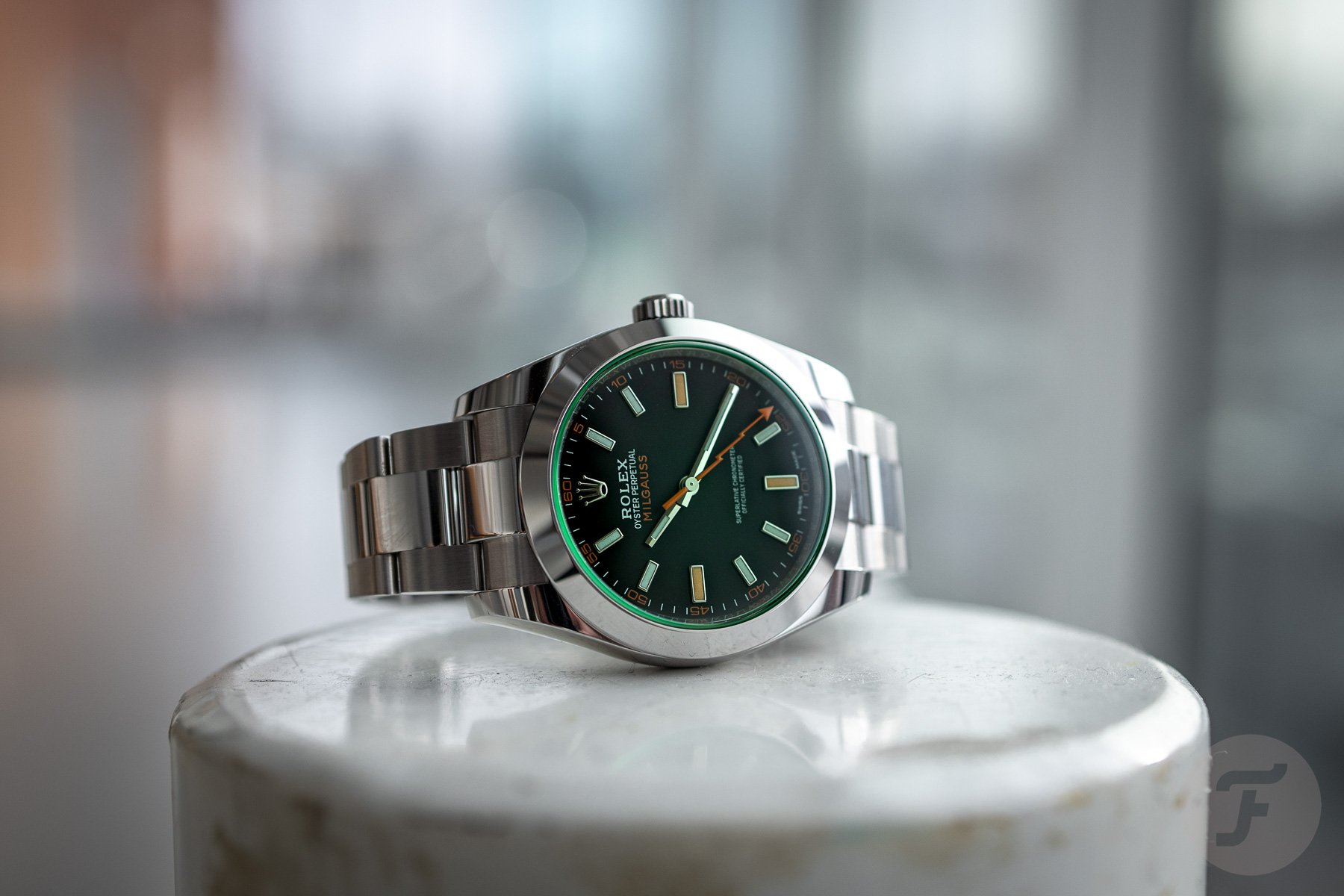
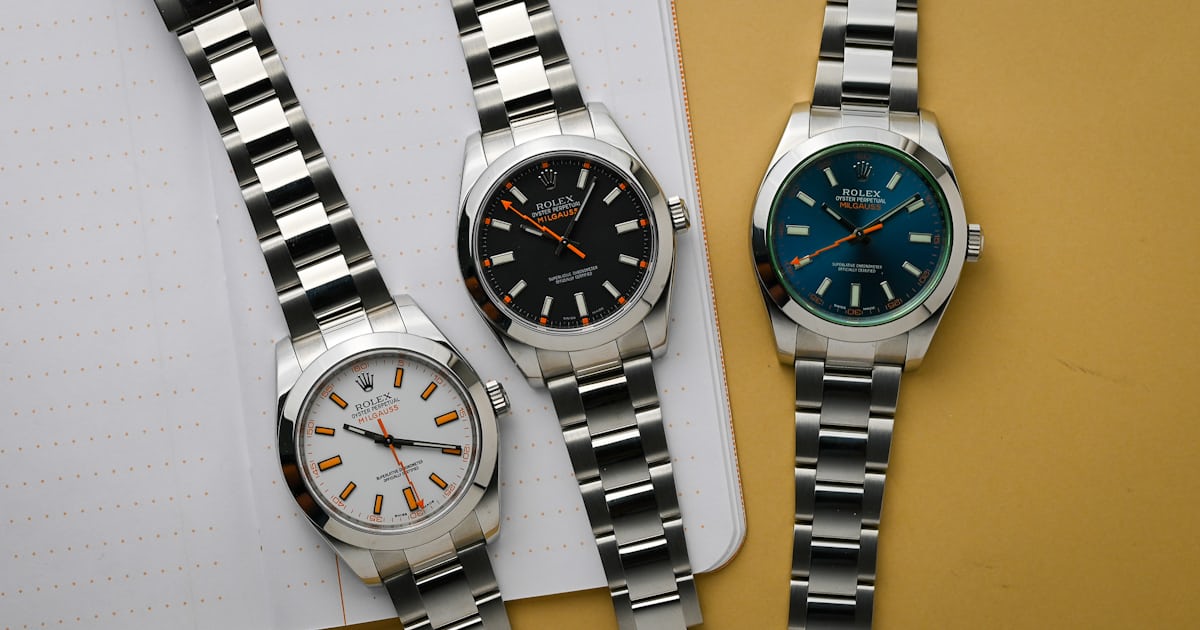
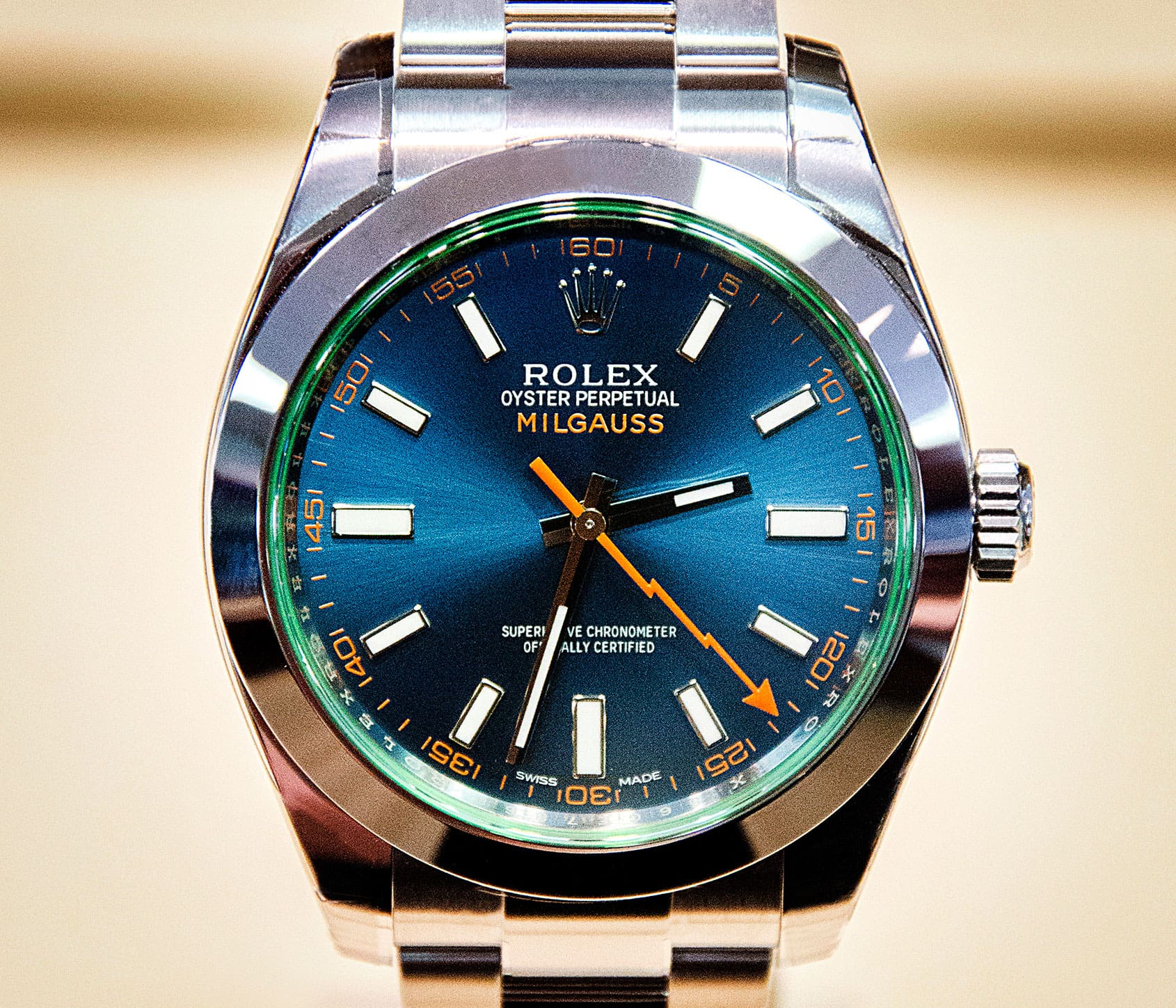
In 2007, Rolex revived the Milgauss as the ref. 116400, restoring the original orange lightning-bolt seconds hand and the 1,000 gauss specification, now achieved with the in-house Cal. 3131 (a Cal. 3135 derivative with shielded magnetic alloy and Parachrom blue hairspring). Two main variants emerged: the standard ref. 116400 with a regular sapphire crystal, and the headline ref. 116400GV ("GV" for Glace Verte, "green crystal" in French), which used a lightly tinted green sapphire crystal, a Rolex first. In 2014 the GV got a striking Z-Blue dial with a horizontal radial sunburst and orange Milgauss text.
The Milgauss never sold in the volumes of the Submariner or Daytona; it found a niche among scientists, engineers, photographers (who hated magnetic field interference with film and exposure meters), and watch enthusiasts who appreciated the cult-icon design language. The reference 116400GV was discontinued at Watches and Wonders 2023, ending Milgauss production for the second time in the model's history. Rolex did not announce a successor. Discontinued examples now trade above their original retail (the GV was USD 8,200 at retail in 2022, and now sells around USD 9,000-12,000 on the secondary market).




Comments
No comments yet, be the first to weigh in.