How a Zenith ended up in a Rolex
For over 25 years (1963-1988) the Rolex Daytona ran the manual Valjoux 72, a hand-wound chronograph from the 1930s. By the late 1980s every other major chronograph was automatic. Rolex needed an automatic chrono engine and chose the Zenith El Primero 400, the high-frequency Charles Vermot-rescued chrono caliber. The new Daytona ref. 16520 arrived in 1988 with the El Primero inside, rebranded as the Cal. 4030.
What Rolex changed
Rolex did not use the El Primero as supplied. They modified roughly 50% of the components for the Daytona application:
- Frequency reduced from 36,000 vph to 28,800 vph (smoother long-term, longer service intervals)
- Date function removed (the Daytona dial has no date window)
- Hour-and-minute totaliser layout reorganised for the Daytona dial
- Rolex's own Microstella regulation system installed
- Rolex's own Breguet-overcoil hairspring
- Adjusted to chronometer specification
The original Zenith chrono module remained intact (column wheel, lateral clutch, integrated layout). The result was the 4030, a movement Rolex officially called "Rolex" but internally was Zenith blood.
The 16520 Daytona
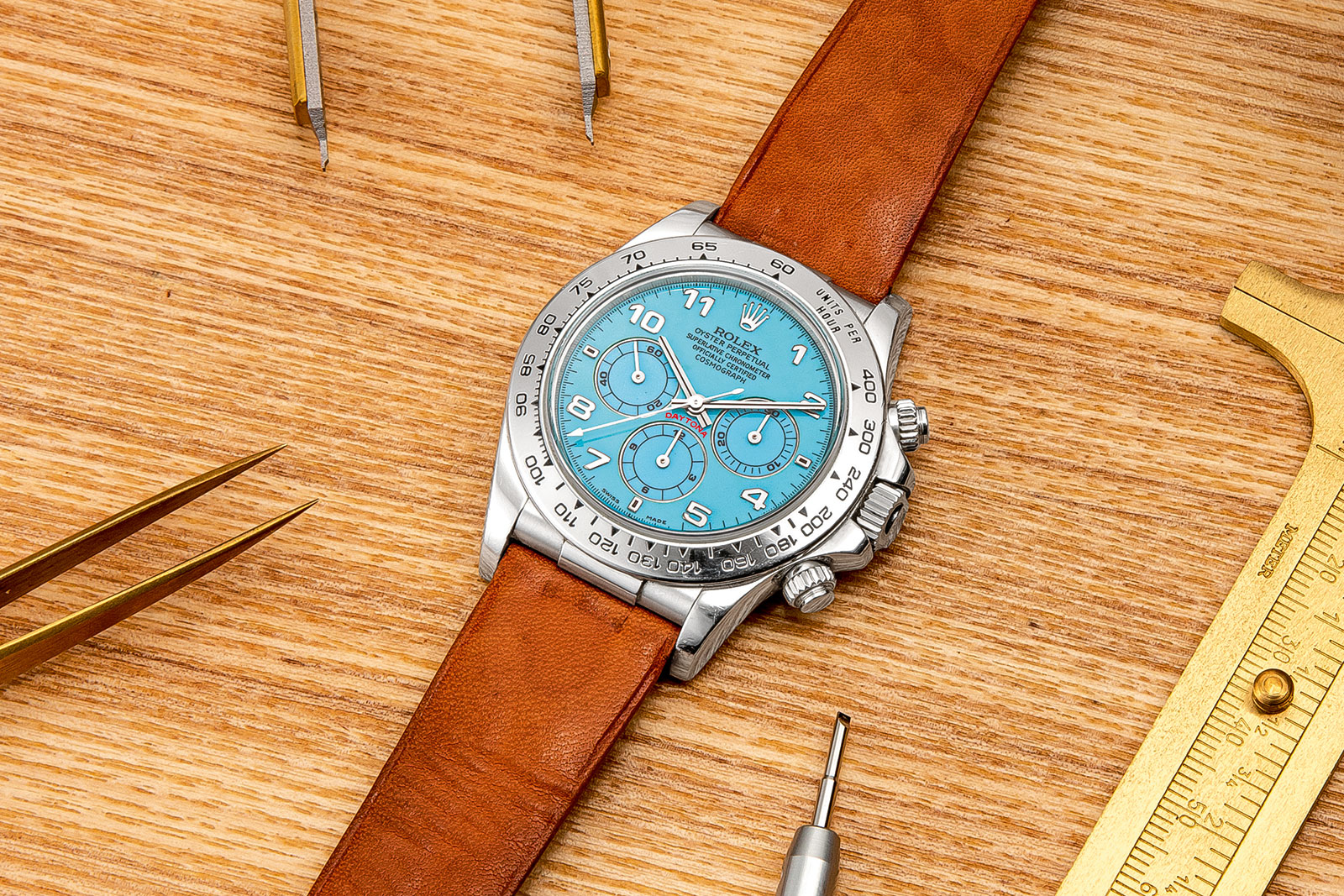
The Daytona ref. 16520 (1988-2000) is now one of the most collected modern Rolexes. It came in steel only, 40 mm, with white "Inverted 6" dials and black "Floating Cosmograph" dials being the most sought variants among the many dial variations across the production run. The 16520 made the Daytona desirable in a way the manual-wind 6263 never quite was at retail: long waiting lists started in the early 1990s and never really stopped, transitioning into the modern Daytona phenomenon. The Rolex/Zenith collaboration was famously kept under wraps; many buyers in 1988 did not know they had a Zenith inside their Daytona.
Why it ended in 2000
In 2000 Rolex replaced the 16520 with the new ref. 116520, powered by the in-house Cal. 4130, Rolex's first fully designed-and-built automatic chronograph. The 4130 brought a vertical clutch (smoother chrono start), a longer 72 h reserve, and a simpler architecture (~60% fewer components than the El Primero). The 4030 was retired. Zenith continued with its own El Primero in Zenith-branded watches.
Vintage market
The 16520 "Zenith Daytona" is firmly collector territory. Prices: USD 25,000-50,000 for a clean steel 16520 depending on dial variant (Inverted 6 dial = premium, Floating Cosmograph = premium, Patrizzi dial = significant premium). Service: any Rolex Service Centre handles 4030 movements, but parts are now shared with Zenith's own El Primero supply chain. The 4030 is widely considered the most romantic modern Daytona caliber: it has a column-wheel architecture (the modern 4130 does too) but with the historical curiosity of being a hybrid Rolex-Zenith engine.
Comments 5