
Tritium tubes are a self-powered illumination system in which microscopic borosilicate glass tubes (typically 1-3 mm long, 0.4-0.6 mm diameter) are filled with low-pressure tritium gas and coated internally with a phosphor. Tritium is a radioactive isotope of hydrogen with a half-life of ~12.3 years; it emits low-energy beta particles (electrons) which cannot penetrate the glass tube but do excite the phosphor coating, causing it to glow continuously and without charging from light. The result is a watch that is readable in absolute darkness, all night, every night, for roughly 25 years, without ever needing to be exposed to ambient light first.
The technology was developed by mb-microtec AG, a small Swiss company in Niederwangen just outside Bern, founded in 1969. mb-microtec's commercial product is sold under the trademark trigalight. The company is the dominant supplier of tritium tubes for the watchmaking industry; competing tube production exists at Traser's in-house facility and at a small number of US and Israeli defence-related suppliers, but mb-microtec's civilian-export tubes account for the bulk of the wristwatch market. The current "trigalight" tube design has been in serial production since ~1989.
"Super-LumiNova fades. Tritium does not. After 8 hours under a sleeve, the tritium watch glows; the Super-LumiNova watch does not. That is the entire case for choosing tubes."- Marathon Watch military-supply specification commentary
The advantage over Super-LumiNova is continuous brightness. Super-LumiNova requires light exposure to "charge"; once charged, it glows brightly for the first 30 minutes, then dims gradually over 6-8 hours. Tritium tubes glow at a fixed brightness (lower than freshly-charged Super-LumiNova) continuously, day or night, for years. For military, law-enforcement, and emergency-services use, where a watch may be in a pocket or under a sleeve for hours before being needed, the tritium system is meaningfully more useful. The trade-off: the tubes glow at a fixed lower intensity than freshly-charged Super-LumiNova, so a tritium watch under a strong UV charge looks dimmer than a Super-LumiNova watch in the first minute after charging.
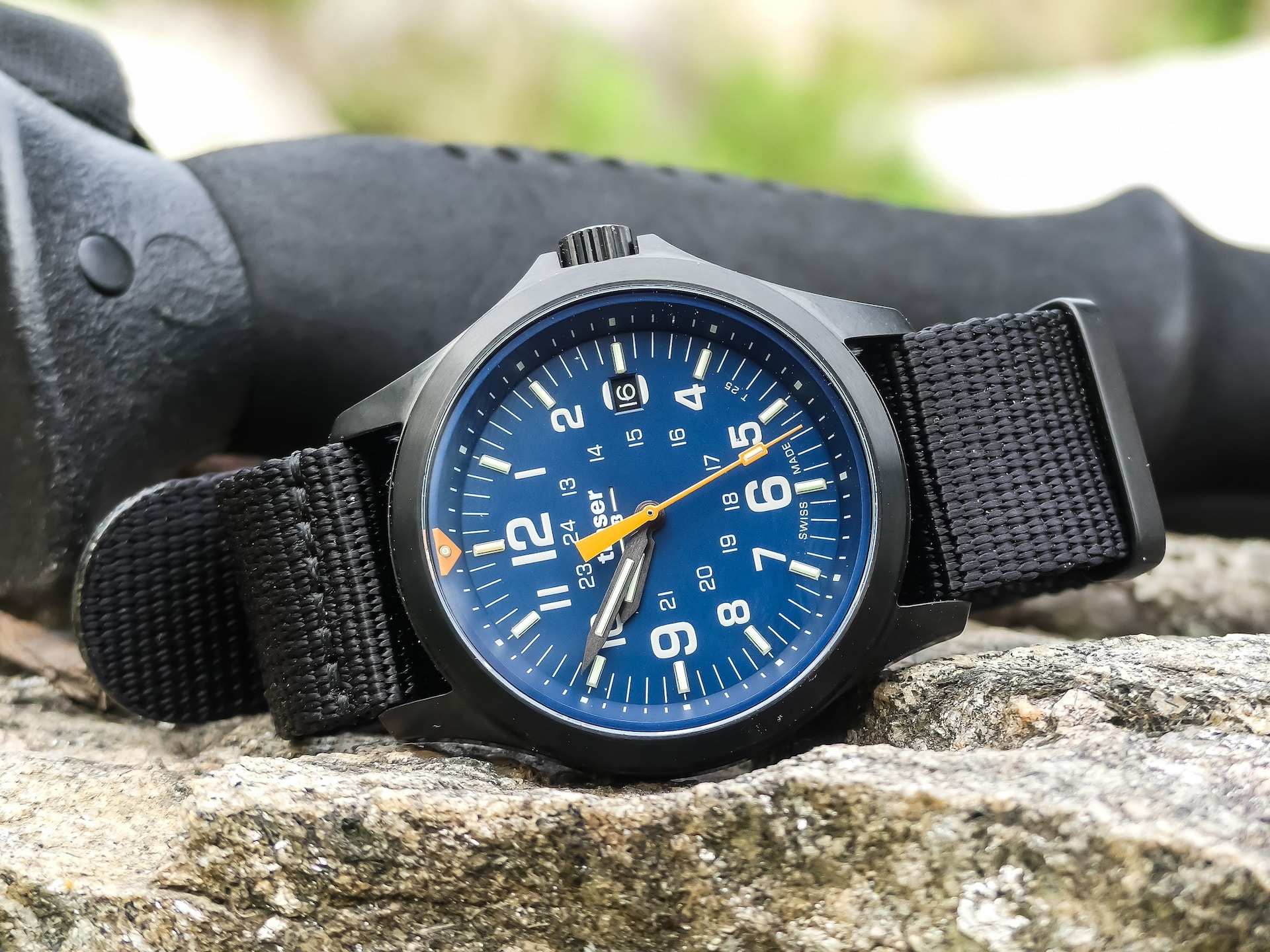
The "T100" and "T25" markings seen on dials of tritium-tube watches indicate the total radiation activity of the tubes. T100 means the tubes contain a total of 1.0 GBq (gigabecquerels) of tritium, the maximum civilian export limit per watch under the IAEA tritium-handling standard. T25 means 0.25 GBq, used on smaller dials, watches with fewer/smaller tubes, or for jurisdictions with stricter import limits. Both are well below any radiation-exposure threshold; the energy of tritium's beta decay is so low that it cannot penetrate the watch crystal, glass tube wall, or even a sheet of paper. The tritium's effects are entirely on the phosphor inside the tube; no radiation escapes the watch.
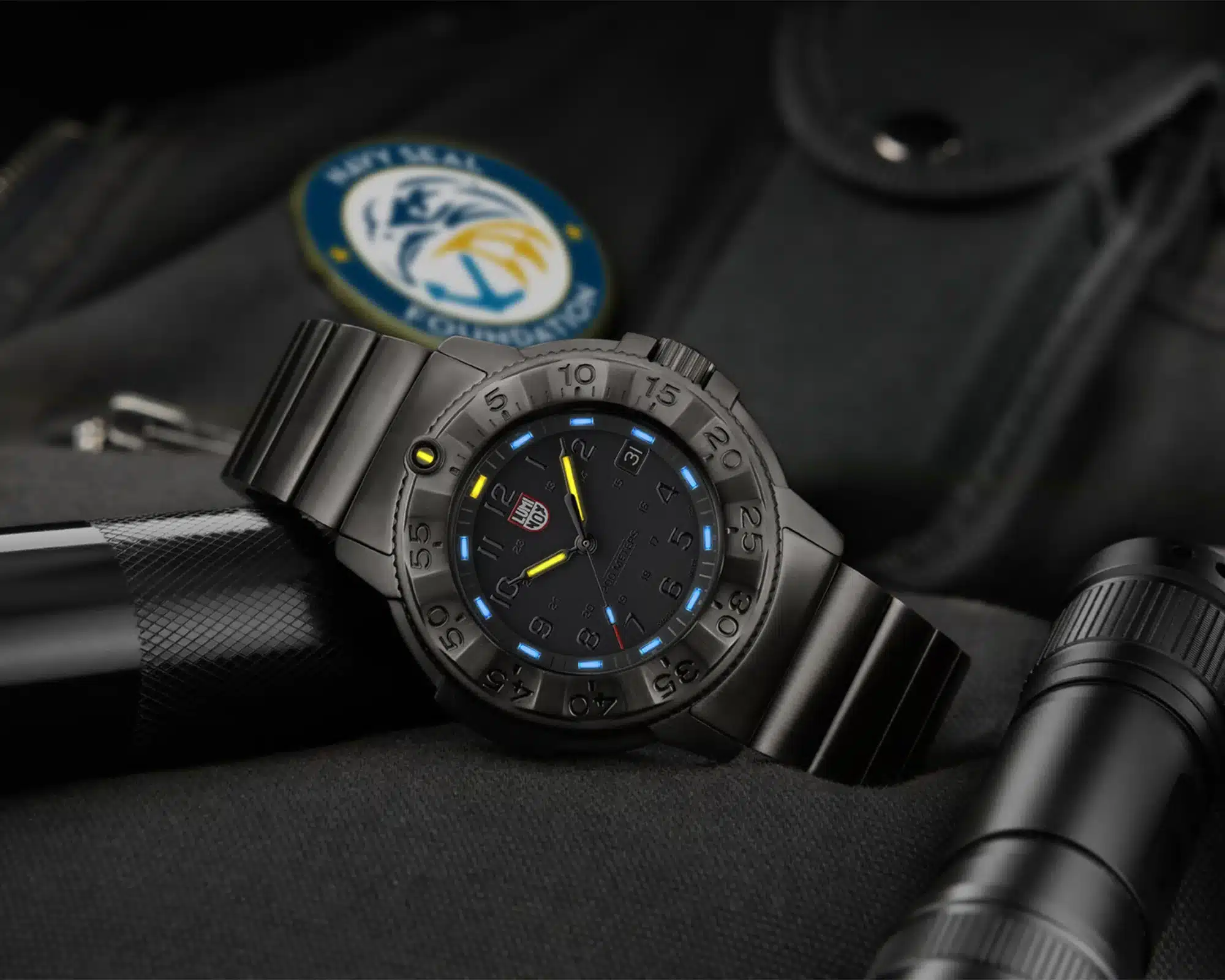
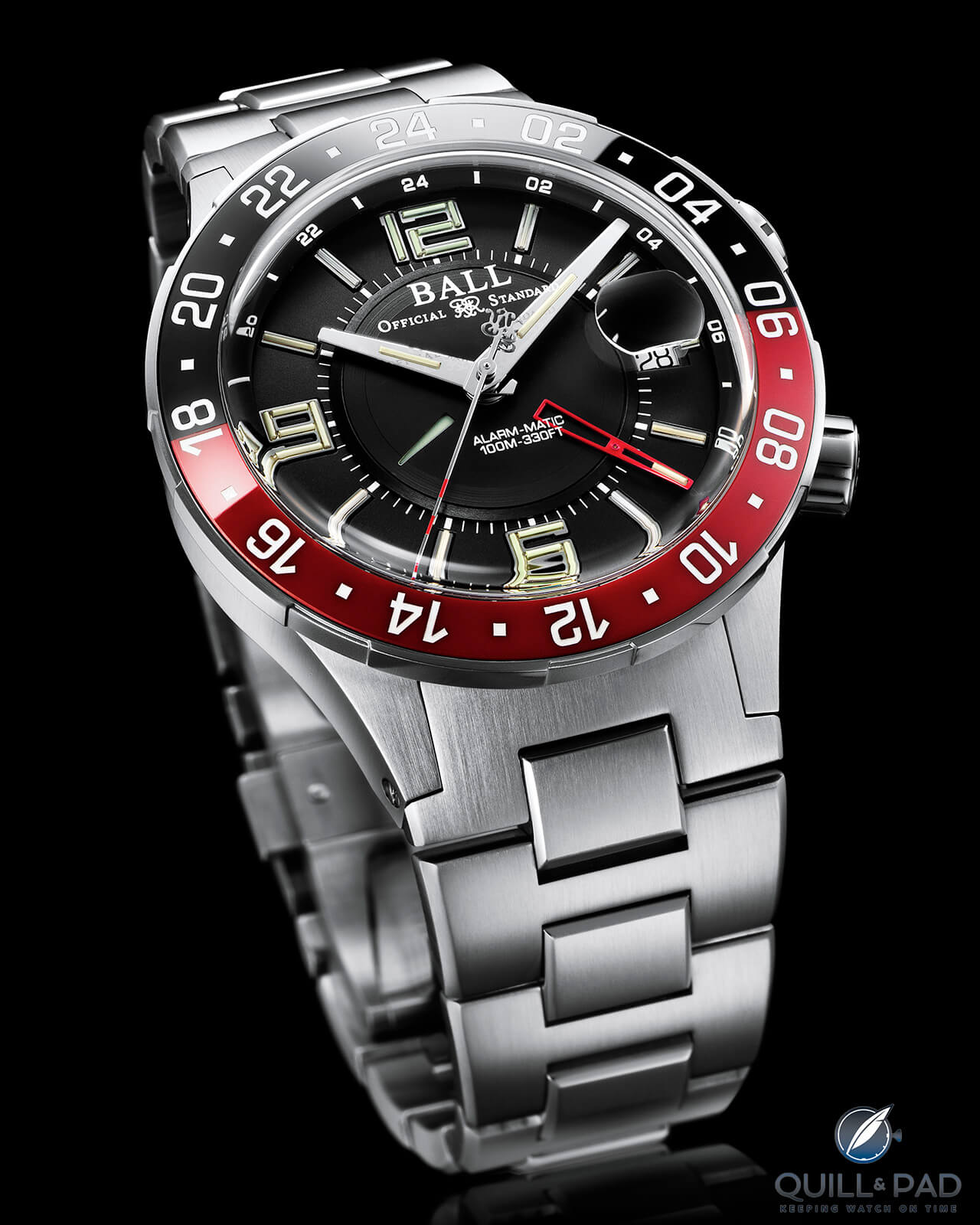
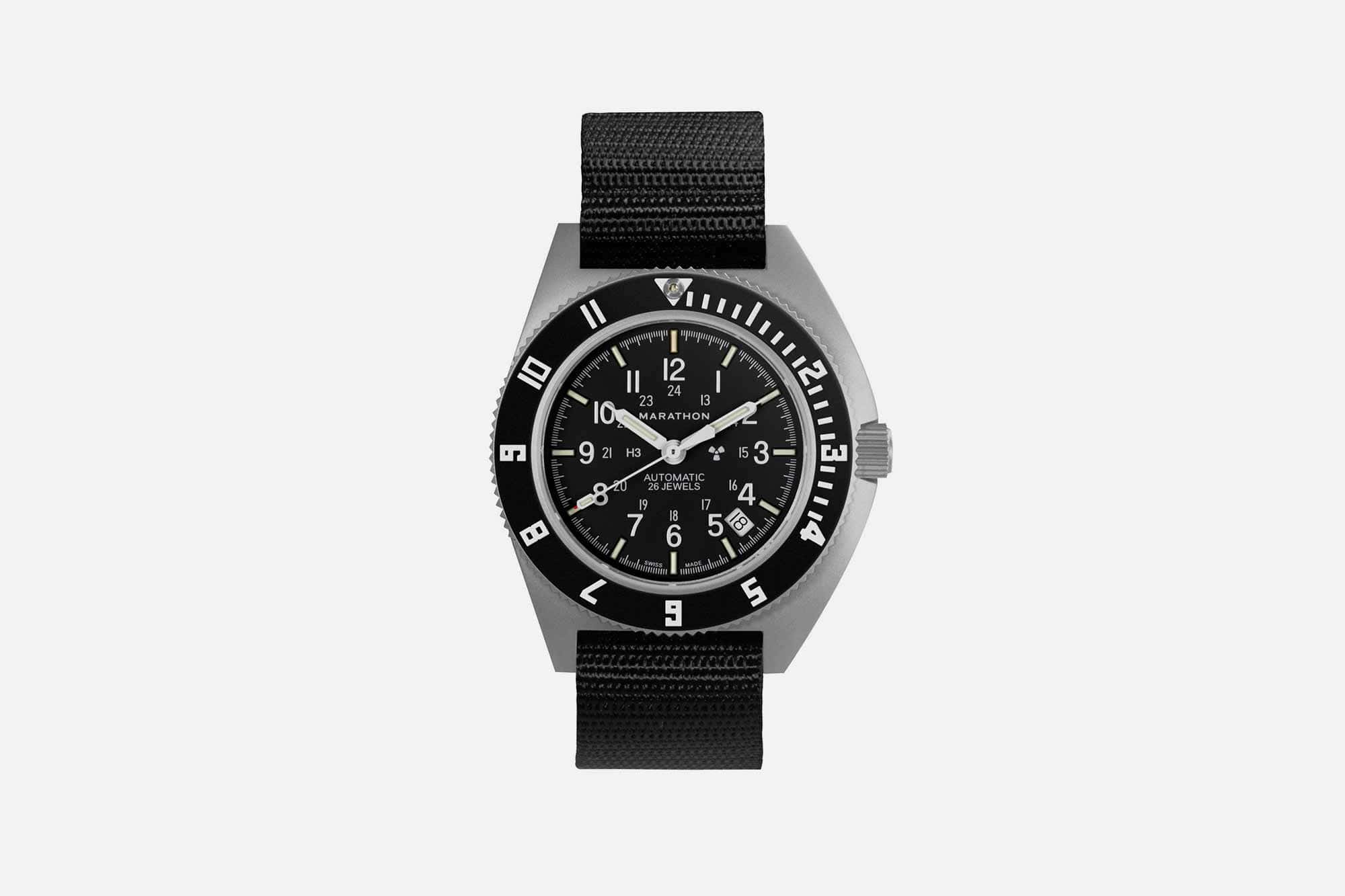
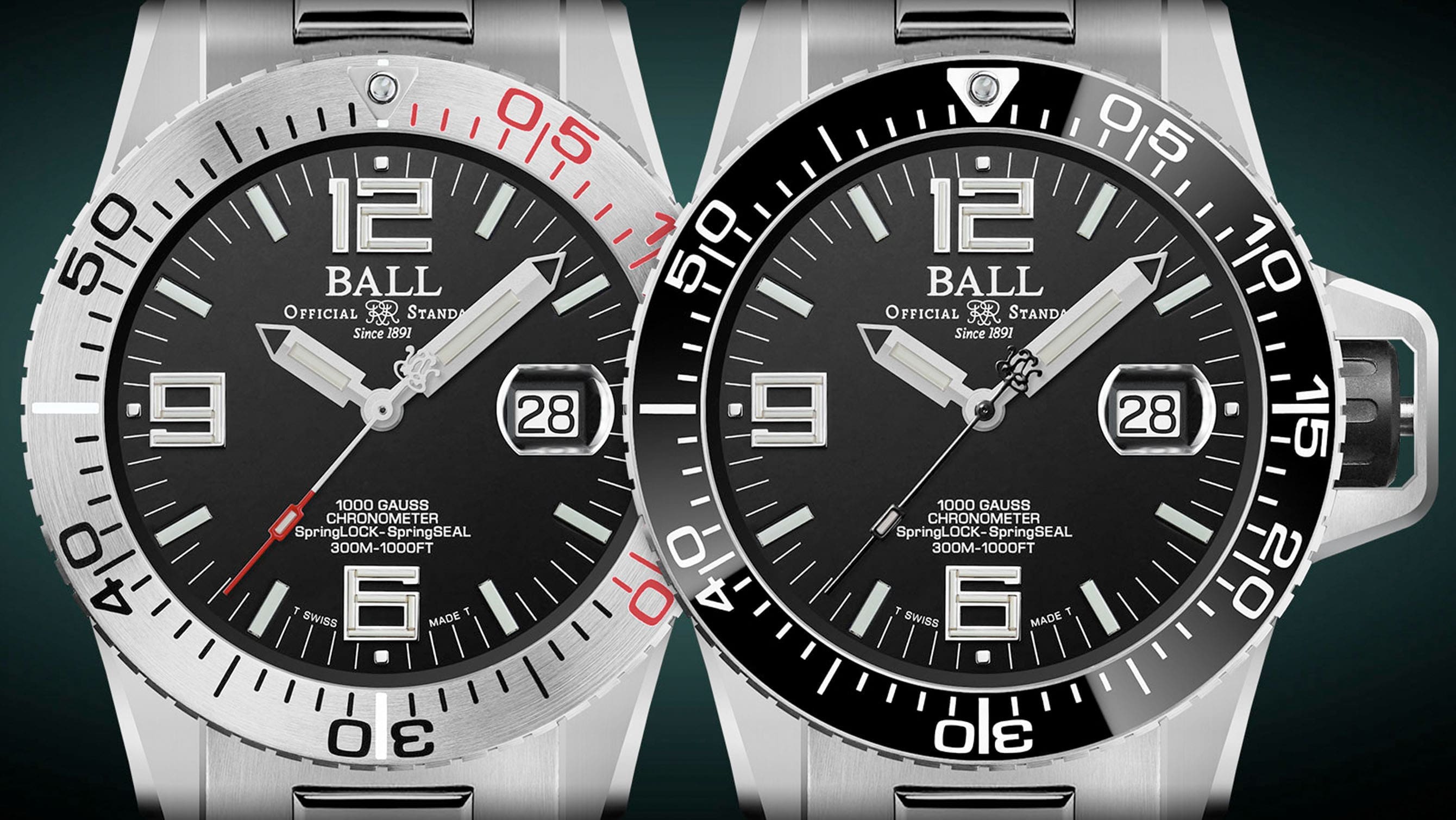
In serial production, tritium tubes appear primarily on military, professional, and tool-watch references. Ball Watch Company uses them across its full catalogue (Engineer Hydrocarbon, Trainmaster, Roadmaster) and is the largest civilian buyer; Luminox built its brand around tritium tubes from the early 1990s and supplies US Navy SEAL teams; Marathon Watch Company supplies the US, Canadian, and German military with tritium-tube field watches; Traser uses an in-house "trigalight" technology with similar specifications; Sinn uses tritium tubes on selected mission-specific references such as the EZM 9 marine pilot. Total industry volume is in the hundreds of thousands of tritium-tube watches per year, mostly in the sub-CHF 1,500 military and professional segment.
The visible signature of a tritium-tube dial is recognisable: tubes appear as raised cylindrical glow points on the markers and hands, with a uniform low-intensity glow in any darkness. The tubes are typically green (the standard phosphor) but mb-microtec offers blue, orange, and yellow tubes for varying applications; multi-colour dials (e.g. blue hour markers, green minute hand, orange seconds) are a common Ball Watch signature. Modern hybrid designs combine tritium tubes (continuous baseline glow) with Super-LumiNova fill (high initial brightness when charged); these "best-of-both" dials appear on selected Marathon and Sinn references.


Comments 2