
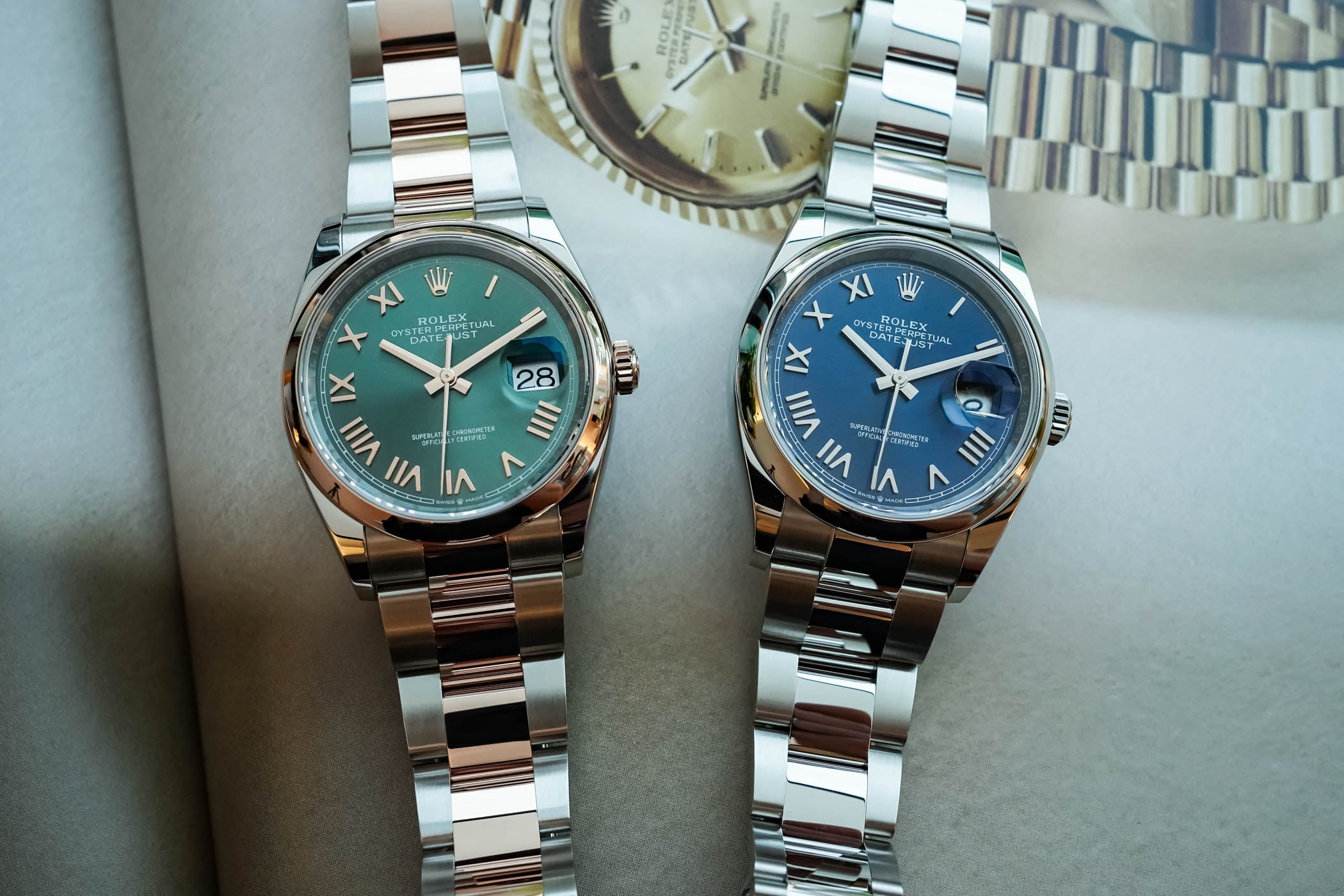
The two most-recommended first-luxury watches
Both watches sit in the €5-10k tier and both are repeatedly named as the strongest 'one-watch collection' choice across watch publications. The Aqua Terra 38 earns the recommendation on engineering: Master Chronometer certification, 15,000-gauss antimagnetic, 55-hour reserve. The Datejust 36 earns it on permanence: 80 years in continuous production, the most-recognised Rolex silhouette, and a service network that exists everywhere.
Spec sheet
| Attribute | Omega Seamaster Aqua Terra 38 | Rolex Datejust 36 |
|---|---|---|
| Reference | 220.10.38.20.03.001 | 126200 |
| Diameter | 38mm × 12.2mm | 36mm × 11.9mm |
| Water resistance | 150m | 100m |
| Movement | Cal. 8800 Master Chronometer | Cal. 3235 Superlative Chronometer |
| Reserve | 55 hours | 70 hours |
| Antimagnetic | 15,000 gauss | Standard (~1,000 gauss) |
| Hairspring | Si14 silicon | Parachrom blue |
| Bracelet | Steel, brushed/polished | Oyster, Glidelock micro-adjust |
| Retail | ~€5,800 | ~€7,800 |
Engineering tier
Aqua Terra Cal. 8800 is Master Chronometer-certified by METAS to -0/+5 sec/day across 15,000-gauss magnetic exposure (vs Rolex's standard ~1,000-gauss tolerance). The Si14 silicon hairspring and antimagnetic ferrous-alloy escapement explain the spec.
Datejust Cal. 3235 is Superlative Chronometer-rated to -2/+2 sec/day (tighter than COSC). Parachrom blue hairspring is paramagnetic but not antimagnetic. The 70-hour reserve is longer.
Aesthetic positioning
The Aqua Terra is more obviously sport-leaning: 38mm × 12.2mm, Teak-pattern dial, 150m water resistance. Reads as 'serious watch' in a casual context.
The Datejust is the canonical dress-sport: 36mm × 11.9mm, fluted bezel option, jubilee or oyster bracelet. Reads as 'classical luxury' across contexts.
Buying experience
Aqua Terra: walk into an Omega boutique, pick a configuration, leave with the watch. Retail.
Datejust 36: AD-dependent. Black or grey dial steel-on-jubilee is usually available with patience; champagne, mother-of-pearl, or fluted-bezel options may need allocation history.
Pros and cons
Seamaster Aqua Terra 38 · Pros
- Master Chronometer 15,000-gauss antimagnetic
- 150m water resistance
- Walk-in retail purchase
- Cheaper at €5,800
Seamaster Aqua Terra 38 · Cons
- 55-hour reserve (shorter than Rolex)
- Less long-term resale strength
- Smaller global service footprint than Rolex
Datejust 36 · Pros
- Strongest resale of any one-watch pick
- 70-hour reserve
- Rolex global service network
- Most universally-fitting Rolex
Datejust 36 · Cons
- More expensive at €7,800+
- Some configurations allocation-only
- Not antimagnetic to Master Chronometer spec
Verdict: which one?
If you're buying by spec sheet: Aqua Terra 38. Master Chronometer is genuinely better engineering at a lower price.
If you're buying by resale and brand permanence: Datejust 36. The 80-year continuous-production heritage and the global service network are real assets.
If you're buying by what you'll wear in 20 years: either works. Both are designs that won't date.
Common questions
Is the Omega Aqua Terra or the Rolex Datejust the better one-watch choice?
Both are repeatedly named the strongest "if you could only own one" pick under €10,000. The Aqua Terra 38 wins on engineering: Master Chronometer certification, 15,000-gauss antimagnetic resistance and a lower price. The Datejust 36 wins on permanence and resale: 80 years in continuous production and a global service network. Spec buyers lean Aqua Terra; resale-and-status buyers lean Datejust.
How much do the Aqua Terra 38 and Datejust 36 cost?
The Omega Seamaster Aqua Terra 38 (ref. 220.10) is around €5,800 and can usually be bought straight from a boutique. The Rolex Datejust 36 (ref. 126200) is around €7,800 at retail, though some dial and bezel configurations are allocation-only at authorised dealers.
Which is more accurate and magnetic-resistant, the Aqua Terra or the Datejust?
The Aqua Terra Cal. 8800 is METAS Master Chronometer-certified to 0/+5 sec/day and resists 15,000 gauss via a silicon hairspring and an antimagnetic escapement. The Datejust Cal. 3235 is Superlative Chronometer-rated to -2/+2 sec/day with a paramagnetic Parachrom hairspring (roughly 1,000-gauss tolerance) and a longer 70-hour reserve.
Which wears smaller, the Aqua Terra 38 or the Datejust 36?
The Datejust 36 is the smaller watch at 36mm x 11.9mm versus the Aqua Terra 38mm x 12.2mm, and its dressier profile reads more compact. The Aqua Terra is the more sport-leaning of the two, with 150m water resistance against the Datejust 100m.
Comments 2