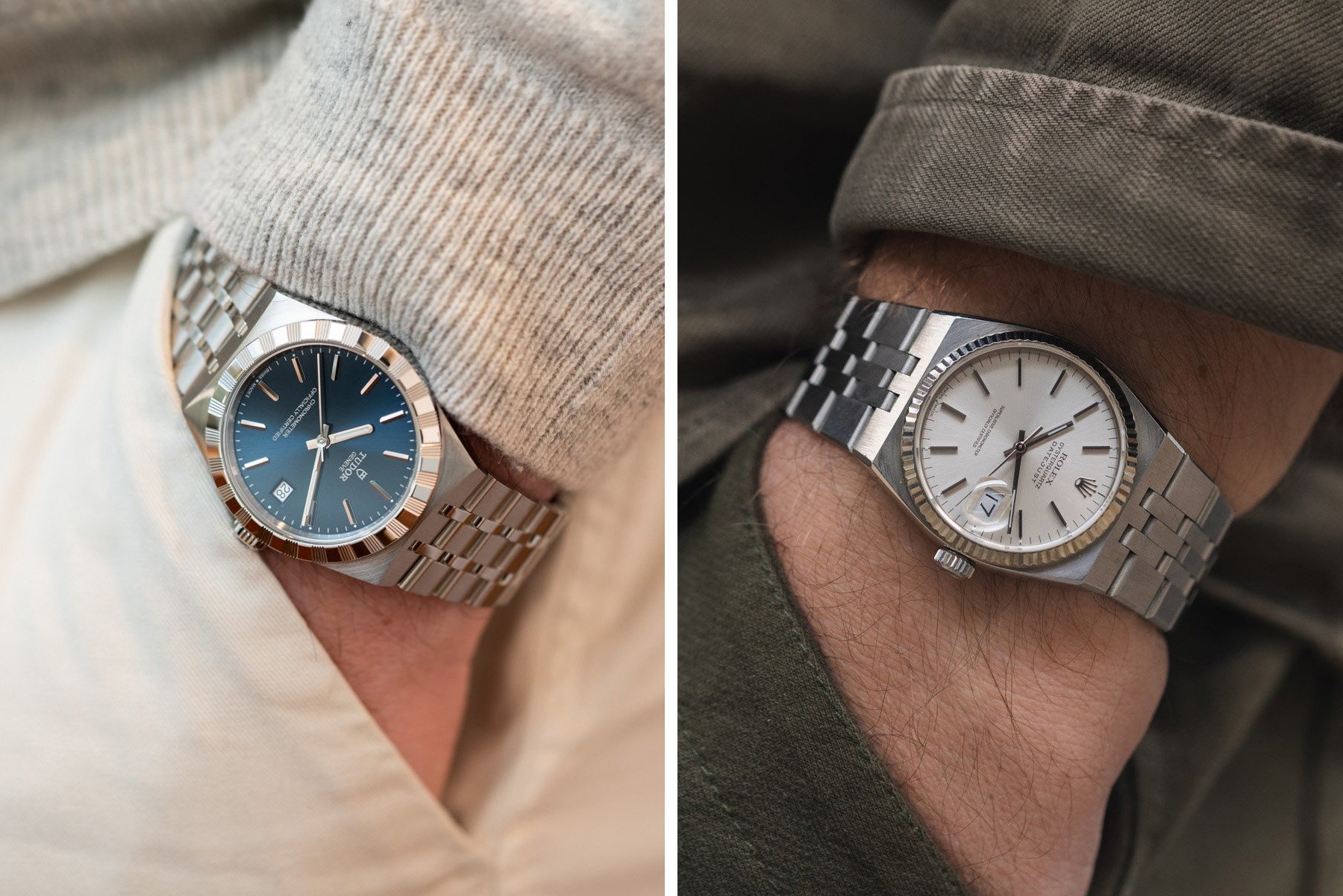
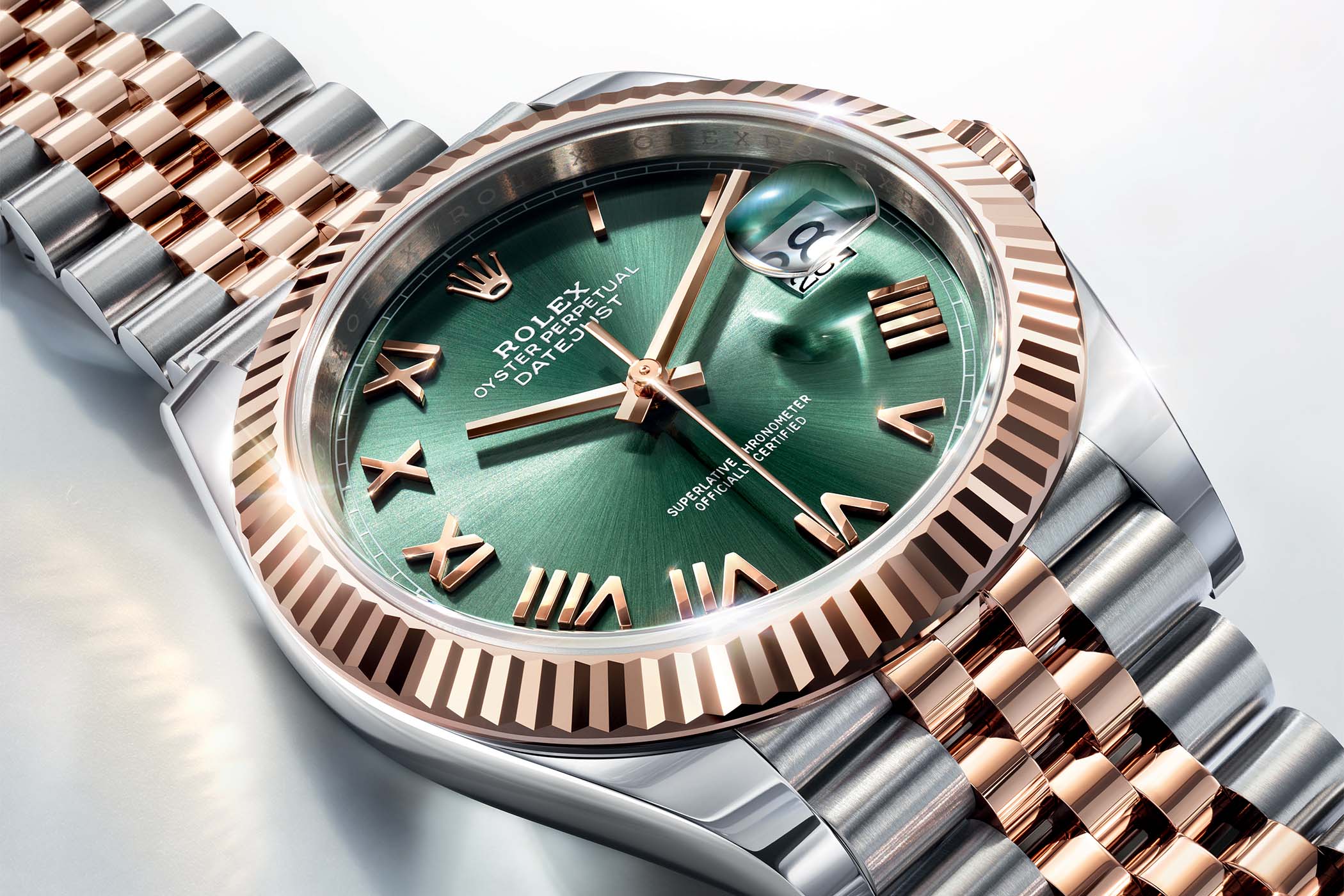
The Rolex Datejust was unveiled on 4 July 1945, the same day Rolex celebrated its 40th anniversary, and it arrived with three claims that no wristwatch had ever made simultaneously: it was self-winding, waterproof, and it displayed the date through an aperture on the dial. The reference 4467 was offered only in yellow or pink gold - Rolex would not produce a steel Datejust until the following decade - and introduced a magnifying Cyclops lens over the date aperture at 3 o'clock, designed to make the date instantly legible without holding the watch close to the eye. Paired with the new Jubilee bracelet, a five-link design of alternating polished and brushed links created specifically for the 40th-anniversary launch, the Datejust established the visual language of the luxury dress watch that most of the industry would spend the following decades attempting to replicate.
What made the Datejust technically significant was the combination of three Rolex innovations that had until 1945 existed only separately. The Perpetual rotor, patented by Rolex in 1931, provided reliable bidirectional self-winding from wrist motion rather than from a mainspring that had to be wound by hand each day. The Oyster case, patented in 1926, provided genuine water resistance to a degree that allowed the watch to be worn through ordinary life without concern. The date complication itself was new for a wristwatch - previous date watches had used pointer-date or sub-dial formats, not a clean window - and Rolex's instantaneous midnight date-change mechanism set a standard that the rest of the industry eventually adopted. Combined in a single reference, these three technologies produced what was in 1945 the most fully-featured everyday watch in the world.
The Datejust quickly became the default reference of the 20th-century luxury wristwatch. Queen Elizabeth II received a Datejust as a coronation gift in 1953. Marilyn Monroe gave John F. Kennedy one in 1962, inscribed on the caseback with the dedication “Jack, with love as always, Marilyn”. Martin Luther King Jr. wore one through the civil-rights years. Eric Clapton, Miles Davis, Frank Sinatra, and essentially every American cultural figure of the mid-20th century owned a Datejust. This breadth of association - political, musical, athletic, and artistic - is unique among watch collections. The Submariner is for adventurers, the Speedmaster for engineers, the Daytona for racing fans. The Datejust is for everyone. It is the watch that most perfectly expresses the idea of the Rolex as a universal signifier of quality, and by volume remains the best-selling model in the brand's history.
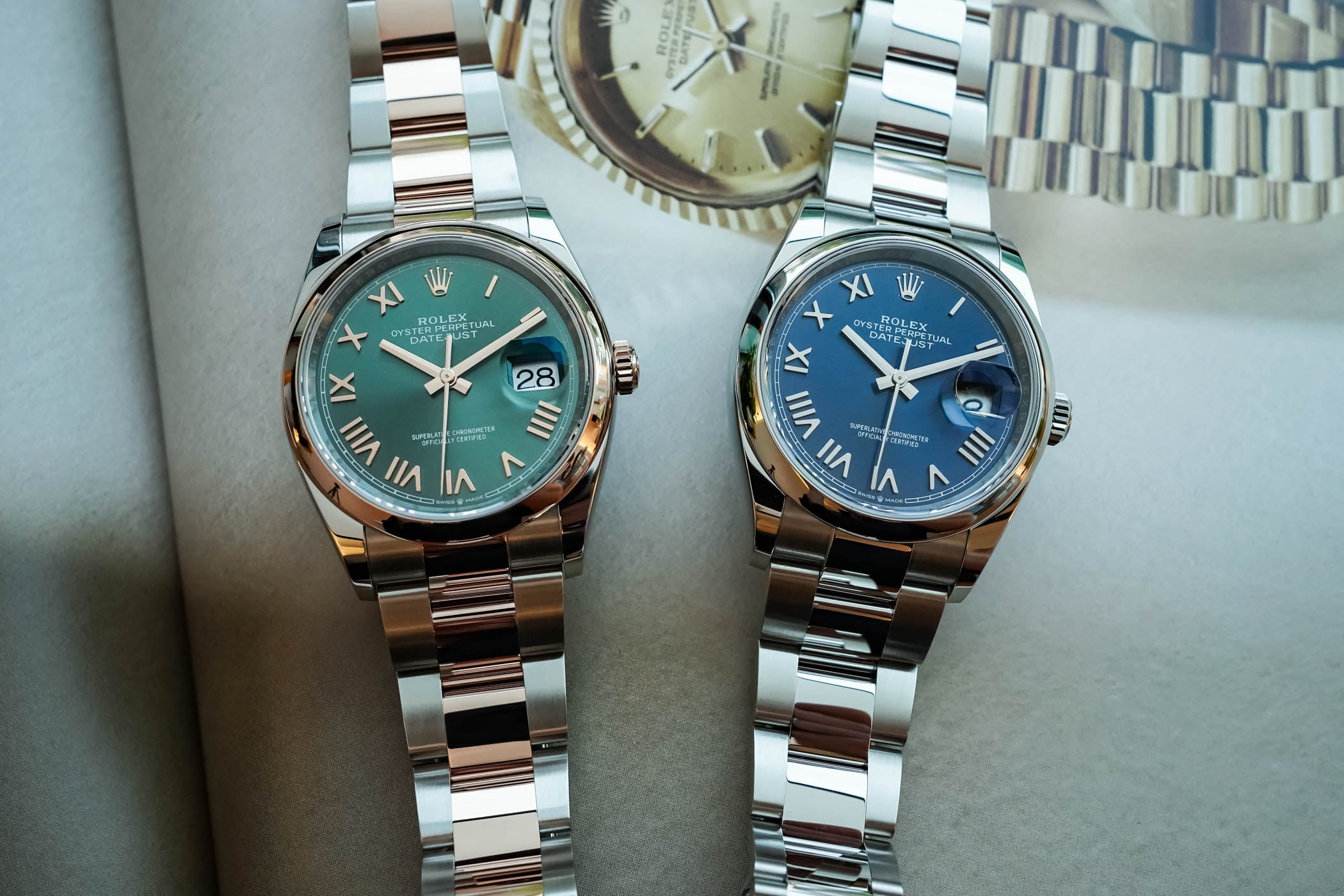
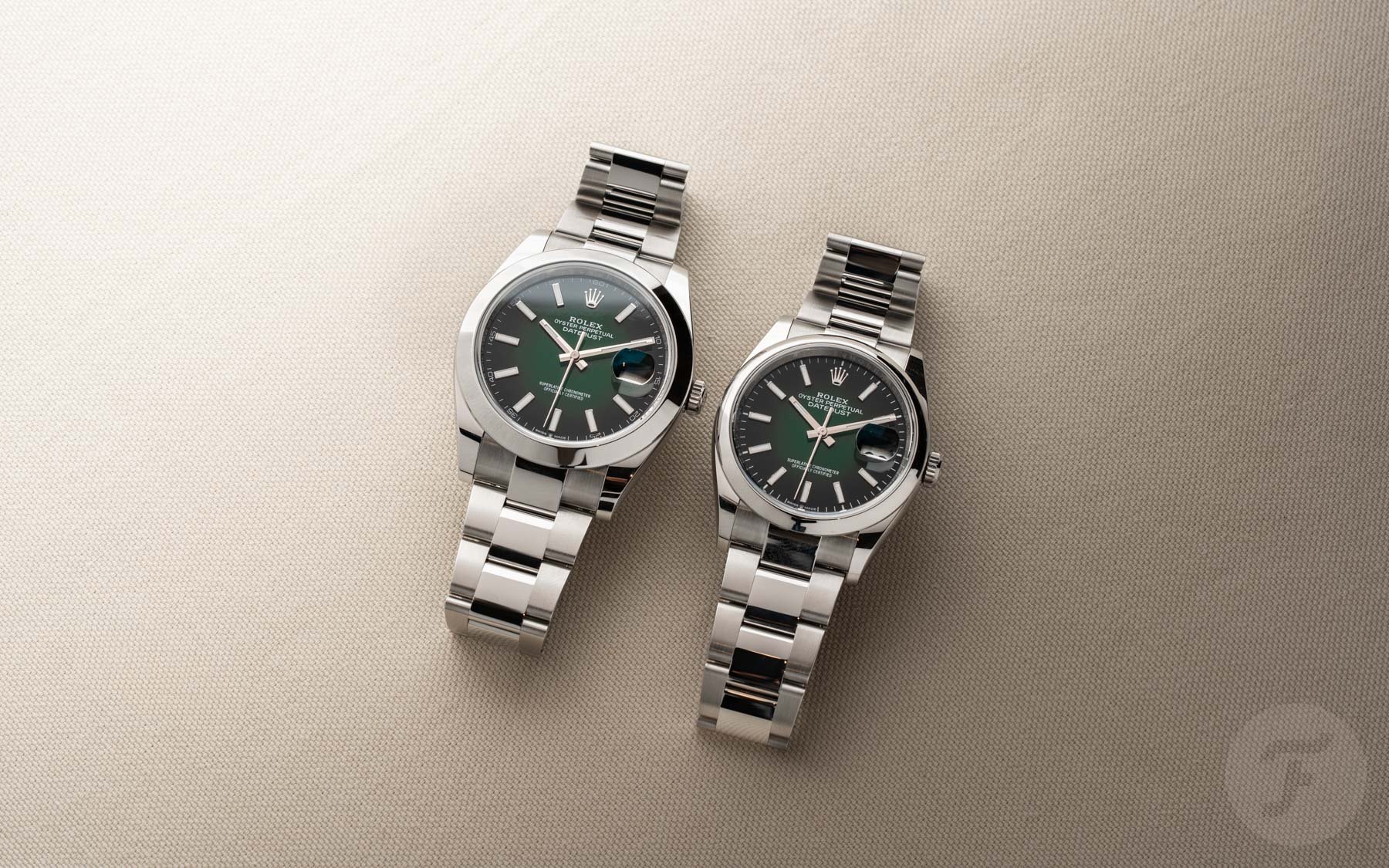
Over eight decades the Datejust family has grown into one of the largest and most varied collections in luxury watchmaking. The Turn-O-Graph (1953), a Datejust variant with a rotating bezel, effectively predicted the design brief that would later become the Submariner. The Lady-Datejust at 26mm (later 28mm) anchored the brand's women's collection. The 31mm Datejust provides a mid-size option, and the modern Datejust 41 (introduced 2017) offers a contemporary larger-case option. Bezels range from smooth to fluted to Thunderbird-rotating to diamond-set, with case materials spanning steel, Rolesor (two-tone), yellow, pink (Everose), and white gold. Dial variants include the Wimbledon slate with Roman numerals and green accents, palm motif, mother-of-pearl, meteorite, diamond-paved, and countless colour-lacquer options released seasonally.
The modern Datejust 36 and Datejust 41 are both powered by the Cal. 3235 movement with a 70-hour power reserve and Chronergy escapement, delivering chronometer-grade accuracy with substantially improved energy efficiency over the previous Cal. 3135. The defining design elements - the Cyclops lens, the date window at 3, the Jubilee or Oyster bracelet, and the fluted or smooth bezel - remain precisely where they were in 1945. That continuity across eight decades is not conservatism; it is the result of getting the details right the first time. Where the Submariner, Daytona, and GMT-Master have each been reinvented several times over Rolex's history, the Datejust has never needed reinvention. It is, in both its simplicity and its reach, the quintessential Rolex - the reference by which all other Rolex references are measured.



Comments
No comments yet, be the first to weigh in.