
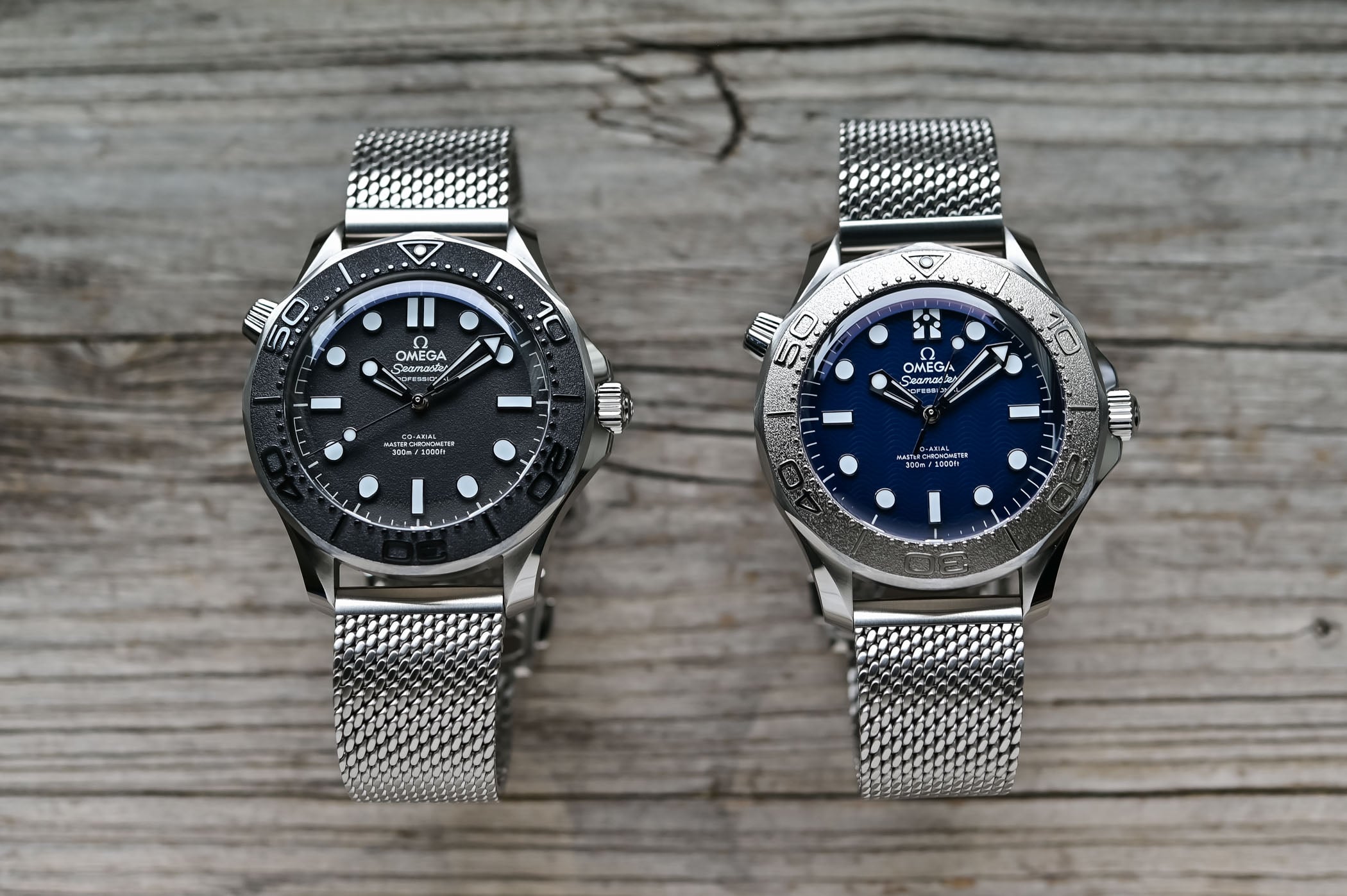
Two Swiss giants, two opposite buying experiences
Rolex and Omega are the two best-recognised Swiss watch brands in the world. Rolex sells roughly 1.2 million watches per year against Omega's ~700,000, both at similar Swiss-Made price tiers. The decision rarely comes down to quality: both brands manufacture in-house COSC-grade automatic movements, both finish to a serious daily-wear standard, both have global service networks. The decision usually comes down to availability, technical spec, and resale economics.
Rolex's sport references (Submariner, Daytona, GMT-Master) are allocation-only at most ADs and trade above retail on the secondary market. Omega's flagship references (Speedmaster Pro, Seamaster Diver 300M, Aqua Terra) are at-retail, in-stock, and the brand has technical advantages on antimagnetism (15,000-gauss Master Chronometer) and movement accuracy specs (METAS at -0/+5 sec/day vs Rolex's -2/+2). Pick on what you want from the experience: brand permanence and resale strength (Rolex), or engineering tier and walk-in availability (Omega).
Spec sheet
| Attribute | Rolex Submariner / Datejust line | Omega Speedmaster / Seamaster line |
|---|---|---|
| Reference watches | Submariner Date 126610LN, Daytona 126500LN | Speedmaster Pro 310.30.42, Seamaster Diver 300M 210.30.42 |
| Founded | 1905 (London, then Geneva) | 1848 (La Chaux-de-Fonds) |
| Annual production | ~1.2 million watches | ~700,000 watches |
| Movement family | Cal. 3230 / 3235 / 3285 / 4131 | Cal. 8800 / 8900 (Master Co-axial) |
| Reserve | 70 hours | 60-72 hours |
| Certification | Superlative Chronometer (-2/+2 sec/day) | METAS Master Chronometer (-0/+5 sec/day) |
| Antimagnetism | Parachrom blue hairspring | 15,000 gauss (METAS spec) |
| Service interval | 10 years | 10 years |
| Allocation | Allocation-only on sport refs | At-retail across the catalogue |
| Retail starting | ~€5,800 (OP 36) | ~€3,200 (Aqua Terra 30) |
| Resale (1 year) | ~95-150% of retail (sport refs higher) | ~75-90% of retail |
Engineering: Superlative Chronometer vs Master Chronometer
Rolex's Superlative Chronometer spec runs at -2/+2 seconds/day after casing, tighter than COSC's -4/+6. The current Cal. 3235 family adds the Chronergy escapement (15% more efficient) and Parachrom blue hairspring (resistant to ±5 gauss). Reserve sits at 70 hours.
Omega's METAS Master Chronometer spec runs at -0/+5 seconds/day after casing, with antimagnetic protection to 15,000 gauss (3,000x stronger than the Rolex Parachrom rating). Cal. 8800 / 8900 use the Co-axial escapement (George Daniels' design, lower long-term wear) and silicon Si14 hairsprings.
The Omega spec is technically more advanced; the Rolex spec is tighter on accuracy. Both exceed COSC by significant margins.
Allocation vs at-retail
The Rolex Submariner, GMT-Master, Daytona, and Sky-Dweller have been on multi-year waiting lists since 2020. Most ADs won't quote a delivery date. Secondary market sits 1.3-2x retail depending on configuration; the green-bezel Submariner "Starbucks" 126610LV currently trades around €15,500 against €11,300 retail.
The Omega Speedmaster, Seamaster Diver 300M, Aqua Terra, and Constellation lines are at-retail at any AD. You walk in, you walk out with the watch, sometimes the same day. Secondary market sits at 75-90% of retail (the typical luxury-watch depreciation curve).
Resale economics and brand permanence
Rolex's 1-year resale on sport references typically sits at 100-150% of retail; the brand's allocation strategy has produced a structural premium that no other Swiss brand maintains. The downside: buying at retail is gated, and grey-market entry is at the same premium.
Omega depreciates more conventionally: 75-90% of retail in year one, stabilising at 60-75% across longer holding periods. The Speedmaster Pro is the exception (its NASA-heritage / Apollo provenance keeps it close to retail). For a watch you're buying to wear rather than flip, Omega's economics are cleaner.
Pros and cons
Submariner / Datejust line · Pros
- 100%+ resale on sport references
- Tighter chronometer accuracy spec (-2/+2)
- Brand recognition outside watch circles
- Global service network at any Rolex AD
- Historic allocation strength stabilises long-term value
Submariner / Datejust line · Cons
- Sport refs allocation-only; multi-year wait
- Grey-market entry at 1.3-2x retail
- Limited dial / case experimentation
- Designs less revised than Omega's annual updates
Speedmaster / Seamaster line · Pros
- At-retail at any AD; no allocation lottery
- METAS Master Chronometer (15,000 gauss)
- Co-axial escapement (lower long-term wear)
- Apollo / NASA heritage on the Speedmaster
- Wider dial-colour and case-material range
Speedmaster / Seamaster line · Cons
- Resale ~75-90% of retail (vs Rolex 100%+)
- Less brand status outside watch circles
- 60-72h reserve depending on calibre
- METAS accuracy spec is wider (-0/+5) than Rolex's (-2/+2)
Verdict: which one?
If brand-as-asset is the actual buying motivation: Rolex. Allocation-only sport references at 100%+ resale; the long-hold investment thesis. Plan for the AD relationship and the wait.
If you want to walk in and walk out with a serious Swiss watch: Omega. Master Chronometer engineering, no allocation, lower entry premium, and Apollo provenance on the Speedmaster Pro. The Aqua Terra 38 is the closest one-watch answer.
For most buyers without an established Rolex AD relationship, Omega is the better-value answer. For the buyer who specifically wants a Submariner or Daytona and can wait: Rolex is the right path, knowing the wait is part of the experience.
Many serious collectors end up with both: Speedmaster Pro for the heritage chronograph, Submariner or Datejust for the long-hold. They are not direct competitors; they are different points on the same Swiss-luxury map.
Common questions
Is a Rolex better than an Omega?
Not in terms of build quality - both make in-house COSC-grade automatic movements, finish to a serious daily-wear standard, and have global service networks with 10-year intervals. The real differences are availability (Rolex sport models are allocation-only with waitlists; Omega is in stock at retail), technical spec (Omega METAS Master Chronometer adds 15,000-gauss antimagnetism and a co-axial escapement; Rolex accuracy spec is tighter at -2/+2 versus -0/+5), and resale (Rolex sport models hold 100%+ of retail; Omega depreciates more conventionally to about 75-90%).
Can I just walk in and buy a Rolex?
Usually not the sport models. The Submariner, GMT-Master, Daytona and Sky-Dweller have been on multi-year authorised-dealer waitlists since 2020, and the secondary market sits around 1.3 to 2 times retail. Omega Speedmaster Pro, Seamaster Diver 300M and Aqua Terra are at-retail at any dealer - walk in, walk out, sometimes the same day.
Which has the more advanced movement, Rolex or Omega?
Technically, Omega. Its METAS Master Chronometer movements (Cal. 8800/8900) use George Daniels co-axial escapement and a silicon hairspring, and are antimagnetic to 15,000 gauss - far beyond Rolex Parachrom rating. Rolex Cal. 3235 family counters with a tighter accuracy spec (-2/+2 versus -0/+5 sec/day), the efficient Chronergy escapement, and a 70-hour reserve. Both comfortably exceed COSC.
Rolex or Omega for a first luxury watch?
For most buyers without an established Rolex dealer relationship, Omega is the better-value answer: you can actually buy one, the engineering tier is high, and the entry premium is lower (the Aqua Terra 38 is the closest one-watch pick). If you specifically want a Submariner or Daytona and can wait, Rolex is the right path - just know the wait is part of the experience. Plenty of collectors end up with both.
Comments 26