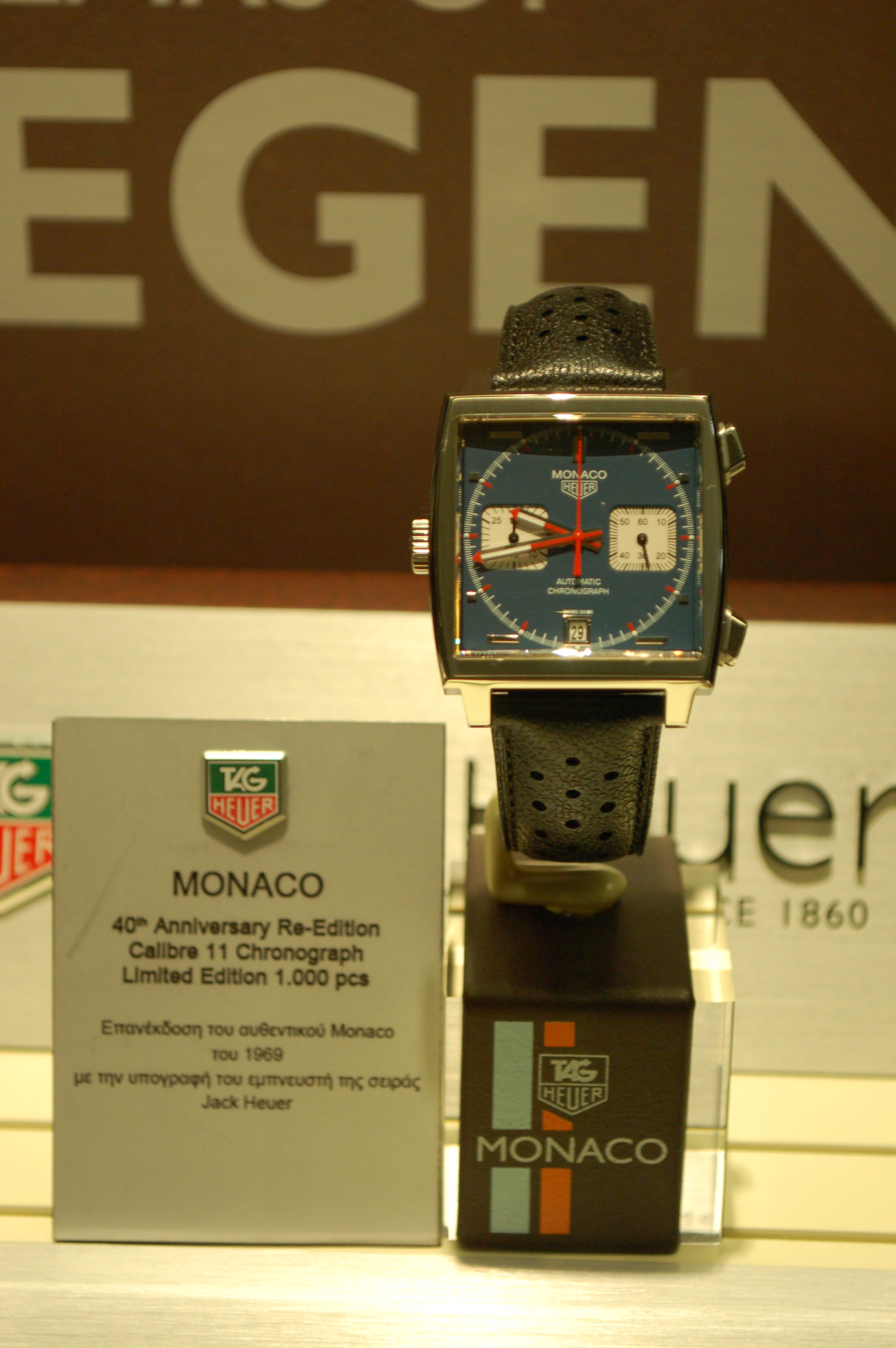
Terence Steven McQueen was the highest-paid film star of 1974 (The Towering Inferno) and a deeply serious racing driver. He co-drove the Porsche 908 to a class win at the 1970 12 Hours of Sebring, finishing second overall while wearing a cast on his foot, and then directed and starred in Le Mans (1971) the year after.
His on-screen-and-off mechanical-watch choices, Heuer Monaco, Rolex Submariner, Hanhart 417 ES, defined the 'tool-watch as fashion' aesthetic that still drives most of mainstream watch culture. McQueen had no commercial relationship with Rolex; with Heuer the relationship was purely production-level.
He was also a serious motorcycle collector. The 1962 ISDT (International Six Days Trials) team photo shows him in US Army-issue gear, holding a Bulova Phantom; at home he had Indians, Triumphs and Husqvarnas. The watch culture he shaped was inseparable from the broader machine-as-object culture he embodied.
The watches


The 'McQueen' name in watch culture
Two distinct watches now carry the McQueen name: the Heuer Monaco he wore on screen, and the Rolex Explorer II ref. 1655 frequently mis-attributed to him in 1990s and 2000s collector circles. McQueen did not wear the 1655. The conflation was popularised by a single Italian magazine photo. The myth persists; the price premium did not survive serious scrutiny.
What he made famous
Square chronograph cases. Tan-strap-on-steel bracelets. The hand-on-shifter cinematic shot with a chronograph in frame. The very idea that a watch on screen could move retail. Modern brand-ambassador economics owe more to McQueen than to any other 20th-century film star.
The auction surge
McQueen's pieces have surfaced steadily since 2009. His Hanhart, his Rolex 5512, two of his Submariners and various pieces from Barbara Minty's estate have all moved through Phillips, Christie's and Sotheby's, with prices uniformly outperforming book value by 3 to 8 times.
Comments 1