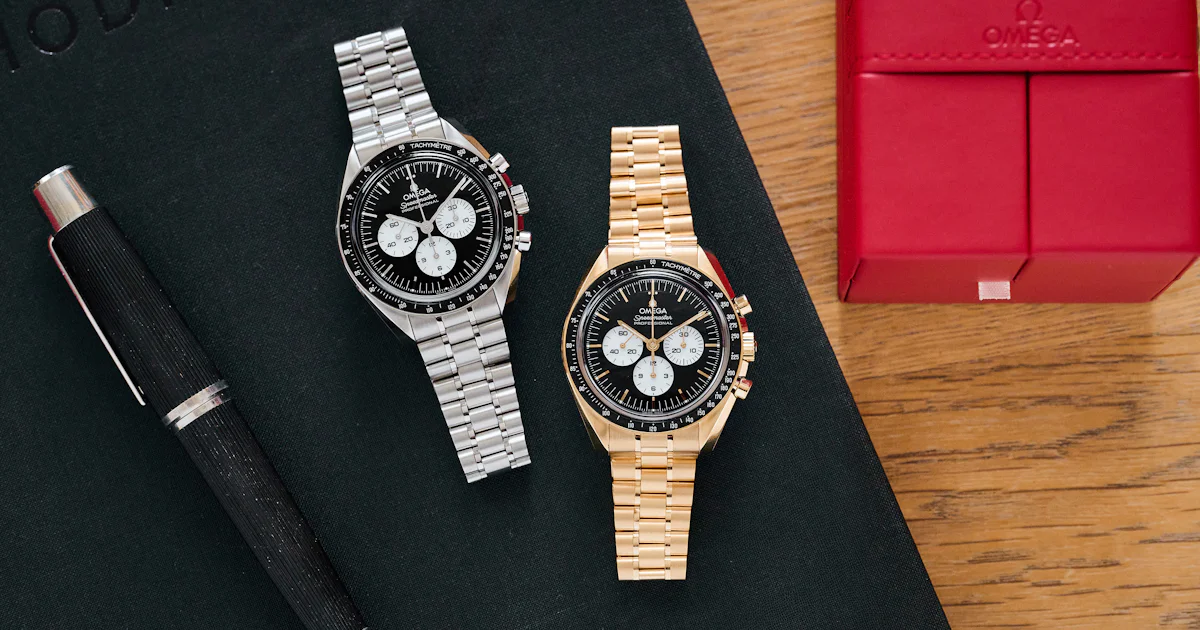
Omega
Speedmaster Professional
310.30.42 · 42mm · 50m
The watch certified by NASA. Worn on the Moon.
Both 1957/1963-era motorsport chronographs that became culture. Speedmaster went to the Moon; Daytona is the Paul Newman price-record holder. €7,000 NASA history vs €15,500 retail Daytona that secondary-trades at €32,000.

Both watches were designed for motorsport timing in the late 1950s and early 1960s. The Omega Speedmaster launched in 1957 (the same year as the Seamaster 300 and Railmaster, completing the 'Trilogy'). The Rolex Daytona followed in 1963, named for the Daytona International Speedway after Rolex secured the official-timekeeper role.
What separates them now is what happened next. NASA tested the Speedmaster in 1965 and certified it for manned space flight; Buzz Aldrin wore one on the lunar surface in 1969. The Daytona crossed into culture via Paul Newman, whose personal ref. 6239 (gifted by Joanne Woodward in 1968) sold for €16.3M at Phillips New York in October 2017, the wristwatch auction record at the time.
| Attribute | Omega Speedmaster Professional | Rolex Cosmograph Daytona |
|---|---|---|
| Reference | 310.30.42 | 126500LN |
| Case diameter | 42mm × 13.2mm | 40mm × 12.2mm |
| Case material | Stainless steel | 904L Oystersteel |
| Bezel | Aluminium tachymeter | Cerachrom (ceramic) tachymeter |
| Water resistance | 50m | 100m |
| Movement | Cal. 3861 in-house | Cal. 4131 in-house |
| Architecture | Manual cam-switching | Automatic, column-wheel + vertical clutch |
| Reserve | 50 hours | 72 hours |
| Beat rate | 21,600 vph (3 Hz) | 28,800 vph (4 Hz) |
| Antimagnetic | 15,000 gauss (Master Chrono) | Standard |
| Crystal | Hesalite (plastic) standard | Sapphire |
| Retail price | ~€7,000 | ~€15,500 |
| Secondary | ~€6,000-7,500 | ~€32,000+ |
Speedmaster Cal. 3861 is the modern Lemania 1873 derivative: cam-switching architecture (instead of column-wheel), manual wind, co-axial escapement. Cam-switching is mechanically simpler than column-wheel and gives the Speedmaster its slightly tactile pusher feel. NASA-qualified spec preserved.
Daytona Cal. 4131 (introduced 2023 in the 60th-anniversary refresh) uses column-wheel + vertical clutch, the modern haute-horlogerie chronograph architecture. Vertical clutch eliminates the sub-second jump on engagement; column-wheel gives a clean pusher action. 72-hour reserve, automatic.
The Speedmaster Professional is at retail in any AD. Walk in, write a check, walk out. ~€7,000 with hesalite or ~€7,800 with sapphire crystal.
The Daytona is the most allocation-restricted Rolex sport reference. AD purchase requires substantial collection history. Secondary-market price is reliably ~2x retail.
Speedmaster at 42mm × 13.2mm wears bigger than its number suggests due to the lug profile and crown guards; works on 6.75"+ wrists comfortably. Daytona at 40mm × 12.2mm wears tighter due to the integrated lugs and bracelet; comfortable from 6.25" up. The Daytona is the more universally-sized watch.
If you want the watch you can actually buy at retail: Speedmaster Pro. NASA-qualified history, in-house manufacture, ~€7k. There is no waitlist.
If you want the blue-chip resaleable asset and you have the AP-style Rolex collection history to justify allocation: Daytona. The 2-x-retail secondary market is real and reliable.
If you want a Daytona without the allocation lottery: pre-owned 116520 (the 2000-2016 aluminium-bezel reference) at ~€22,000. Different watch, but it gets you the silhouette and the column-wheel.
Speedmaster + €7k cash > Daytona + €25k allocation premium for most buyers. Heritage is on the Speedmaster's side; investment is on the Daytona's. Pick on which one you'll wear, not which one will appreciate.
Question, suggestion, or just want to say hi? Drop a note.
Comments 1