Why a new caliber in 1968?
Lemania 1873 was developed in 1968 to replace the column-wheel Lemania 2310 with a more economical chronograph. The 2310 was a beautiful column-wheel design but expensive to produce relative to the cam-actuated chronographs the rest of the Swiss industry was moving toward. The 1873 substitutes a cam-switching system (also called shuttle cam) for the column wheel, where a pivoting cam takes the place of the column wheel for chronograph operations. Cam-switching is mechanically simpler and cheaper to manufacture but produces a slightly less crisp pusher feel. The 1873 ran at 21,600 vph (3 Hz) versus the 18,000 vph of the 2310, gaining a small accuracy advantage at the same time.
Becoming the post-Apollo Moonwatch caliber
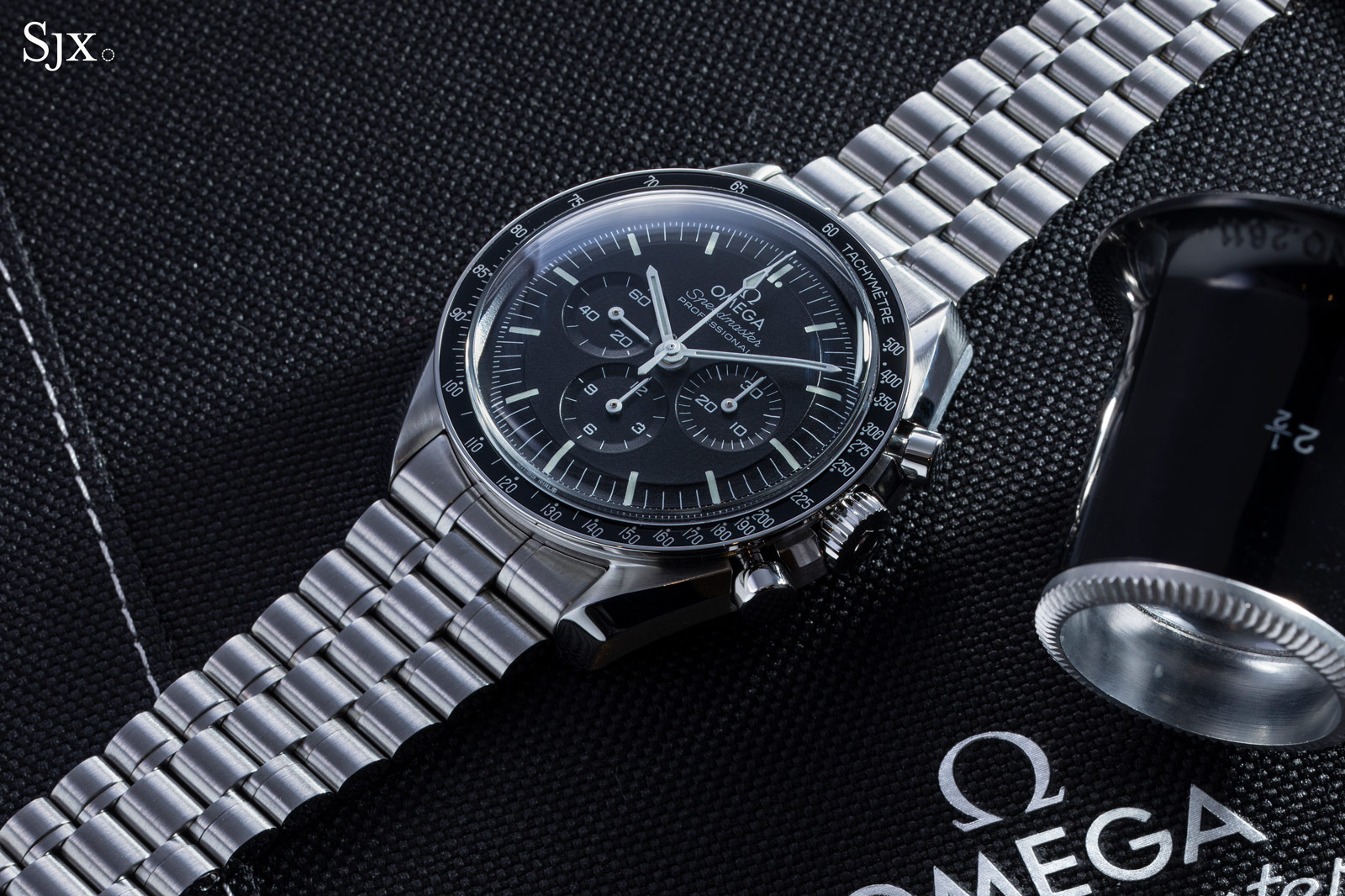
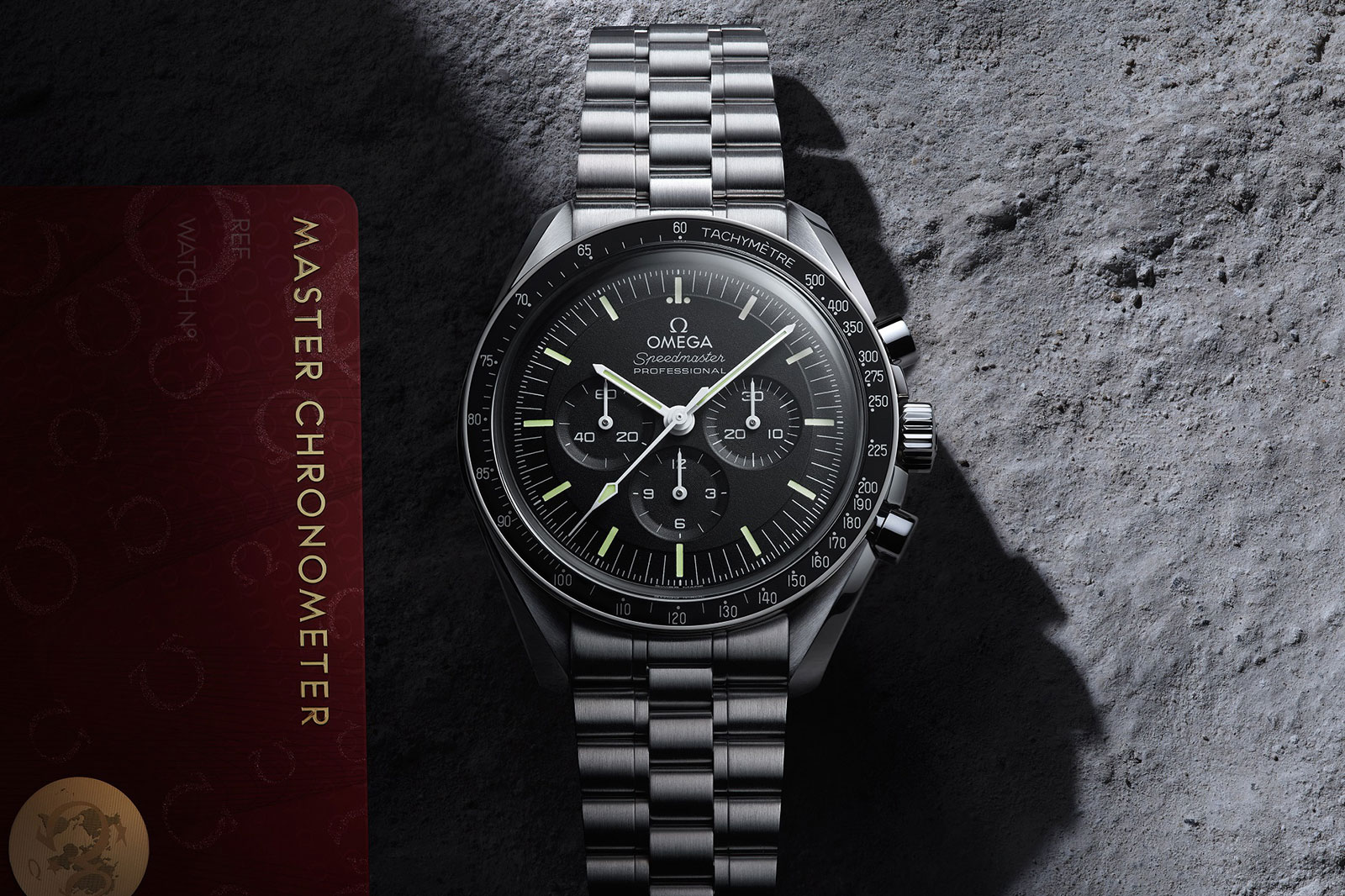
Omega rebadged the 1873 as Cal. 861 and replaced the Cal. 321 in the Speedmaster Professional in 1968. The Cal. 861 became the post-Apollo Moonwatch movement; while the column-wheel 321 was on the wrist for the actual Moon landing in July 1969, the 861-equipped Speedmasters carried the Moonwatch lineage through the next 30 years of NASA missions (Skylab, Apollo-Soyuz, the Shuttle programme, the ISS). Production continued essentially unchanged until 1996, when Omega introduced minor updates as Cal. 1861 (rhodium plating, refined finishing, Glucydur balance).
The 861 / 1861 family
Subvariants of the 1873/861 family include Cal. 1862 (display caseback variant with extra finishing), Cal. 1863 (improved finishing for the Speedmaster Professional sapphire-sandwich variants), and the modern Cal. 3861 (2021+, the in-house Master Chronometer successor with co-axial escapement, silicon hairspring, and METAS certification). The 1873 architecture itself remained in production at Breguet/Lemania through the 2010s; minor variants are still available to other Swiss brands as a low-cost manual chronograph base. Examples: Lemania 1872 / 1872 GG (variants for high-end chronographs at smaller manufactures).
Mechanical specification
Cam-actuated chronograph at 21,600 vph (3 Hz), hand-wound, 17 jewels (some service variants 18), power reserve approximately 45 hours, diameter 27 mm. Single barrel feeds a Glucydur balance on a Nivarox hairspring. Standard layout: small seconds at 9, 30-minute counter at 3, 12-hour totaliser at 6 (the same 3-6-9 layout the modern 3861 inherits). The cam-actuated chronograph is functionally equivalent to a column-wheel for the user (start, stop, reset on pusher) but the lever-and-cam architecture is visibly different through a display caseback: the small geometric column wheel of the 321 is gone, replaced by a flat oblong cam.
"Was the cam a downgrade?"
Among Speedmaster collectors, the 1968 transition from the column-wheel 321 to the cam-actuated 861 is sometimes lamented. The 861 has a slightly less crisp chronograph feel, and the column-wheel mystique is gone. In practice the 861 is more reliable, easier to service, and arguably more accurate: cam mechanisms are simpler to assemble correctly, produce less variation between examples, and require less skilled regulation. The 861 also runs faster (21,600 vph vs 18,000), which gives it a small accuracy advantage. The "downgrade" is real on the haptics and the prestige but absent on the pure timekeeping spec.
Service and modern availability
A Lemania 1873 / Omega 861 / 1861 service through Omega currently runs CHF 600-900, with a 2-year warranty. Independent service is widely available; the 1861 is one of the most commonly-serviced chronograph calibers in modern Swiss watchmaking, with parts inventory through Cousins UK, Otto Frei, and Omega's own service network. Service interval: 5-7 years for daily wear. The 1861 was also unusual for a chronograph in being hand-wound, which simplifies the architecture and means there is no rotor or automatic-winding system to fail. For the column-wheel predecessor see Lemania 2310 / Omega 321; for the modern co-axial successor see Omega Cal. 3861.



Comments
No comments yet, be the first to weigh in.