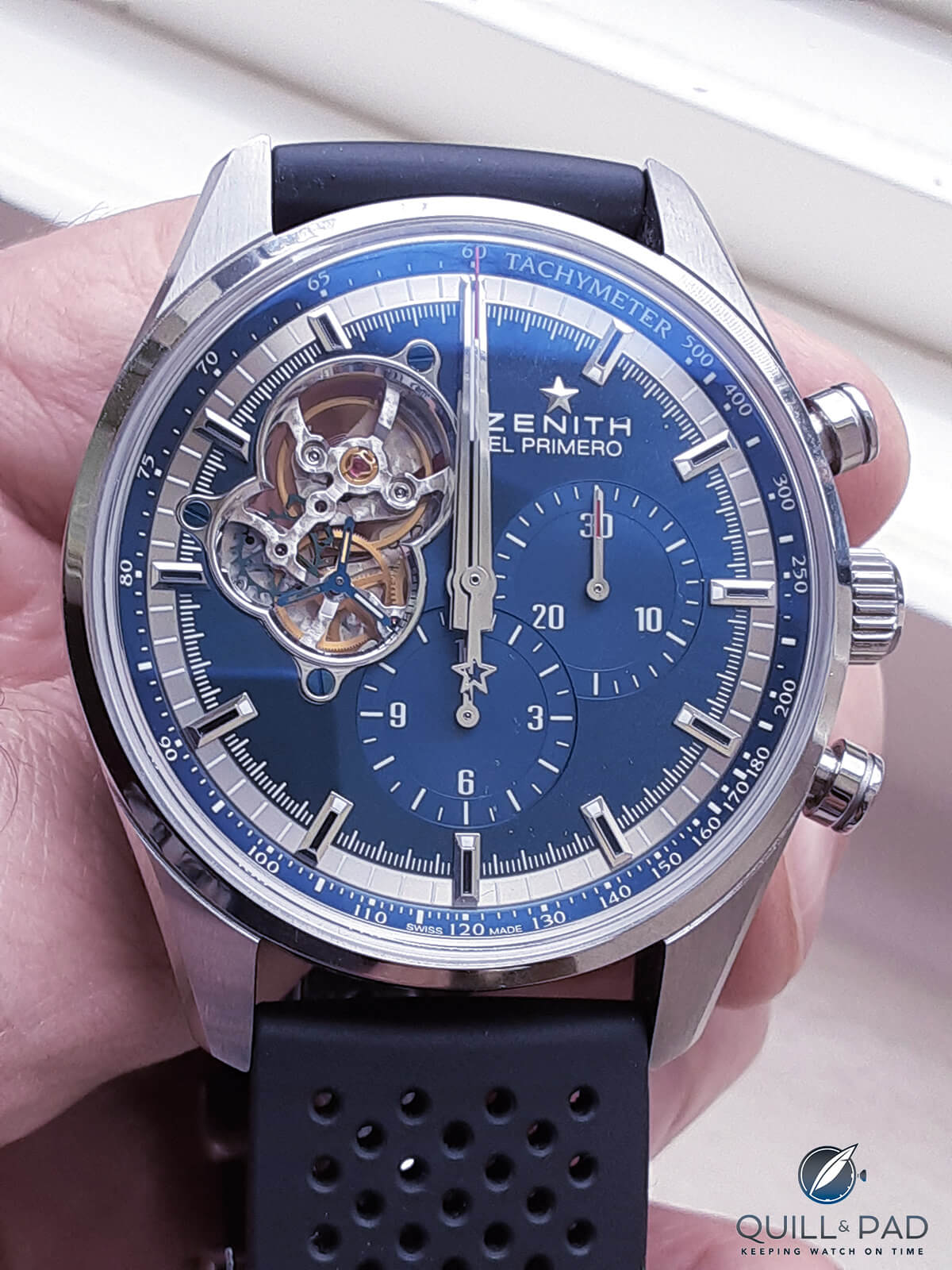
In 1975, the Swiss mechanical-watchmaking industry was in existential crisis. The 1969 Seiko Astron launch had triggered a market shift to quartz; mechanical-watch sales were collapsing; major Swiss firms were going bankrupt; the federal banking commission was bailing out the industry. Zenith at the time was owned by the unrelated Zenith Radio Corporation of Chicago (a US consumer-electronics firm that had purchased the Swiss watchmaker in 1971); the American parent decided that the future was quartz and that all mechanical production would cease.
The order from Chicago was specific: scrap the mechanical movement tooling. Presses, jigs, fixtures, and technical documents for the El Primero chronograph caliber (launched 1969 as one of the world's first automatic chronographs, a 5 Hz column-wheel automatic that was Zenith's technical signature) were to be sent to a recycling foundry. The order had a deadline; compliance was non-negotiable from corporate headquarters; Zenith's Le Locle manufacture was to be permanently converted to quartz-only production.
"They told me to destroy the tooling. I knew the watch industry would come back. So I put the tooling in boxes and put the boxes in the attic."- Charles Vermot, in archive interview
Charles Vermot, a Le Locle movement engineer with deep knowledge of the El Primero programme, did not comply. With colleagues, Vermot crated up the El Primero tooling, presses, jigs, and technical drawings in wooden cases; the cases were carried up to the attic of the Zenith manufacture building; the attic floor was reinforced where needed and the cases were stacked away from the corporate inspection routes. Vermot kept inventory documents personally and continued working at Zenith through the quartz era, never revealing what he had hidden.
Vermot's justification, in interviews given decades later, was simple: the El Primero was a 1969 technical achievement that had taken Zenith years to develop; destroying it for short-term corporate compliance was an act of vandalism against Swiss watchmaking heritage; he expected mechanical watchmaking to recover, and when it did the El Primero would be needed. The decision was personal, not part of any formal Zenith policy; if discovered Vermot would have been dismissed for insubordination.
In 1978 Zenith Radio Corp sold the Swiss watch firm to a French luxury group; in 1985 the firm passed to Italian-Swiss financier Paul Castella; mechanical-watch demand had begun recovering by the mid-1980s. Rolex approached Zenith in 1986 with a request for the El Primero caliber as the basis for the new automatic Daytona (replacing the manual Valjoux 727 of the 6263/6265 era). Vermot revealed the hidden tooling; the El Primero went back into production in 1986 and the modified Cal. 4030 (Zenith El Primero base, Rolex modifications) powered the Daytona ref. 16520 from 1988 to 2000, one of the most-collected vintage modern Daytonas.
Charles Vermot retired from Zenith in the 1990s. The story of the hidden tooling has become canonical Zenith brand mythology; modern Zenith marketing references it explicitly, and the manufacture's attic where the cases were hidden is visited by industry tours. The El Primero remains continuously produced in modified form today (Cal. 3600 with 1/10 second sub-dial in the modern Chronomaster Sport; Defy 21 with 1/100 second extension); without Vermot's 1975 intervention the caliber would have ended in 1975 and modern Zenith would have to engineer a replacement from scratch. Vermot is consequently regarded as the engineer who saved one of the most important calibers in 20th-century Swiss watchmaking.

Comments 2