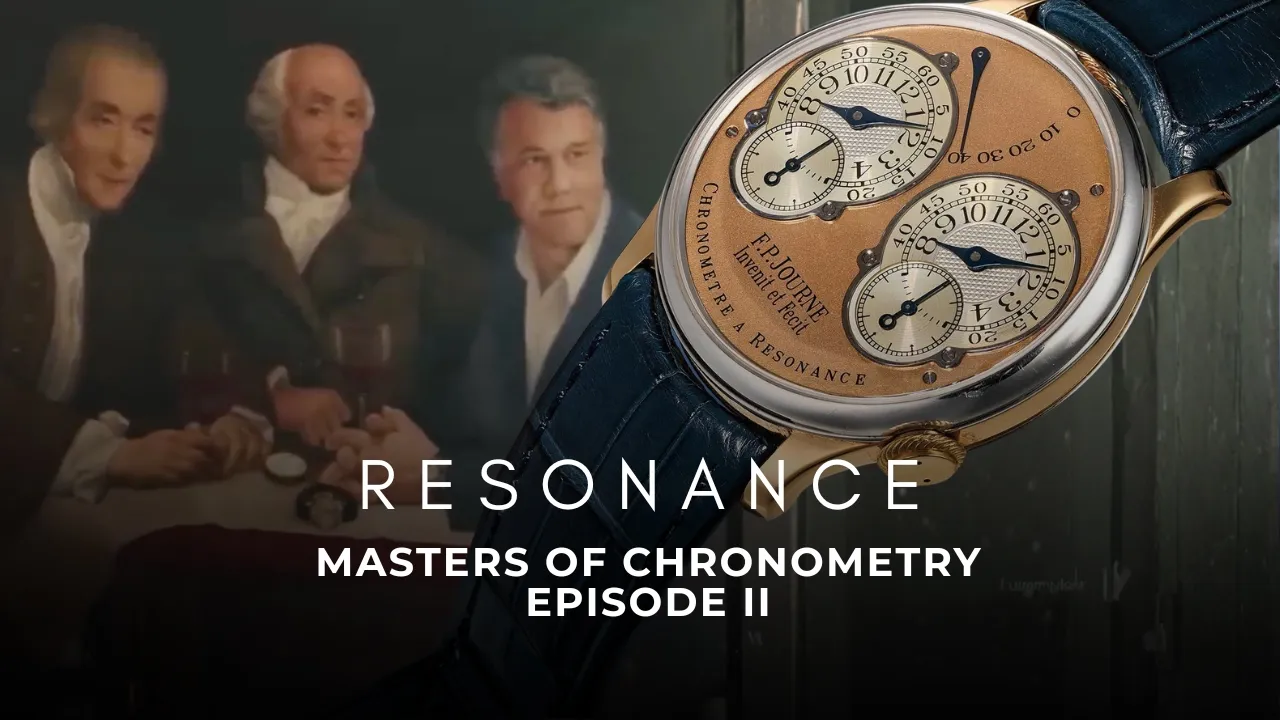
François-Paul Journe spent nearly two decades studying the resonance principle before launching his Chronomètre à Résonance in 2000. The principle dates to Christiaan Huygens, who in 1665 noted that two pendulum clocks mounted on the same wall synchronised their swings through vibrations transmitted via the wall. Abraham-Louis Breguet and Antide Janvier produced resonance regulator clocks around 1780 (Janvier's Régulateur de Résonance survives at the Patek Philippe Museum in Geneva). Journe's achievement was to miniaturise the system into a 40mm wristwatch case, with two complete escapements and balance wheels that synchronise within around five minutes of each other and stay locked in counter-phase indefinitely.
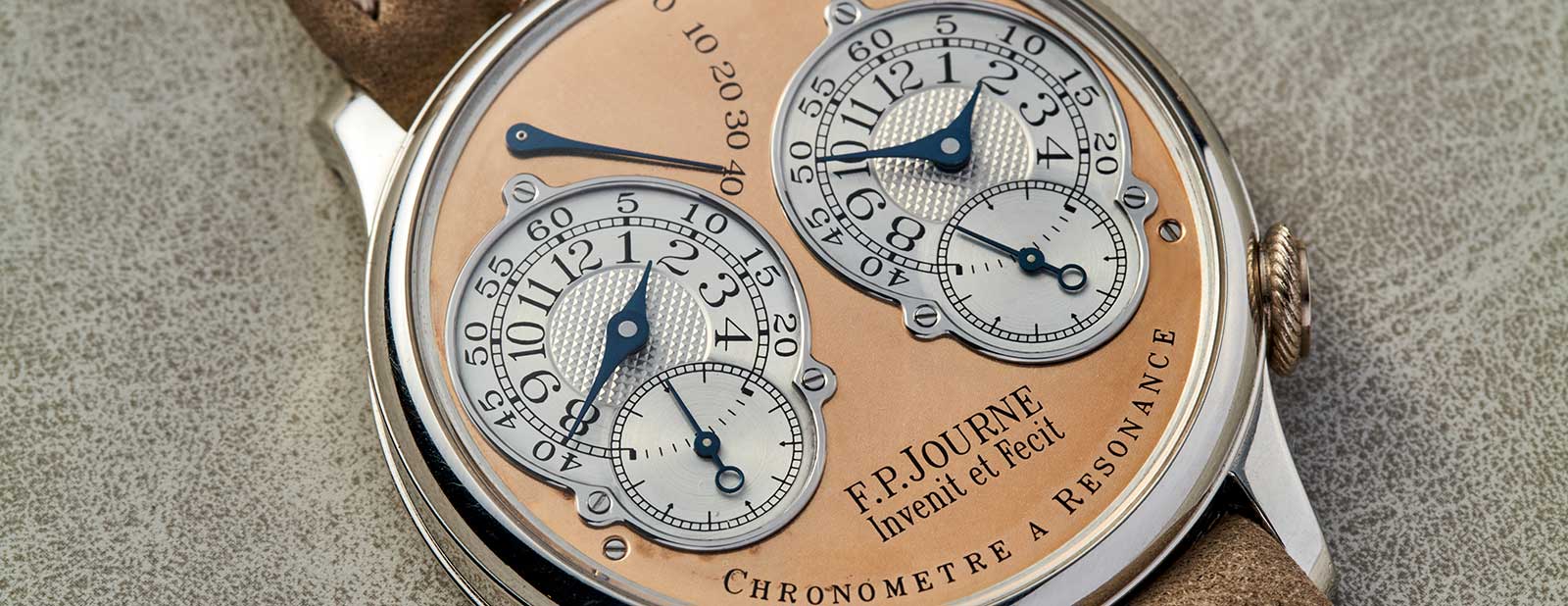
The launch reference (Cal. 1499, brass movement, 2000-2004) had two independent dials side-by-side, each driven by its own balance wheel, often configured as home time and travel time (the wearer adjusts one independently of the other via a separate crown). The two balances oscillate at the same rate but in opposite directions, so the angular momentum cancels, the watch is less sensitive to wrist motion, and timekeeping accuracy is meaningfully better than a single-balance equivalent under normal wearing conditions. Journe demonstrated this at multiple chronometric trials in the early 2000s.
The movement evolved through three major generations. In 2004 Journe switched to solid 18k pink gold baseplates and bridges (Cal. 1499.2), a signature material that became the visual identity of every Journe in-house movement. In 2010 Cal. 1499.3 added refinements to the resonance-coupling spring; in 2019 the all-new Cal. 1520 added a constant-force remontoire that decouples the escapements from the mainspring barrel, delivering identical impulse to both balances regardless of the state of wind. The 2019 update also redesigned the dial with a single seconds counter centered between the two time displays.
Journe Résonance production has remained tiny across the 25-year run: typical annual production of fewer than 100 pieces, in 38mm, 40mm, or 42mm cases, in platinum, pink gold, or yellow gold. Retail for the current Cal. 1520 platinum reference is approximately CHF 95,000; secondary-market values for vintage Cal. 1499 brass movements (2000-04) are CHF 150,000-300,000+ depending on configuration. The watch has remained throughout its production the most direct expression of François-Paul Journe's personal horological philosophy: a centuries-old principle, miniaturised, with no shortcuts.




Comments
No comments yet, be the first to weigh in.