 Hodinkee
Best of Watchville: Collectability's Definitive Guide To Skeletonized Patek Philippe Wristwatches
A can't miss reference guide to a traditional craft.
Hodinkee
A can't miss reference guide to a traditional craft.
 Revolution
 Hodinkee
A titanium flying tourbillon in two sizes.
 SJX Watches
With last year’s limited editions packaged with extreme adventures having sold well commercially, Panerai is once again offering a watch packaged with a once-in-a-lifetime experience, except that the timepiece is no longer merely a basic dive watch. Limited to just five pieces, the Submersible EcoPangaea Tourbillon GMT PAM01108 is equipped with a skeletonised movement featuring a second time zone and tourbillon. More unusually, the massive, 50 mm case of the PAM 1108 is fabricated from recycled steel. The EcoPangaea tourbillon has an unusual bezel milled to have its markings in relief Named EcoPangaea steel, the material is recycled from the discarded drive shaft of Pangaea, the 35 m sailboat owned by South African conservationist and explorer Mike Horn. The vessel has accompanied Mr Horn on various expeditions around the world, from Antarctica to the Amazon. Fittingly, the watch includes an Arctic adventure supervised by Mike Horn, which Panerai describes as “an opportunity to test your physical limits and witness the imperiled state of our ecosystem.” The perpendicular tourbillon The PAM 1108 is powered by the P.2005/T, a movement Panerai has used on several other skeleton-tourbillon watches. Hand-wound with a six-day power reserve, the P.2005/T incorporates a second time zone function with a central GMT hand, as well as the novel tourbillon at 10 o’clock. Unlike conventional tourbillons that rotate on the same plane as the dial, with the balance wheel oscilla...
 Revolution
Vacheron Constantin refreshes its sporty Overseas collection with a skeletonized iteration of the great ultra-thin perpetual calendar and a new solid gold bracelet.
 SJX Watches
The virtual doors of Watches & Wonders 2020 are now open – here’s an overview of all notable new releases from the exhibiting brands. This page will be updated as additional watches are launched in the coming months, so bookmark this. A. Lange & Söhne Odysseus Datomatic in white gold Zeitwerk Minute Repeater in white gold Cartier Cartier Privé Tank Asymétrique Maillon de Cartier Pasha de Cartier Santos-Dumont XL Santos-Dumont Limited Editions Santos de Cartier ADLC Girard-Perregaux Laureato Absolute Light IWC Portugieser Automatic 40 Portugieser Chronograph 3716 Portugieser Monopusher Chronograph Edition “Laureus Sport for Good” Portugieser Perpetual Calendar 42 IWC Portugieser Yacht Club Moon & Tide Jaeger-LeCoultre Master Control Collection Master Control Memovox and Master Control Memovox Timer Montblanc 1858 Automatic 24H 1858 Split Second Chronograph Limited Edition 100 Heritage Manufacture Pulsograph Panerai Luminor Marina Carbotech PAM01661 Luminor Marina Titanio DMLS PAM01117 Luminor Marina Fibratech PAM01663 Submersible EcoPangaea Tourbillon GMT PAM01108 Parmigiani Toric Tourbillon Red Gold Slate Piaget Altiplano Ultimate Concept Vacheron Constantin Égérie collection Les Cabinotiers Grand Complication Split-Seconds Chronograph “Tempo” Les Cabinotiers Astronomical Grand Complication “Ode to Music” Les Cabinotiers “The Singing Birds” Overseas Ultra-Thin Perpetual Calendar Skeleton Traditionnelle Tourbillon Chronograph
 Hodinkee
A highly complicated sports watch gets an old-school twist.
 SJX Watches
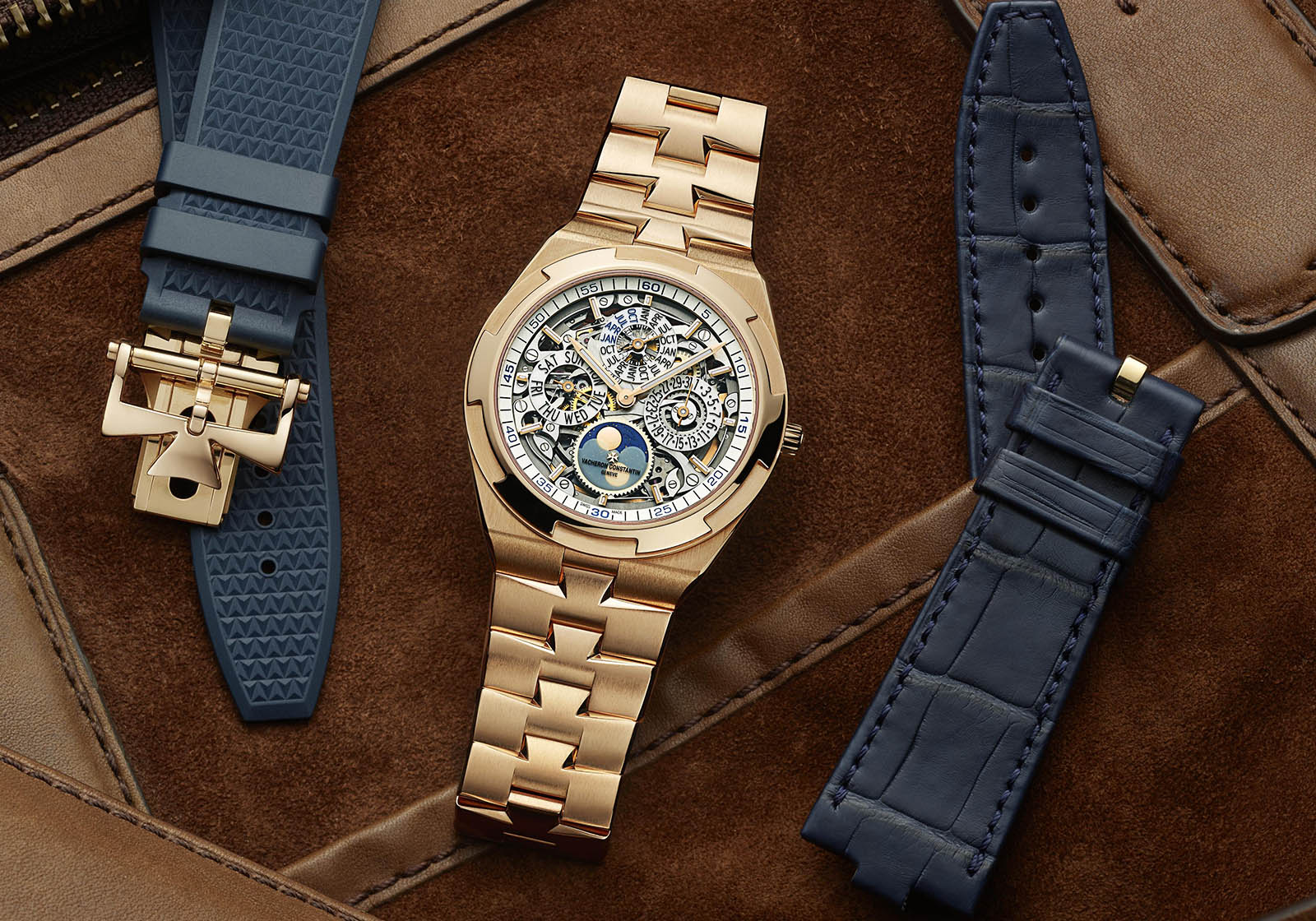
Since its 2016 relaunch after a major revamp, the Vacheron Constantin Overseas collection has filled out nicely with a diverse range of complications, ranging from world time to tourbillon – and even a one-off prototype that was sold for charity. At Watches & Wonders 2020, Vacheron Constantin debuts the first skeleton model in the line-up, the Overseas Ultra-Thin Perpetual Calendar Skeleton. It has the same gorgeously elegant lines as the standard Overseas perpetual calendar, but now enhanced by the intricately open-worked movement. Rendered only in pink gold for now – other variants will surely emerge if the rest of the collection is anything to go by – the case measures 41.5 mm across and just 8.1 mm high, leaving it surprisingly slimmer than both the Patrimony Ultra-Thin Perpetual Calendar that’s powered by the same movement. In typical Overseas style, both the case and bracelet are finely executed, with alternating brushed and polished surfaces. Even the inner faces of the notches on the bezel are brushed, while the deeply-set inner angles on the bracelet are polished. Framed by a minute ring, the dial is mostly clear sapphire with applied hour markers in pink gold, as well as day, date and month counter rings. The moon phase disc at six o’clock is covered by a frosted portion of the crystal to delineate the age of the moon, with a gold Maltese cross applied on the frosted display. The movement is the cal. 1120QPSQ/1, the skeletonised version of the ultra-t...
 Hodinkee
The Privé Collection Asymétrique debuts with an openworked in-house movement, caliber 9623 MC
 Hodinkee
An openworked take on the brand's reimagined icon.
 SJX Watches
After unveiling the glow-in-the-dark Santos Skeleton ADLC “Noctambule” last year, Cartier debuts the similar, but simpler, Santos de Cartier ADLC at Watches & Wonders 2020. The new Santos actually revives a look the brand first rolled out in 2009 with the Santos 100 ADLC, which was the brand’s first use of amorphous diamond-like carbon (ADLC) as a case coating. A nano-composite coating, ADLC possesses diamond-like properties, including high corrosion and scratch resistance, improving the robustness of the watch case. But like all coatings it can detach if the material below is dented or scratched deeply. All-black (left), or a combination of natural-finish steel and ADLC-coating Shades of black Like the Skeleton ADLC “Noctambule”, the Santos ADLC is available only in the largest LM case that’s 47.5 mm by 39.8 mm on the face and a height of 9.38 mm, making it a big but relatively slim watch. It is available in two iterations: all-black ADLC-coated steel, or two-tone steel with an ADLC bezel. While the case dimensions are identical to the standard Santos, the new models have a low-key matte finish. The bezel is brushed, instead of the mirror polish found on the standard model, with only the bevels along the edge of the case being polished. The steel model features a dark grey dial which matches the shade of the ADLC coating on the bezel. Though the dial is a single colour, it appears two-tone due to the surface finishing – vertical brushing on the inner dia...
 SJX Watches
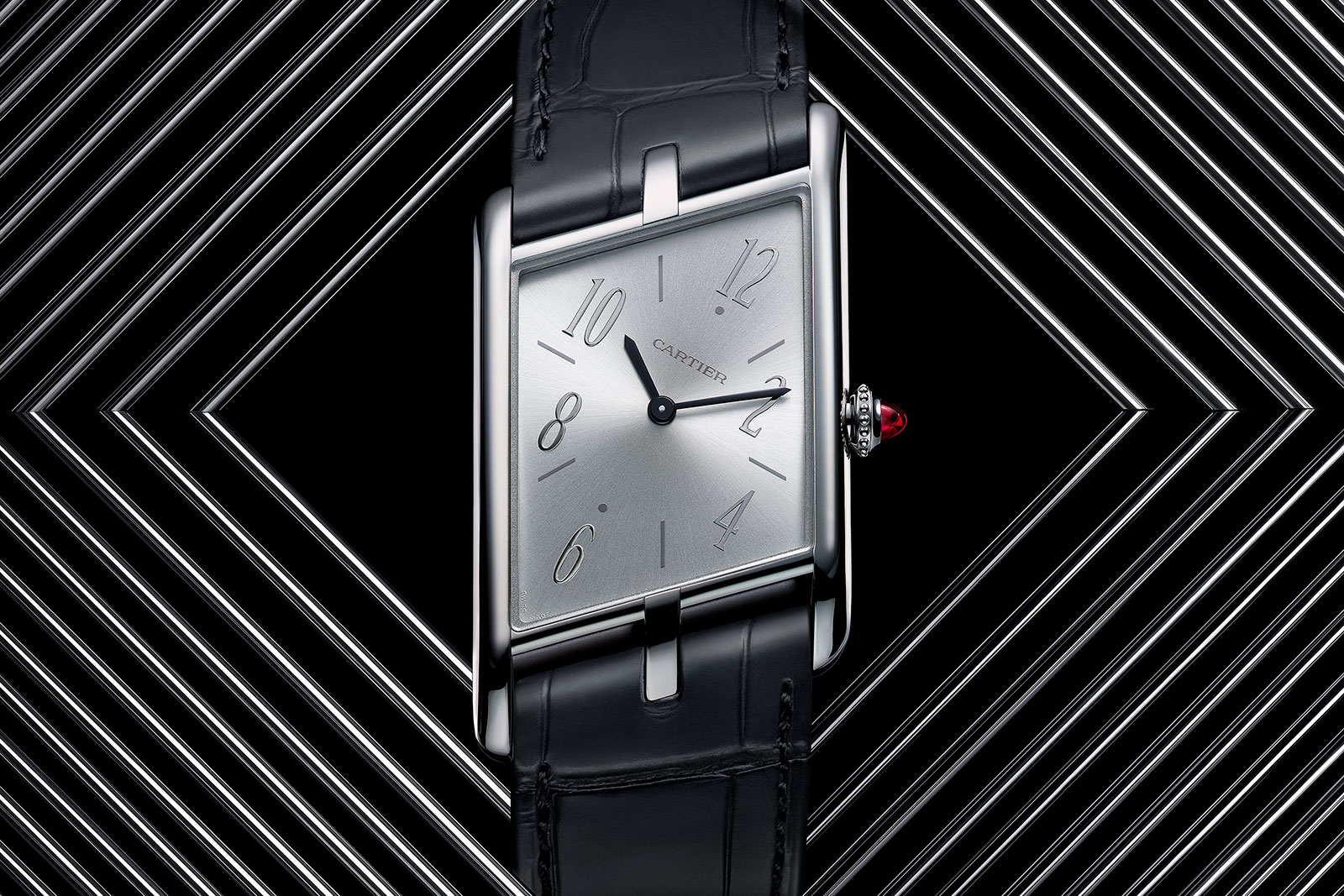
Cartier has made it an annual tradition to revive one of its iconic case shapes as part of the compact and focused Cartier Privé line, having started with the Tank Cintrée in 2018, followed by the Tonneau last year. Now at Watches & Wonders 2020, the jeweller has recreated one of its most divergent Tank models with the Cartier Privé Tank Asymétrique, in the classic time-only format as well as a contemporary skeleton version. The Tank Asymetrique Skeleton Introduced in 1936, the Asymétrique was not conceived as a Tank wristwatch at the time of its launch, and was known as the Parallélogramme or Losange after its case shape. It deviated from a conventional rectangular case literally, with the case brancards offset in opposite directions, transforming the rectangle into a diamond, while the dial was rotated by 30 degrees to the right. A distinctive feature of the dial on the vintage Parallélogramme watches were the alternating Arabic numeral and baton hour markers, probably conceived to improve legibility of the skewed dial. In the modern day, the Asymétrique was incorporated into the Tank wristwatch line-up when it was reproduced as a limited edition. That happened first in 1996 with a limited edition with a small case size, with 300 examples in yellow gold and another 100 in platinum, both having the same dial style as the vintage originals. (And in 1999 a tiny run of watches was made to commemorate the handover of Macau to China.) The CPCP Tank Asymetrique of ...
 SJX Watches
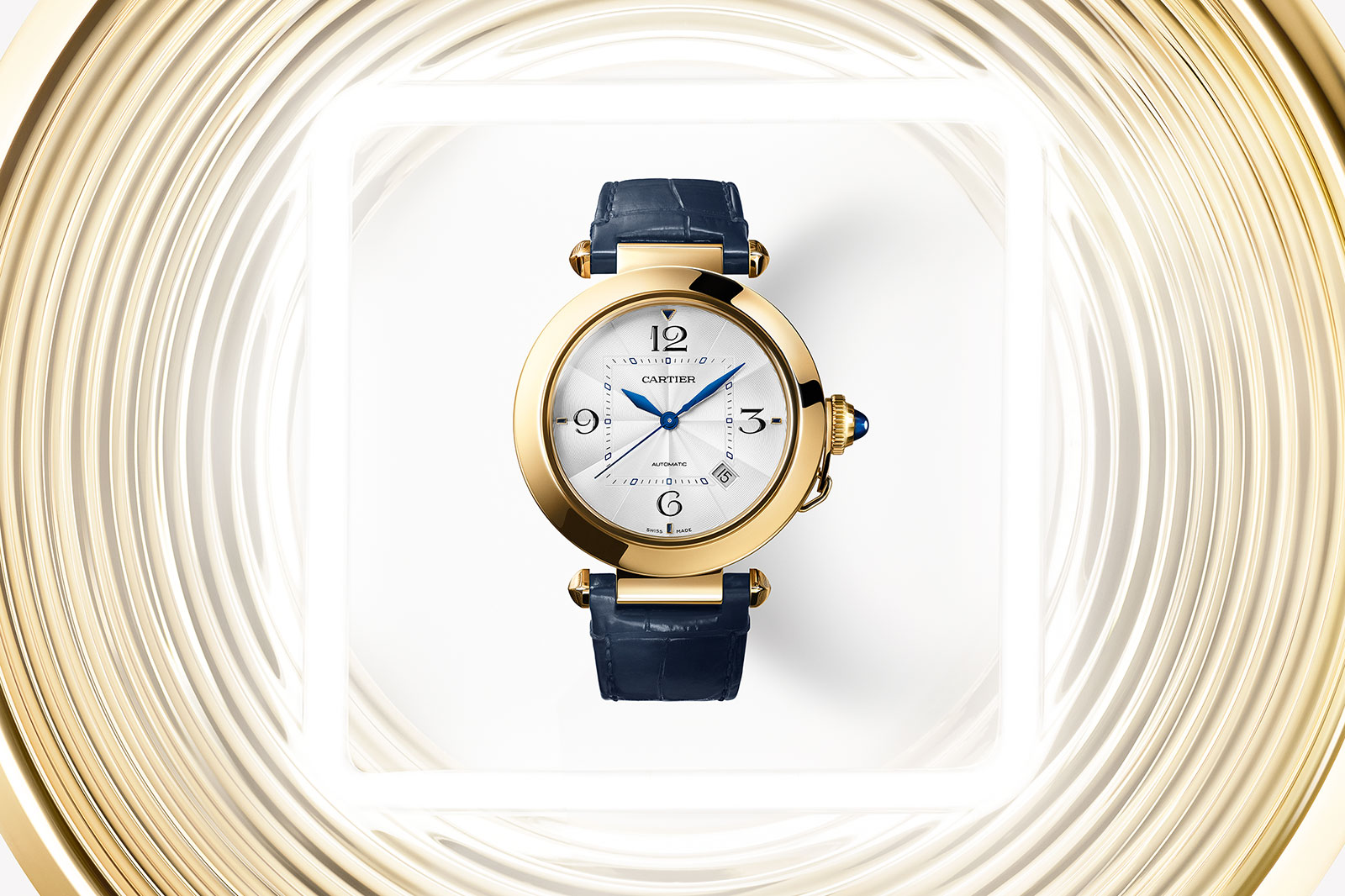
As it does every couple of years, or decades, Cartier reintroduces one of its iconic wristwatches, this time the Pasha de Cartier. Launched in 1985 and a big hit in the decade after, the Pasha was Cartier’s original round-case bestseller, long before the Ballon Bleu. Three decades on, the new Pasha makes its debut once again at Watches & Wonders 2020 as a full-fledged collection with models for both men and women, from time-only to skeleton tourbillon, as well as diamond-set versions. Variants of the new Pasha 41 mm for men Mysterious origins Despite having a round case – Cartier is most famous for its shaped watches like the Tank and Santos – the Pasha is amongst the most historically-important Cartier timepieces, apparently. Legend has it that Cartier first created a water-resistant watch in 1934 for the fabulously wealthy Pasha of Marrakesh, Thami El Glaoui, who wanted a watch he could wear while swimming. The result was one of the first-ever luxury-sports watches. While the Parisian jeweller no doubt made a watch to fulfil the Pasha’s request, it was most likely a rectangular Tank Etanche, rather than anything resembling today’s Pasha watch. Inspired by that tale, the modern-day Pasha was born in 1985, penned by the hand of Gerald Genta, the prolific designer whose heyday in the 1970s and 1980s saw him create a string of hits, ranging from the Audemars Piguet Royal Oak to the Bulgari Bulgari. Genta’s creations were often avant-garde in their day, and his...
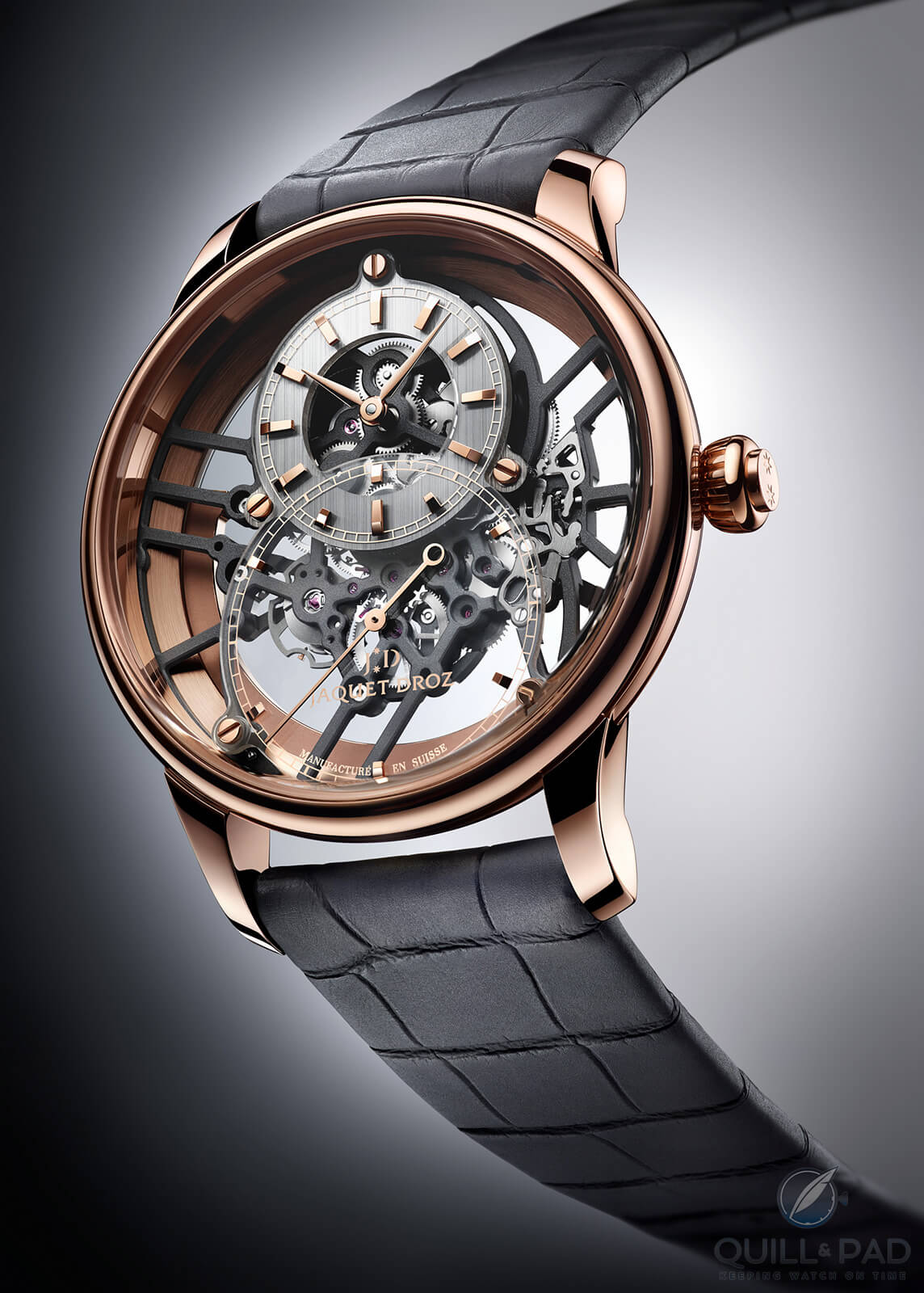 Quill & Pad
While Martin Green is not a particular fan of skeletonized watches, the Jaquet Droz Grande Seconde Skelet-One has seduced him. Here he explains why.
 SJX Watches
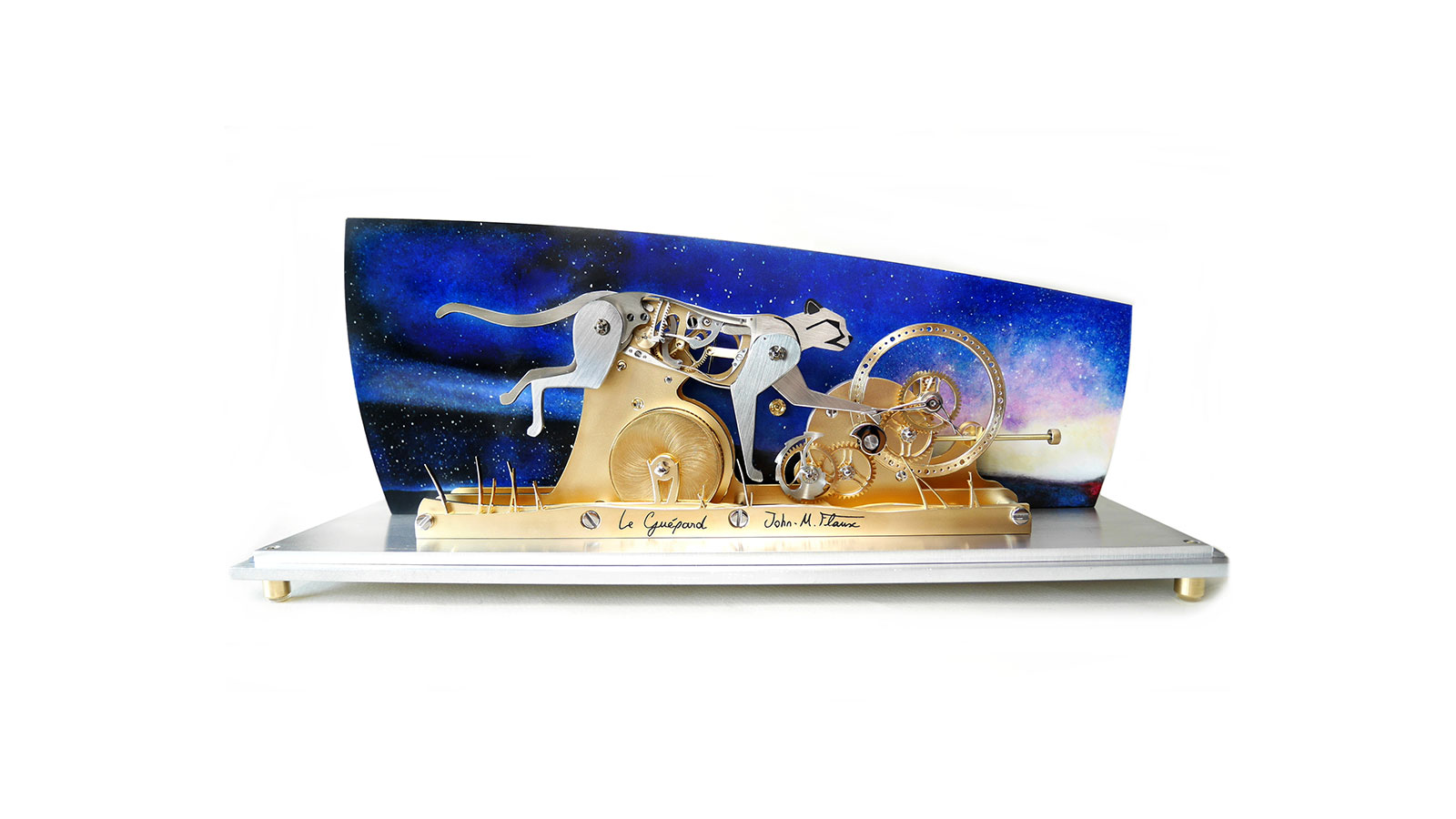
A young French horologist who specialises in automaton clocks – his most recent work was a retro-automobile that tells time – John-Mikaël Flaux has just unveiled his most elaborate work to date, Le Guépard. Translating as “The Cheetah”, Le Guépard is an elegantly-conceived, hour-striking clock with its movement forming an automaton of a big cat. Made of brass and steel, Le Guépard tells the time on an open-worked dial on its right, but it is also a sonnerie en passant, chiming out the time as it passes. Mr Flaux, who attended the same watchmaking school as independent watchmakers Cyril Brivet-Naudot and Theo Auffret, describes Le Guépard as a “poetic take” on the hour-striking clock. At the top of every hour, the clock chimes the number of hours via a hammer striking the large bell on its rear. Triggered by a snail cam and front paw of the cheetah, the strike work propels the limbs of the cheetah, which moves in slow motion as the rack of the strike work “counts” the number of hours being struck. The clock can also strikes the hours on demand – a feature activated by pressing on the tail of the cheetah. Located behind the decorative panel are the hammer and bell that sound the hours Made up of 205 parts, most of the clock is produced by Mr Flaux using traditional methods, like turning wheels on a manual lathe. The movement is mounted on a steel platform, but sits against a background of an abstract starry night on the African plains. Executed in a...
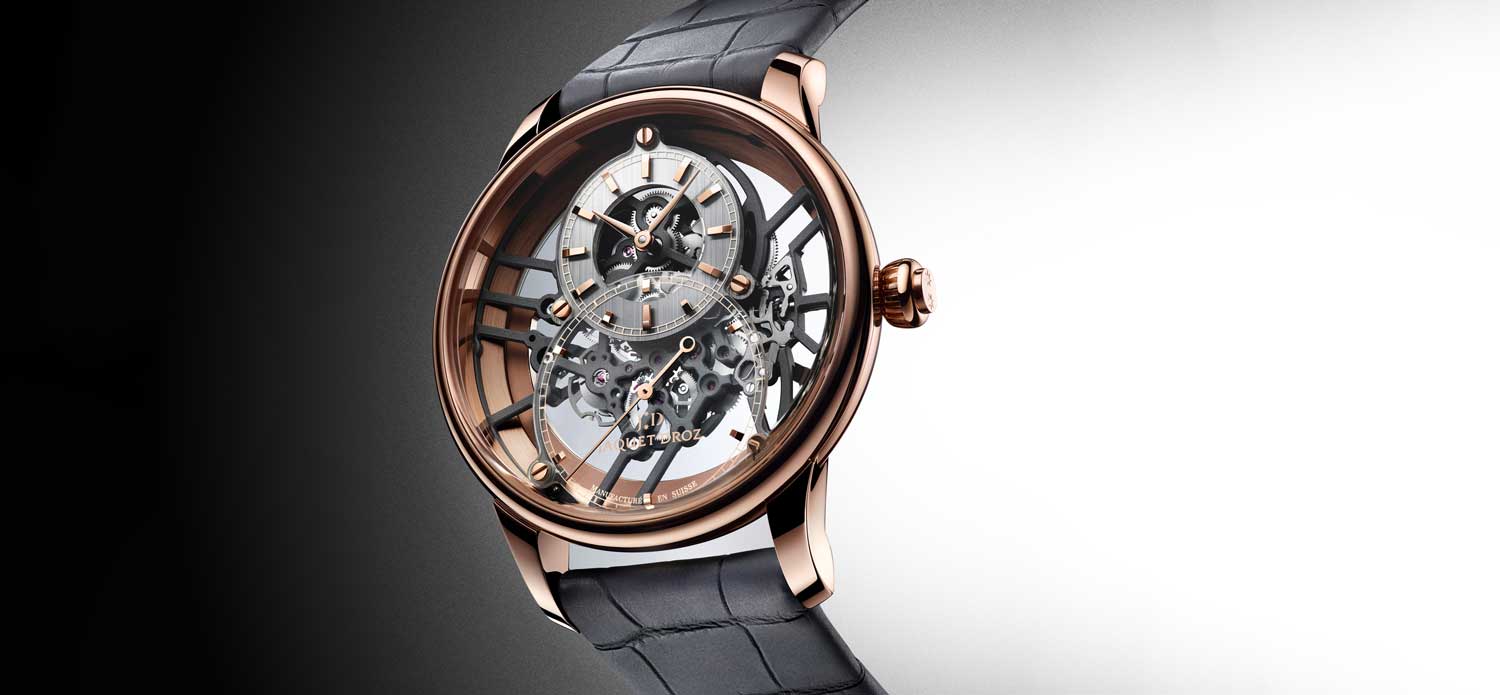 Revolution
New technology emerges in Jaquet Droz’s modern skeleton interpretation of the Grande Seconde.
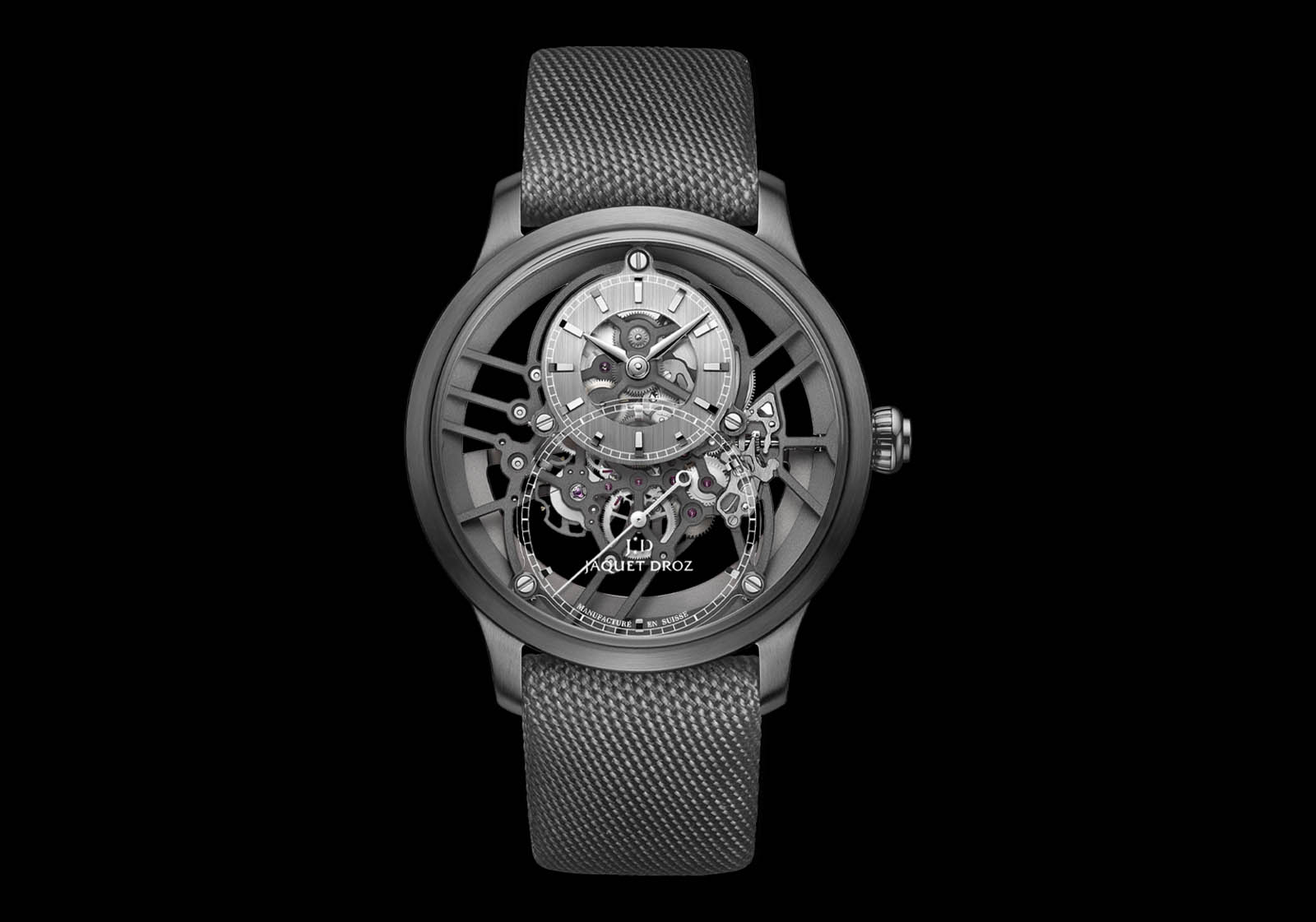 SJX Watches
A contemporary take on the brand’s iconic watch – itself based on a 18th century pocket watch – the Jaquet Droz Grande Seconde Skelet-One Plasma Ceramic is a sleek and modern open-worked wristwatch, now in a new, high-tech case material. Originally available in ordinary ceramic, the watch has now been given a case of “plasma ceramic”, an unusual material that’s best described as a ceramic that resembles metal. The material begins are white ceramic that’s treated with a plasma gas, essentially ionised gas created at 20,000°C. The process of plasma carburising transforms the surface layer of the white ceramic into a metal oxide, giving the ceramic a grey, metallic finish while retaining all of the desirable properties of ceramic including hardness, low density and scratch resistance. Though plasma ceramic has been a hallmark of the Swatch Group and its many brands, including Rado, Omega and Blancpain, it is being used for the first time by Jaquet Droz. The case measures 41.5 mm across and 12.48 mm high, making it a tad larger than its gold counterparts, which is typically the case for ceramic cases due to the necessities of construction in an ultra-hard, but potentially brittle, material. Unusually for ceramic that is typically mirror-polished all round, the case is finished with contrasting surfaces – the bezel and top surfaces of the lugs are brushed while the case band has a polished finish. A clear sapphire disc forms the Grande Seconde dial, wit...
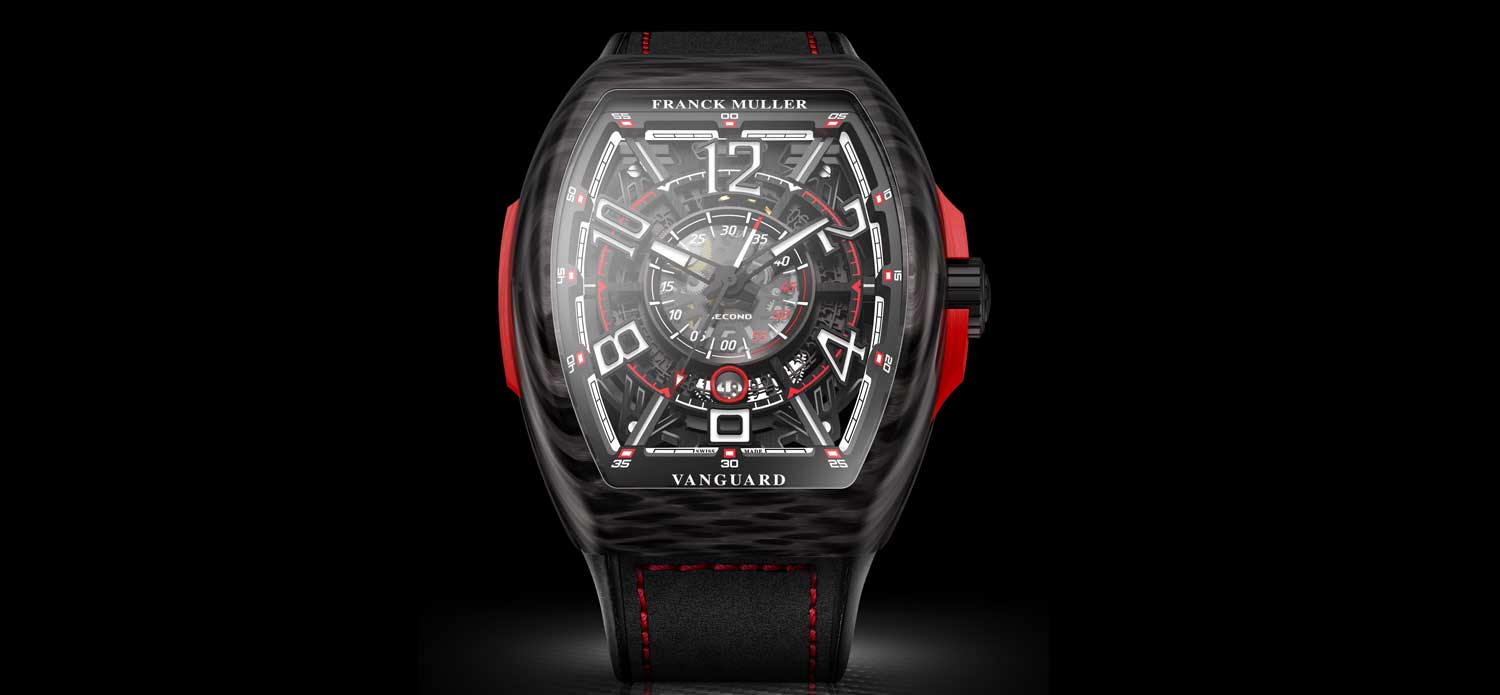 Revolution
Franck Muller’s Vanguard gets an adrenaline shot with a new racing-inspired model.
 SJX Watches
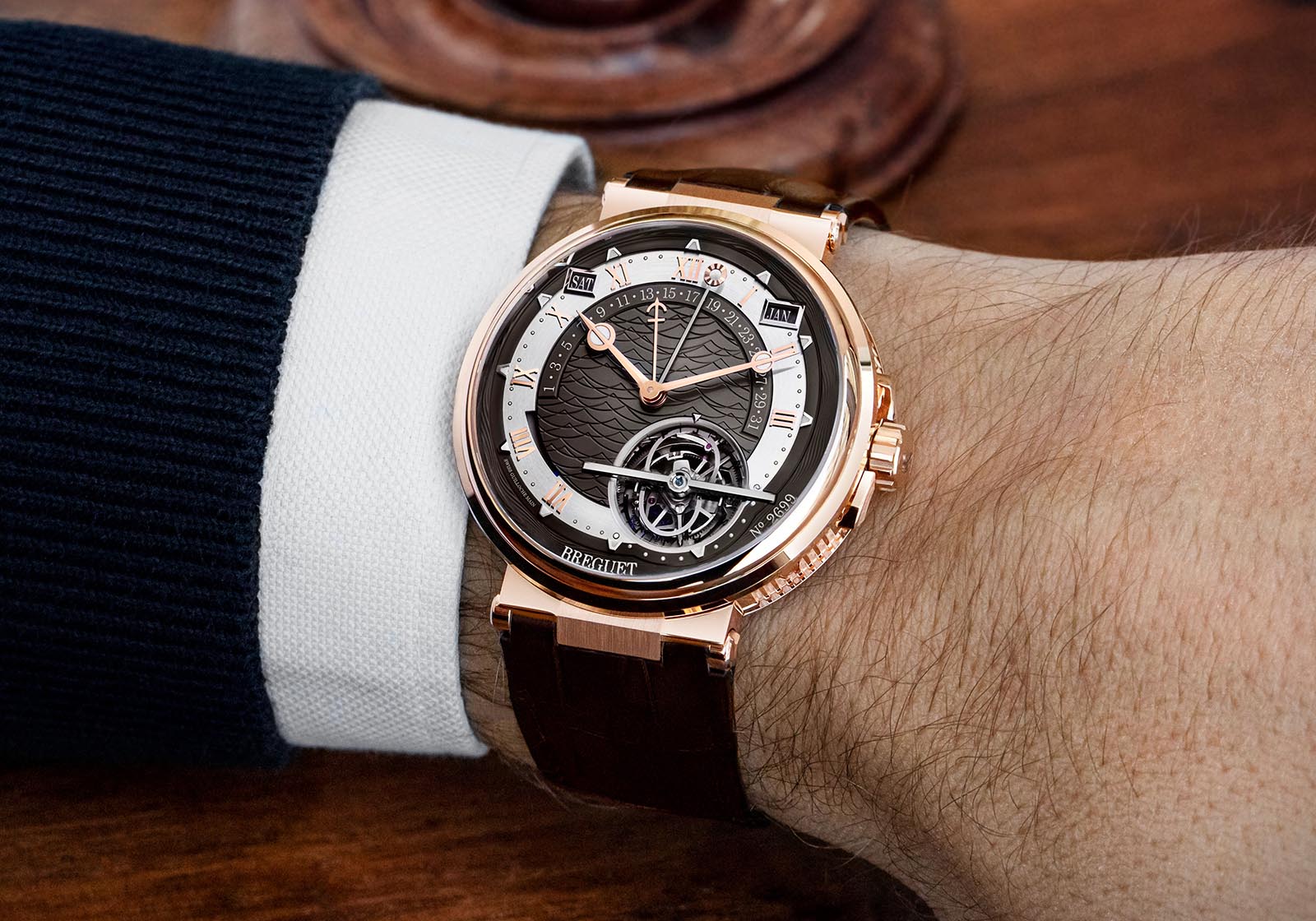
One of the most exotic Breguet watches in production today, the Marine Tourbillon Équation Marchante 5887 combines a tourbillon regulator, perpetual calendar, and running equation of time. Complexity aside, the watch is mechanically fascinating: the traditional complications within are executed in a modern and practical way. The equation of time, for instance, relies on an open-worked cam produced via the high-tech LIGA photolithography technique. And the tourbillon cage is lightweight titanium with a silicon escapement, while the automatic winding is equipped with a peripheral rotor. Breguet has now introduced a new version of the grand complication, in pink gold with a slate-grey dial. While it is mechanically identical to the two earlier versions – in platinum with a blue dial or pink gold with a silver dial – the new watch is striking and harmonious, shedding a bit of the sports-watch aesthetic of the Marine by way of the richer colours. Being a facelift, the dimensions of the watch remain unchanged. It is still a massive 43.9 mm in width, though a svelte 11.75 mm high, thanks to the ultra-thin movement inside. Like the movement, aesthetics across the case and dial are very much a blend of new and old. The case has the traditional fluted band, but is paired with modern integrated lugs. Similarly, the dial is solid gold and decorated with traditionally-executed guilloche engraved with a rose engine, but in a modern, stylised wave motif. In a nod to the age-o...
 SJX Watches
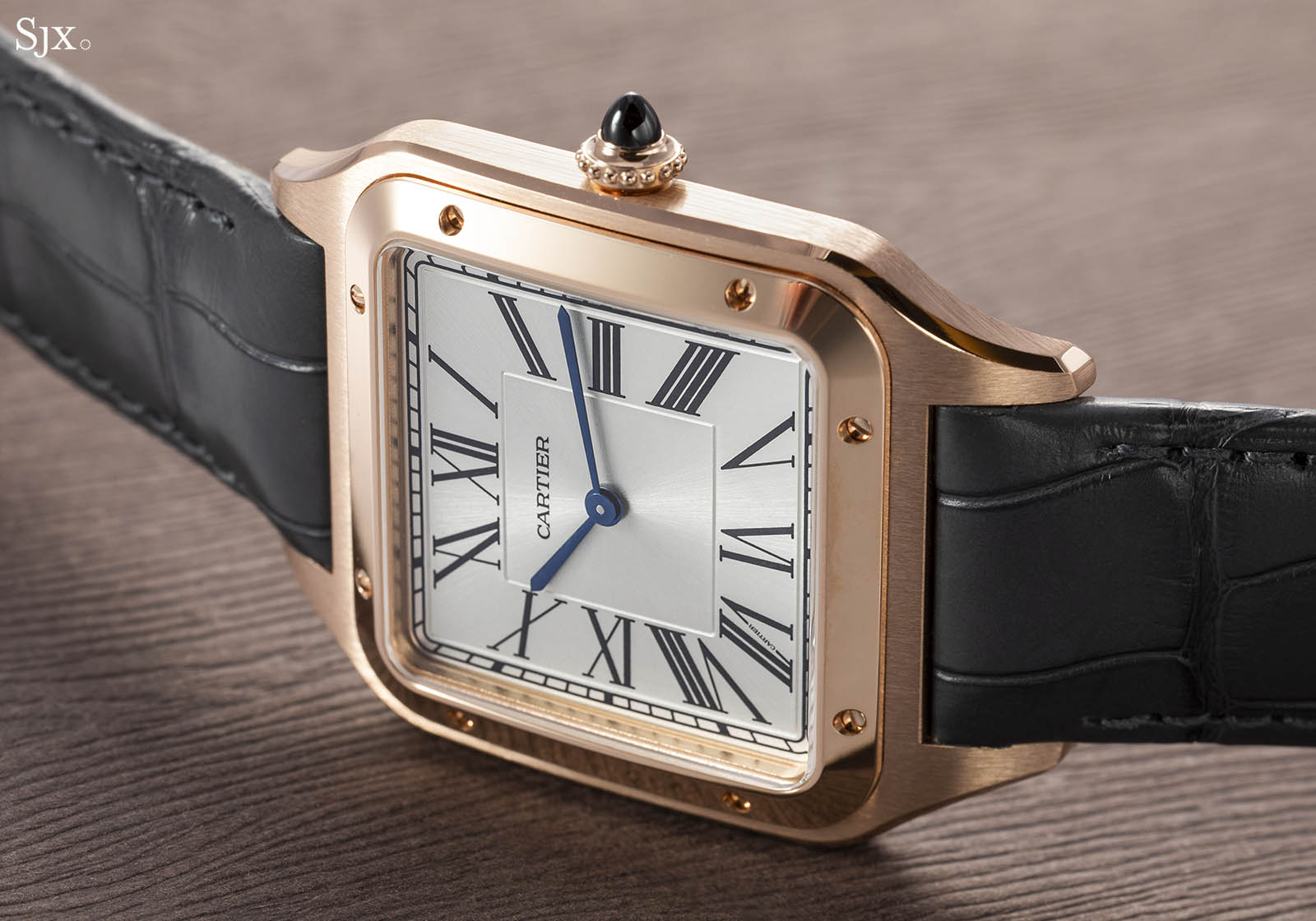
Conceived by Louis Cartier for Brazilian aviation pioneer Alberto Santos-Dumont – who needed a timepiece he could read while flying – the Santos-Dumont wristwatch has the double distinction of being the first wristwatch designed from the ground up for men, as well as being the first-ever pilot’s wristwatch. Now the 116-year old design has just received its latest update with the unveiling of the hand-wound Santos-Dumont XL. [Update March 23, 2020: Read the review with more photos.] Though the Brazilian pilot got his wristwatch in 1904, it took until 1911 for the design to be sold commercially. For most of the century since, the Santos-Dumont has been part of the Cartier line-up in one way or another, often in gold but occasionally in platinum (one outlier was a special edition in titanium with a skeleton movement). The most recent facelift happened in 2005, which saw the unveiling of a version without a bezel. The new Santos-Dumont XL in all three versions Last year, the latest generation of the Santos-Dumont was unveiled, marking a return to the iconic Santos bezel with screws. For the first time ever, the Santos-Dumont was available in steel as well as two-tone steel and gold, along with the traditional all-gold case. However, the new Santos-Dumont didn’t quite receive unanimous acclaim because it was quartz movement. But now Cartier has finally unveiled what was long expected, the mechanical Santos-Dumont XL. Measuring 46.6 by 33.9 mm and just 7.5 mm in height...
 Time+Tide
Fans of Franck Muller will know there is something in the Vanguard collection for everyone. With more than 30 different references in the current lineup, including chronographs, tourbillons and skeletonised movements, the independent watchmaker has ensured that no matter where you want to take your watch, there is a generously curved creation for you. Despite … ContinuedThe post INTRODUCING: The Franck Muller Vanguard Classic that can take you from boardroom to beach appeared first on Time+Tide Watches.
 Time+Tide
Transparency is almost always a good thing, be it in political donations, corporate bonuses or who your local member of parliament is having lunch with. It is a concept that Chanel has adopted as a motif in their watchmaking department, seen in the Boy.Friend Skeleton, their remarkable Monsieur de Chanel Pocket Watch (an almost US$800,000 skeletonised … ContinuedThe post INTRODUCING: The Chanel J12 X-Ray is the clarity you need in your life appeared first on Time+Tide Watches.
 SJX Watches
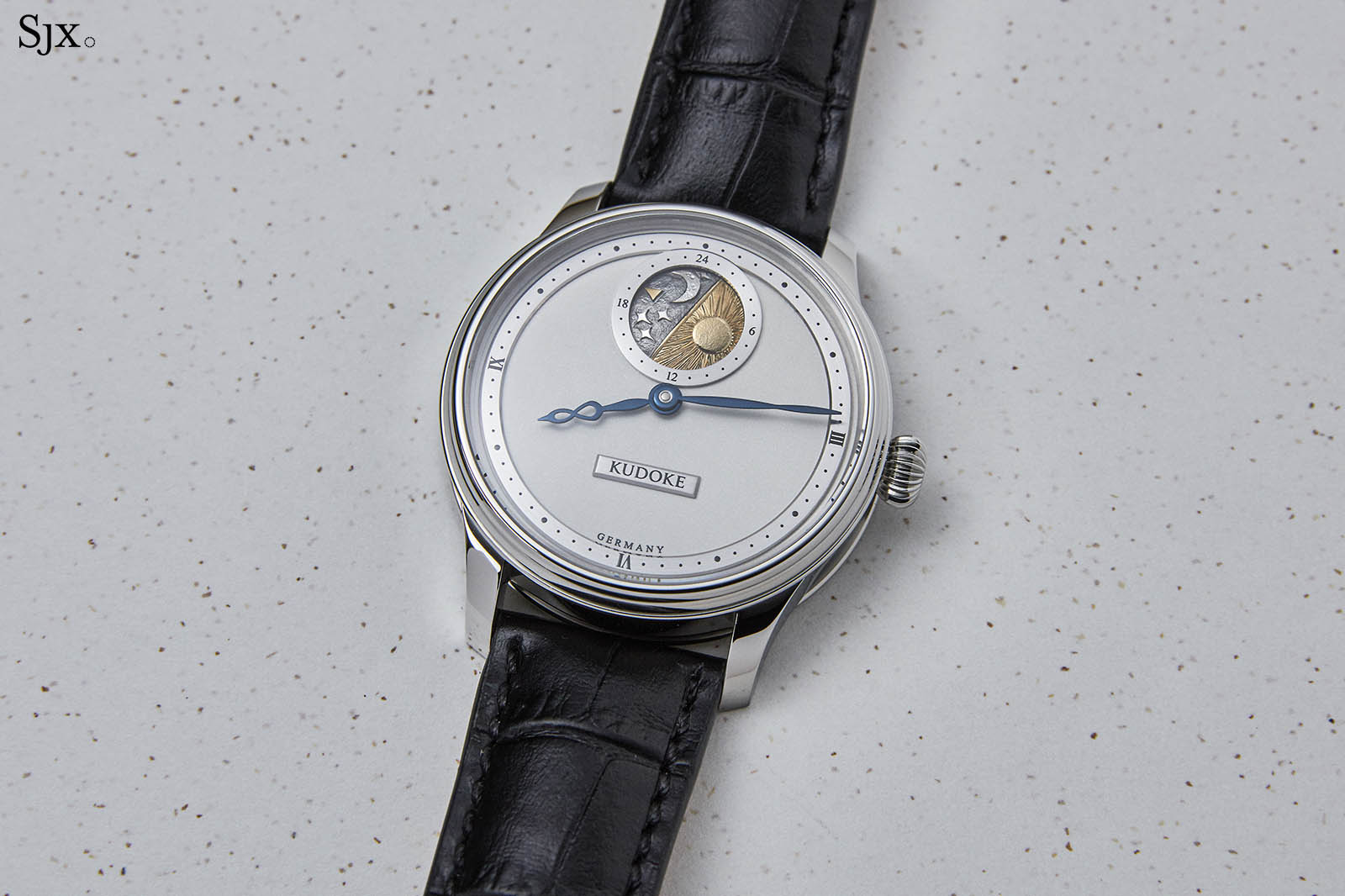
Two years ago, German independent watchmaker Stefan Kudoke announced his first proprietary movement, the Kaliber 1, which was developed in collaboration with Habring2. A year later, the movement has made its debut in a pair of classically-styled watches – the Kudoke 1 and Kudoke 2. Both models mark a stark departure from his earlier watches both in terms of design and price. Based in a small town east of Dresden, Kudoke was best known extravagantly engraved, skeletonised timepieces, often powered by a Unitas-based movement (which meant they were all relatively large). But the latest Kudoke watches are far more understated, as well as attractively priced, starting at just over US$7,900. In fact, these watches present a compelling proposition, offering an unusual level of hand-decoration for its price bracket, save for a handful of other small independents, such as D. Dornblüth & Sohn. The Kudoke 1 Gently hand-engraved The Kudoke 1 is a well-designed watch showing the hours, minutes and seconds, while the Kudoke 2 replaces the seconds with a wonderfully engraved day and night indicator. Both watches are compact and thin enough to wear comfortably, though not quite so thin as to be true formal watches. Instead they feel like elegant everyday watches with discreet, appealing details in the hands, dial and movement. The two have the same steel case that’s 39 mm wide, but differ slightly in thickness due to the addition of the domed day and night indicator in the Kudoke ...
 SJX Watches
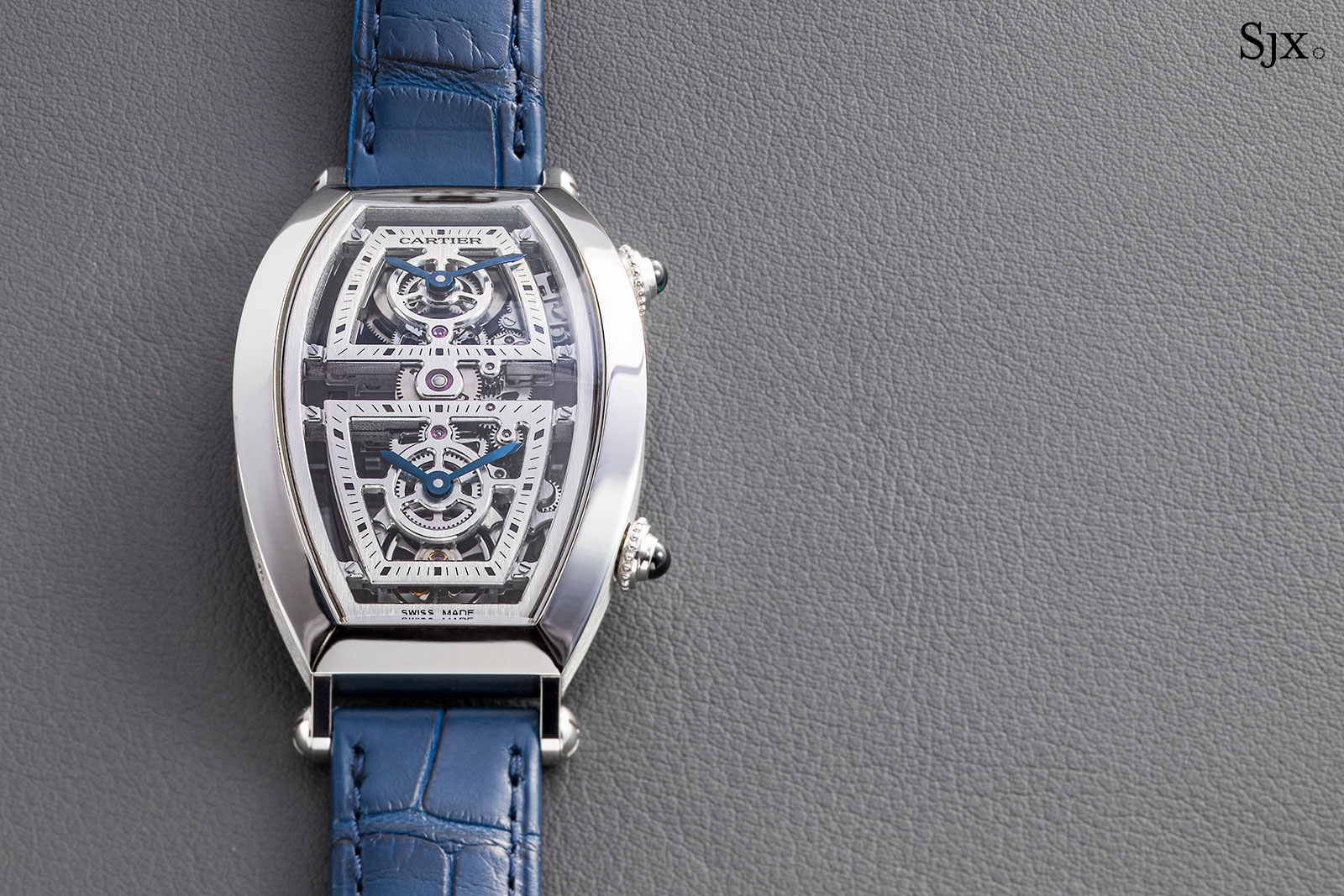
Launched last year alongside the time-only Tonneau, the Privé Tonneau Skeleton Dual Time is classical Cartier in style and execution. The case is a century-old Cartier design that has not aged, while the movement is interesting in aesthetics and mechanics. In fact, the 9919 MC inside is surprisingly novel – it’s a skeleton, form, and curved movement with two time zones. The Tonneau Skeleton is also being produced in a modest limited edition, which means it will remain unusual. But it is hindered by a high price tag. Double fuseau The Tonneau Skeleton Dual Time is modelled on the Tonneau double fuseau (French for “double time zone”) that was produced in a variety of versions, including a 1999 Macau handover commemorative edition, from the 1990s until the mid 2000s. A Cartier Collection Privee Cartier Paris (CPCP) Tonneau dual time zone in white gold, c. 1998. Photo – Sotheby’s Cartier was particularly fond of the twin time zone complication during the period, and the double fuseau was also produced in many Tank case styles, ranging from the Tank Cintree to the Tank Louis Cartier. Despite the diversity, all the double time zone watches shared a common feature – they were powered by two separate small movements – either mechanical or quartz, depending on the model – essentially two tiny watches combined into an extra-large case. Though mechanically unsophisticated, the two-in-one construction made each time zone entirely independent, down to the minute....
Question, suggestion, or just want to say hi? Drop a note.
Comments 5