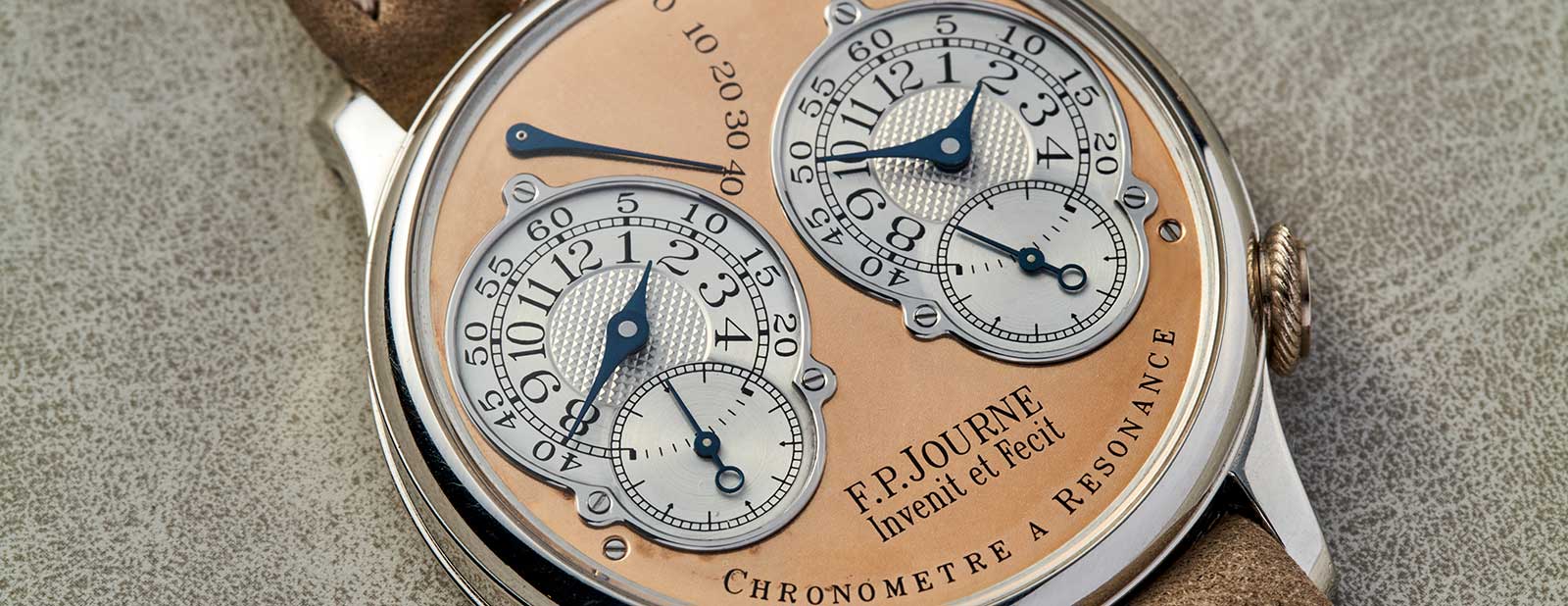
François-Paul Journe was born in Marseille in 1957. He apprenticed at the École d'Horlogerie de Paris and then with his uncle Michel Journe, a Paris-based restorer of complicated pocket watches. Through the late 1970s and 1980s Journe restored pieces by Abraham-Louis Breguet, Antide Janvier, and Louis Berthoud for Paris museums and private collectors, becoming one of the few watchmakers of his generation fluent in 18th- and 19th-century haute horlogerie as a living practice, not a historical study.
In 1983, aged 26, Journe built his first complete watch, a tourbillon pocket watch, from scratch for himself. Through the late 1980s and 1990s he produced hand-built pocket watches and prototypes for brands including Cartier and Breguet. In 1991 he presented a wristwatch concept for a resonance movement (two balance wheels mechanically synchronised by resonance at a distance) at the Basel Fair, but took another eight years to perfect it and build a viable brand around it.
"For me, a watchmaker is someone who invents. Making a watch from an existing movement, that's assembly. The word means more."- François-Paul Journe
F.P. Journe Invenit et Fecit was founded in Geneva in 1999. The opening collection was centred on three pieces: the Tourbillon Souverain (with remontoir d'égalité and dead seconds, the first modern wristwatch tourbillon with those two constant-force complications), the Chronomètre à Résonance (2000, the first serial resonance wristwatch), and the Sonnerie Souveraine (2006, a grande-sonnerie wristwatch with a patented hammer-mute system). Every movement uses the rose-gold plates that became the F.P. Journe signature. Every dial bears the Latin legend Invenit et Fecit, "invented and made", claiming authorship of both the design and the manufacture.
F.P. Journe today produces roughly 900 watches per year from a Geneva atelier of about 80 people, with no external ownership, no investor, and no sub-contracted movement supplier. Every movement is built in-house in precious metal. Output of the flagship F.P. Journe pieces (Chronomètre Bleu, Chronomètre Souverain, Élégante) is a fraction of demand; waitlists for new pieces run two to five years; secondary-market prices often double or triple retail. Journe is the most commercially successful independent watchmaker of the modern era, and the clearest continuation of the Breguet-Journe-Daniels tradition of authoring a new mechanical idea and producing it under one's own name.






Comments 2