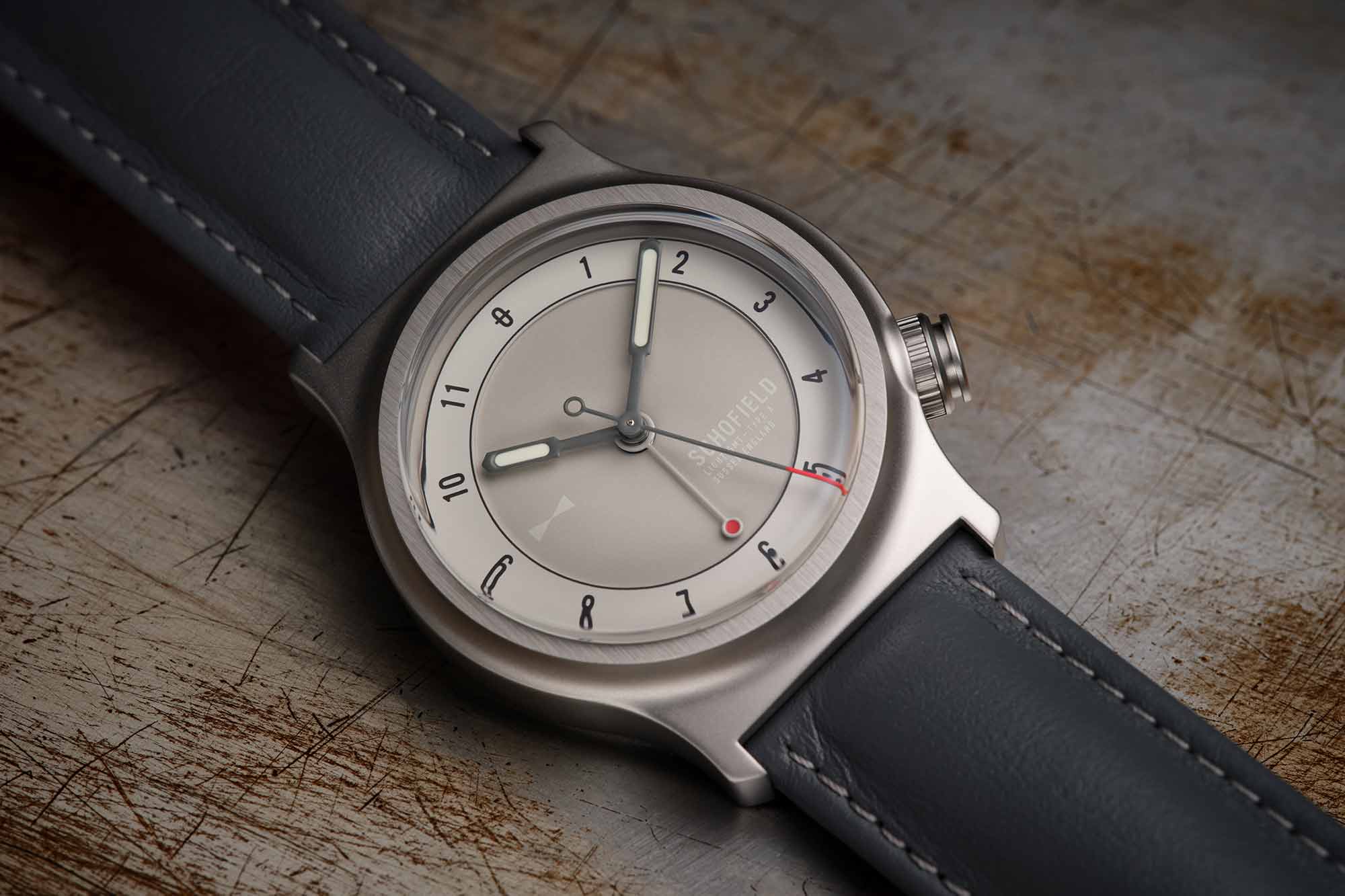
In 1950s underwater diving, a key operational requirement for a dive watch was readable seconds in low light at depth: divers timed bottom and decompression intervals using the seconds hand and any moment of misreading could be a safety issue. Conventional seconds hands were thin needles with at most a small dot of lume near the tip; under reduced light at depth the lume was hard to track. The lollipop hand was the engineering answer: a round luminous disc near the tip giving 5-10x the lume area of a conventional needle hand, immediately visible against the dial pattern.
The earliest documented lollipop seconds in production are on Rolex Submariner references 6538 (the "Big Crown", James Bond Goldfinger watch, 1956-58) and 5513 (1962-89, the longest-produced Submariner). On both references the lollipop is a small ~3mm lume disc mounted near the tip of an otherwise conventional thin steel hand; the disc is filled with radium or tritium lume (depending on production year) matching the dial markers. The hand was retired by Rolex in the early 1990s as the modern Submariner shifted to a longer Mercedes-style hand.
"At ten metres of depth in the Mediterranean, you do not see a needle. You see the disc. That is why we put the disc on the seconds hand."- French Marine Nationale dive instructor on military Submariner specification
Tudor military Submariners issued to the French Marine Nationale through the 1960s-80s carried similar lollipop seconds hands, often with custom lume colours (yellow vs white). These vintage MN-issue Tudors are some of the most-collected military Submariners; their distinctive snowflake hour and minute hands paired with the lollipop seconds make for an immediately identifiable visual identity that modern Tudor Black Bay design language explicitly references.
Modern Tudor Black Bay (launched 2012, expanded across the catalogue) places the lollipop seconds at the centre of its design identity. The modern Black Bay 58, Black Bay 36, Black Bay GMT, Black Bay Pro, and Pelagos LHD all carry lollipop seconds hands; the visual is the strongest single cue identifying a Tudor BB at distance. The modern lume is Super-LumiNova in faux-aged amber or modern white; the disc diameter has been increased over the vintage spec (~4-5mm vs ~3mm) for stronger visual presence on modern photography.
Beyond Tudor, the lollipop hand has become a microbrand and heritage-reissue staple. Serica 5303 / 5305, Baltic Aquascaphe, several Longines Heritage Diver references, Steinhart military divers, Christopher Ward C65, and dozens of microbrand divers all use lollipop seconds. The cue is so strongly associated with vintage military divers that any modern dive-watch design omitting it must consciously justify the choice; lollipop seconds are now near-default for the heritage-aesthetic dive watch sub-segment.
The lollipop is almost never used on dress watches or chronographs. The visual is too tool-watch-coded for dress positioning; chronograph subdial seconds hands have specialised geometries (counter-balanced needles for dynamic timing) that are inconsistent with the lollipop format. Sub-seconds hands on dress watches almost always use thin needle or sword-style hands. The lollipop is functionally the seconds-hand counterpart of the snowflake hour hand: a strongly tool-watch-coded design cue.
Comments 2