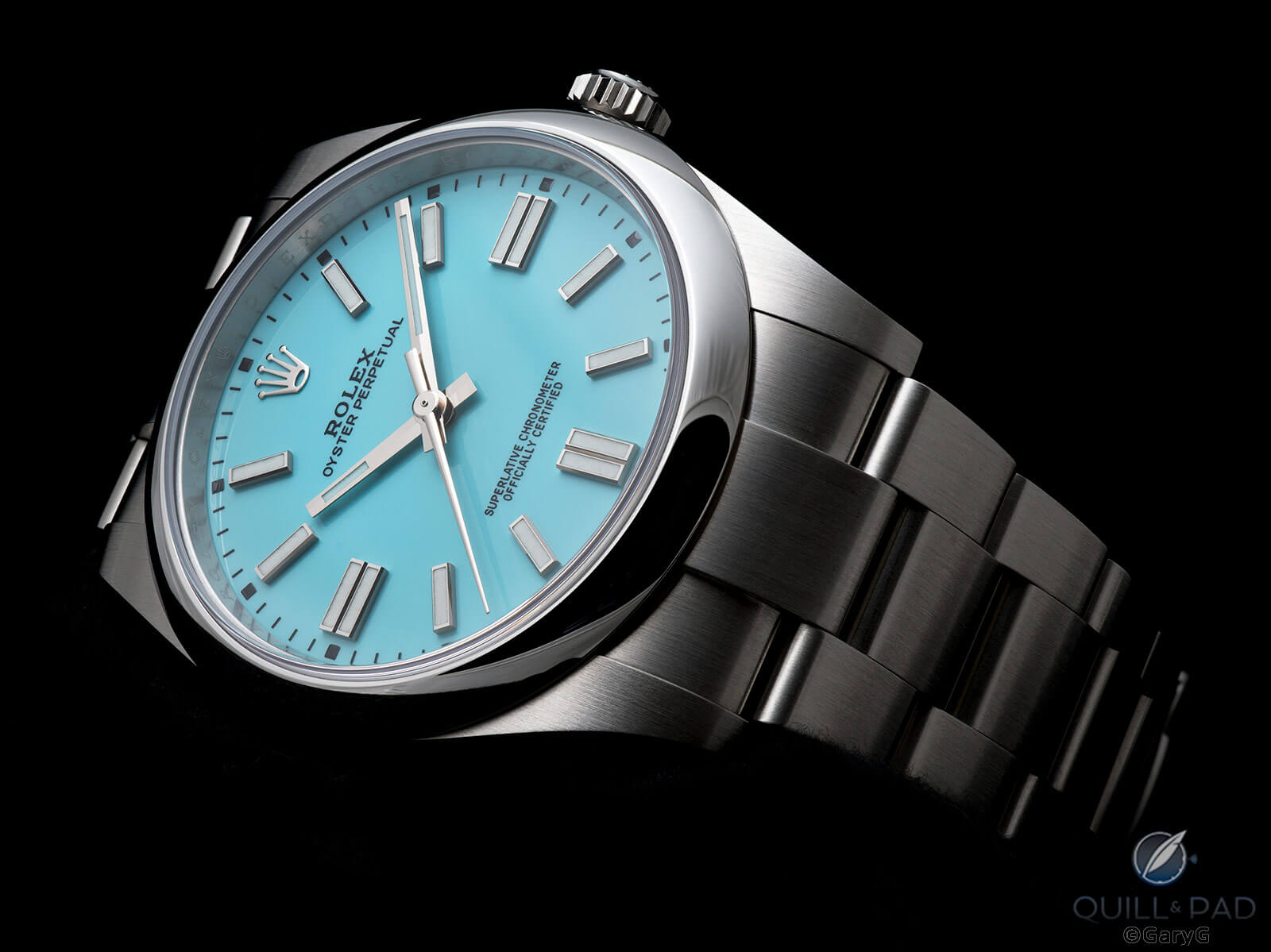
Stella dials are the brightly coloured, opaque, lacquered dials produced for selected Rolex Day-Date references in the 1970s and early 1980s. The dials were manufactured for Rolex by the Stella dial laboratory, a small specialist dial-finishing operation in Geneva that supplied lacquered and enamel dials to multiple Swiss watchmakers. The "Stella" name comes from the supplier; Rolex internally referred to them as "laquered colour dials" but the modern collector vocabulary is universally "Stella dial".
The technical construction was straightforward but executed to extreme tolerances. A brass dial blank was prepared with the standard Day-Date applied indices, crown logo, and Roman or stick markers; a thick layer of opaque coloured lacquer was then applied over the entire dial face (excluding the index cutouts), polished to a high gloss, and the indices reinserted. The lacquer thickness was unusual, ~0.3-0.5 mm vs ~0.05 mm for typical paint dials, which gave Stella dials their distinctive deep saturated colour and slight translucent depth.
"In 1979 a yellow Stella dial was a watch your accountant would have found embarrassing. In 2024 it is a watch your hedge-fund manager bids against the Sotheby's phone for. The watch never changed; the world around it did."- Phillips Watches Vintage Day-Date catalogue note, Geneva Spring 2022
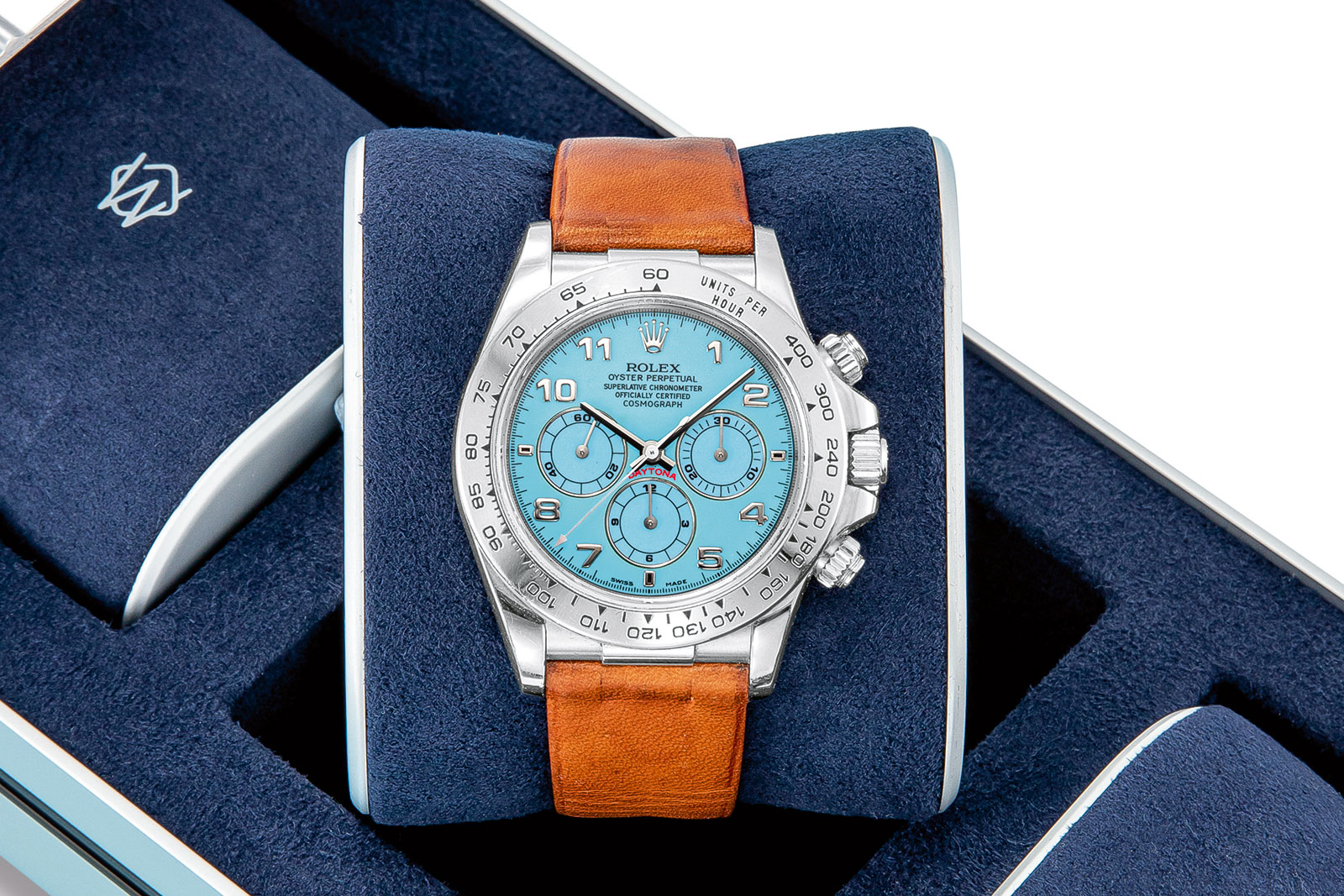
Colour range: Stella produced dials in approximately 11-15 documented colours across the 1970s-early 80s production run. The most-cited Stella colours: "Stella Red" (the brightest, most-photographed; auction premium 1.5-3× over standard red), "Stella Turquoise" (cyan-blue, the rarest, perhaps 50-200 produced total), "Stella Salmon" (pink-orange), "Stella Lavender" (light purple, very rare), "Stella Yellow" (saturated lemon), "Stella Green" (forest or jade green), "Stella Blue" (electric blue), "Stella Pink", "Stella Orange", plus white and black variants. Each colour exists in multiple sub-shades; auction-house cataloguing now describes the precise hue and finish for serious collector references.
Stella dials were applied to precious-metal Day-Date references: yellow gold ref. 1803 / 1806 / 18038 / 18238, white gold equivalents (1804 / 18039 / 18239), platinum ref. 1804 (rare), and similar mid-1970s-early-80s gold variants. Steel Day-Dates of the era did not receive Stella dials (Rolex never made steel Day-Dates as a deliberate brand-positioning choice). The combination is therefore: yellow or white gold case, gold President bracelet, gold-applied indices, Stella-coloured lacquered dial.
Why unfashionable in the 1970s: bright-coloured watch dials were associated with women's fashion watches at the time, and the conservative Day-Date customer base (US presidents, captains of industry, Asian luxury buyers) generally preferred the standard champagne, silver, blue, or black dials. Many original Stella dials were service-replaced during the 1980s-90s with standard dials at Rolex's authorised service centres; this is one reason original Stella dials are so rare today. Of the perhaps ~10,000-15,000 Stella dials produced 1970-1985, perhaps 1,000-3,000 survive in their original watches.
The collector revival began in the mid-2000s as the vintage Rolex market matured. Phillips Watches, Christie's, and major dealers began catalogue-listing Stella dials separately; by 2015 the format had multi-thousand-dollar premium over standard dials; by 2020 the rarest colours (Turquoise, Lavender) were reaching $300,000-$500,000+ at auction. The 2018 Phillips Geneva sale of a 1979 Day-Date 18038 with original Stella Lavender dial for $543,000 was a watershed moment that confirmed Stella dials as a top-tier vintage Rolex collecting category. Today Stella dials are routinely the highest-priced vintage Day-Date references at auction.

Comments 1