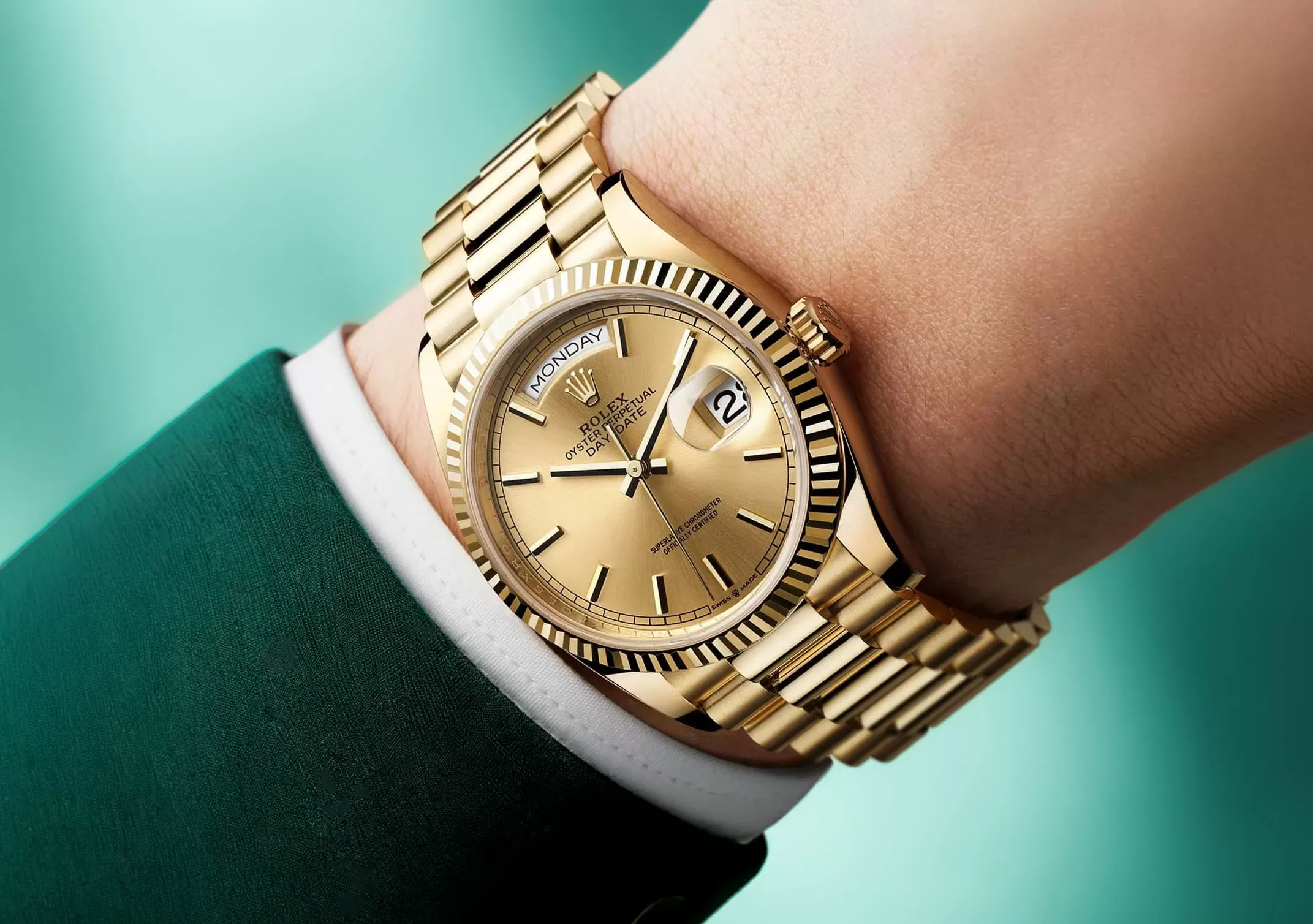
The President bracelet was introduced in 1956 for the launch of the Rolex Day-Date, ref. 6510, the world's first wristwatch to display the day of the week spelled out in full at 12 o'clock alongside a date window at 3. The Day-Date was conceived as the absolute Rolex flagship, executed only in precious metals (no steel option, ever), and sold with a new bracelet design specifically created for it: three semi-circular links, with the centre link rounded into a half-cylinder and the two outer links similarly profiled. The bracelet was sold initially without a name; Rolex internally referred to it as "the bracelet for ref. 6510".
The "President" name emerged organically through the late 1950s and 1960s as the watch became associated with US presidents and other heads of state. Dwight D. Eisenhower received a Day-Date as a gift in 1953; Lyndon B. Johnson, Richard Nixon, and various senators and ambassadors followed. Fidel Castro wore two Day-Dates on Presidents at the same time. By the late 1960s the bracelet was widely called "the President" in collector vocabulary, and Rolex eventually adopted the name in marketing.
"The Day-Date is the only watch where the bracelet has its own name. The Submariner is on an Oyster; the Daytona is on an Oyster. The President is on a President. That tells you what kind of watch it is."- Hodinkee Reference Points, Day-Date history
The Crownclasp is the bracelet's defining technical feature: the clasp uses a small Rolex coronet logo as the operating button, which folds completely flush with the bracelet when closed so that the clasp is invisible from above. The end-links similarly conceal the transition between the bracelet and the case lugs, producing an almost continuous loop visually. The combination of the smaller rounded links and the hidden clasp produces a look that is more like jewelry than tool-watch hardware, which is why Rolex has never offered the President in steel.
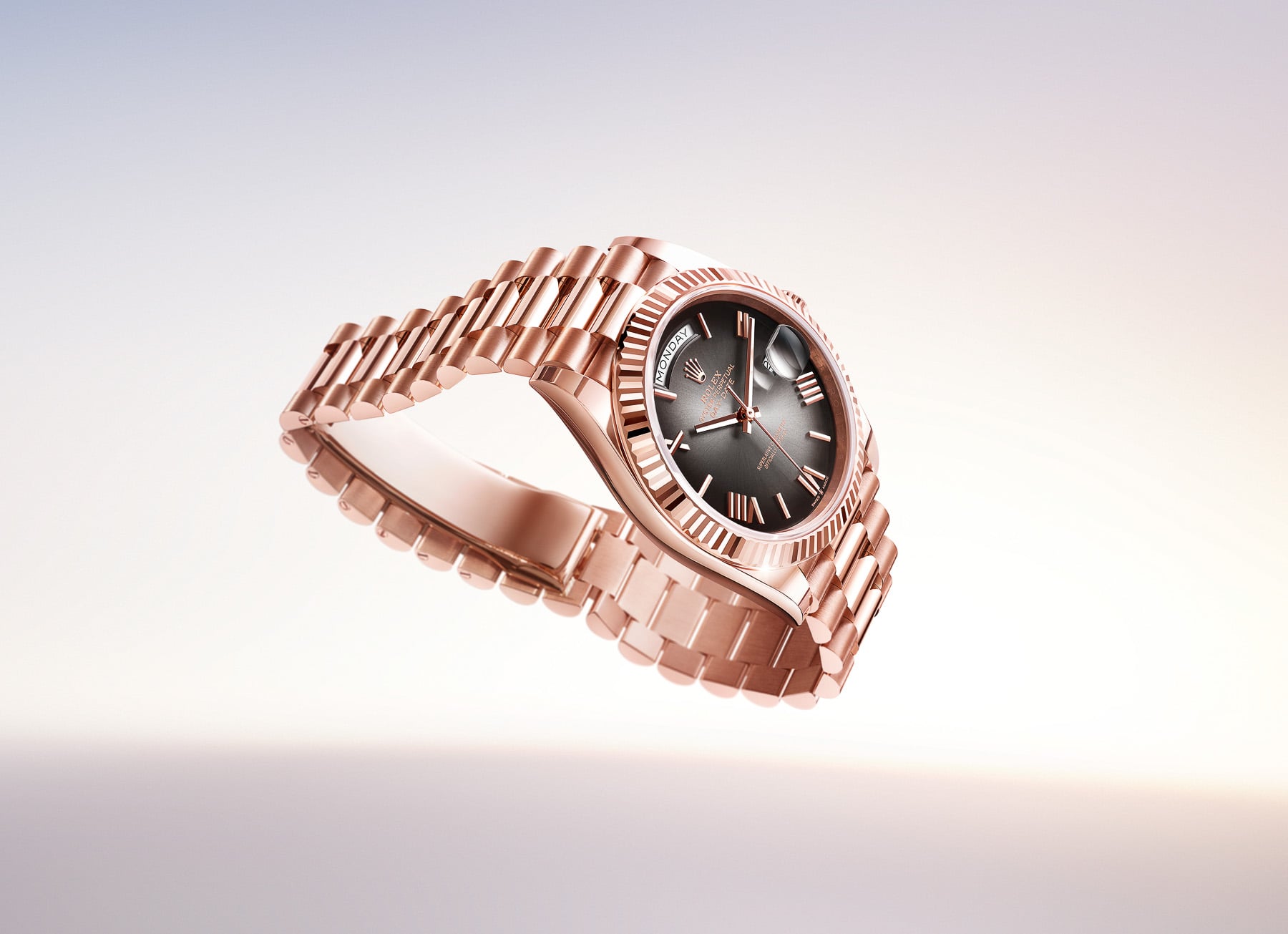
Modern Presidents are produced in the four Rolex precious-metal options: yellow gold, white gold, Everose (Rolex's proprietary platinum-stabilised rose gold; see proprietary gold alloys), and platinum. The Lady-Datejust model offers a President option in 28 mm and 31 mm sizes; the men's Day-Date 36 and 40 use the standard 20 mm-tapering-to-15 mm President. Diamond-set and baguette-set Presidents are available at the upper end of the catalogue, with full diamond pavé bracelets sometimes adding $80,000-$120,000 to the watch price.
The "Pearlmaster" bracelet, also Rolex-produced and superficially similar, is a different design: it uses five smaller rounded links and is sold on the Pearlmaster ref. 86285 series. Collectors distinguish the President (three rounded links, on Day-Date) from the Pearlmaster (five rounded links, on Pearlmaster) by link count and reference watch. Both share the rounded-link aesthetic and the Crownclasp, but the visual mass is different: the Pearlmaster is more obviously jewellery, the President is dressier-formal.
Aftermarket Presidents are essentially nonexistent at the high end. Rolex's patents on the link geometry are long expired, but the Crownclasp tooling and the Everose alloy are not reproducible without violating active trademarks. Some smaller Asian aftermarket makers produce visually similar bracelets in steel for fashion-watch use, but no serious watchmaker offers a President-style bracelet for non-Rolex watches; the form is too closely identified with the Day-Date and the Crownclasp would be a trademark violation.



Comments 2