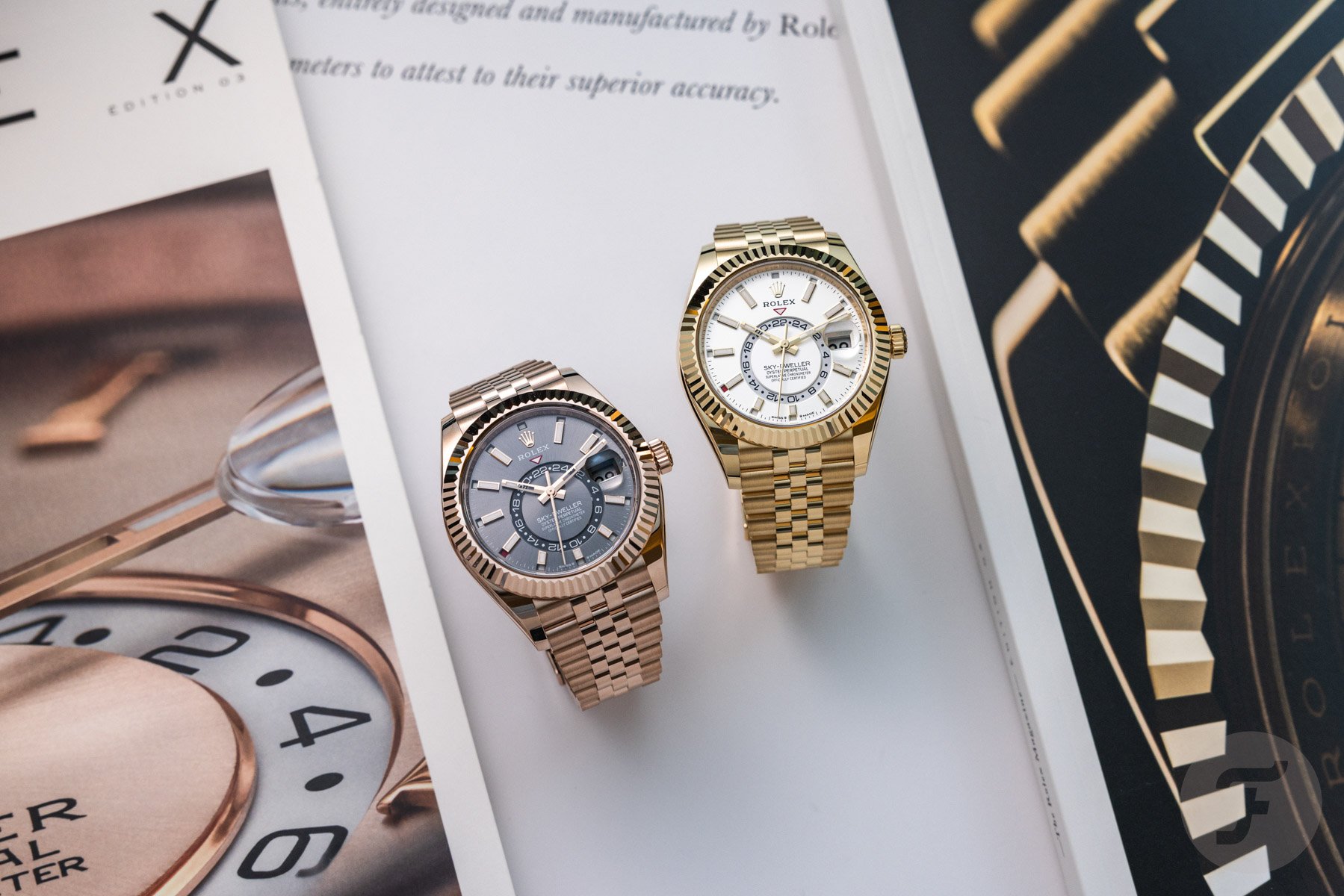
The Jubilee bracelet was introduced in 1945 alongside the launch of the Datejust ref. 4467 to commemorate Rolex's 40th anniversary. The architecture was novel: five-link construction with two flat outer links, two narrow side links, and one centre link, alternating brushed-and-polished surfaces. The result was dressier and more flexible than the contemporaneous Oyster bracelet (1947), with a softer drape on the wrist and a more decorative aesthetic.
Through the 20th century, the Jubilee was associated with the Datejust and women's Rolex sport-dress watches. The bracelet was rarely seen on tool watches; the cultural pairing was sport-dress wear rather than dive or pilot use. Modern variants are produced in steel, two-tone (steel + gold), and full gold; clasps include the Crownclasp (concealed Crown logo), the Oysterclasp, and the Easylink extension.
"The Oyster says you're at sea. The Jubilee says you're at dinner. Same brand, different evenings."- Rolex collector commentary on the Oyster vs Jubilee distinction
The 2018 launch of the GMT-Master II 'Pepsi' ref. 126710BLRO with Jubilee bracelet was a notable modern departure: the first time Rolex paired a tool sports watch with the Jubilee. The combination was controversial at launch (collectors expected Oyster) but became hugely popular; the Jubilee on a sport reference adds dress-watch flexibility without compromising the watch's tool credentials.
Modern Jubilee bracelets are solid milled links (from the 2000s), heavier and more robust than the hollow-link constructions through the 1990s. The Crownclasp keeps the bracelet visually clean (no visible folding clasp); the Easylink integrated into the clasp provides 5mm of micro-adjustment. The 2018-onward Jubilee on the GMT-Master II is the most-photographed Rolex bracelet of recent years; the canonical Datejust pairing remains in continuous production.




Comments 3