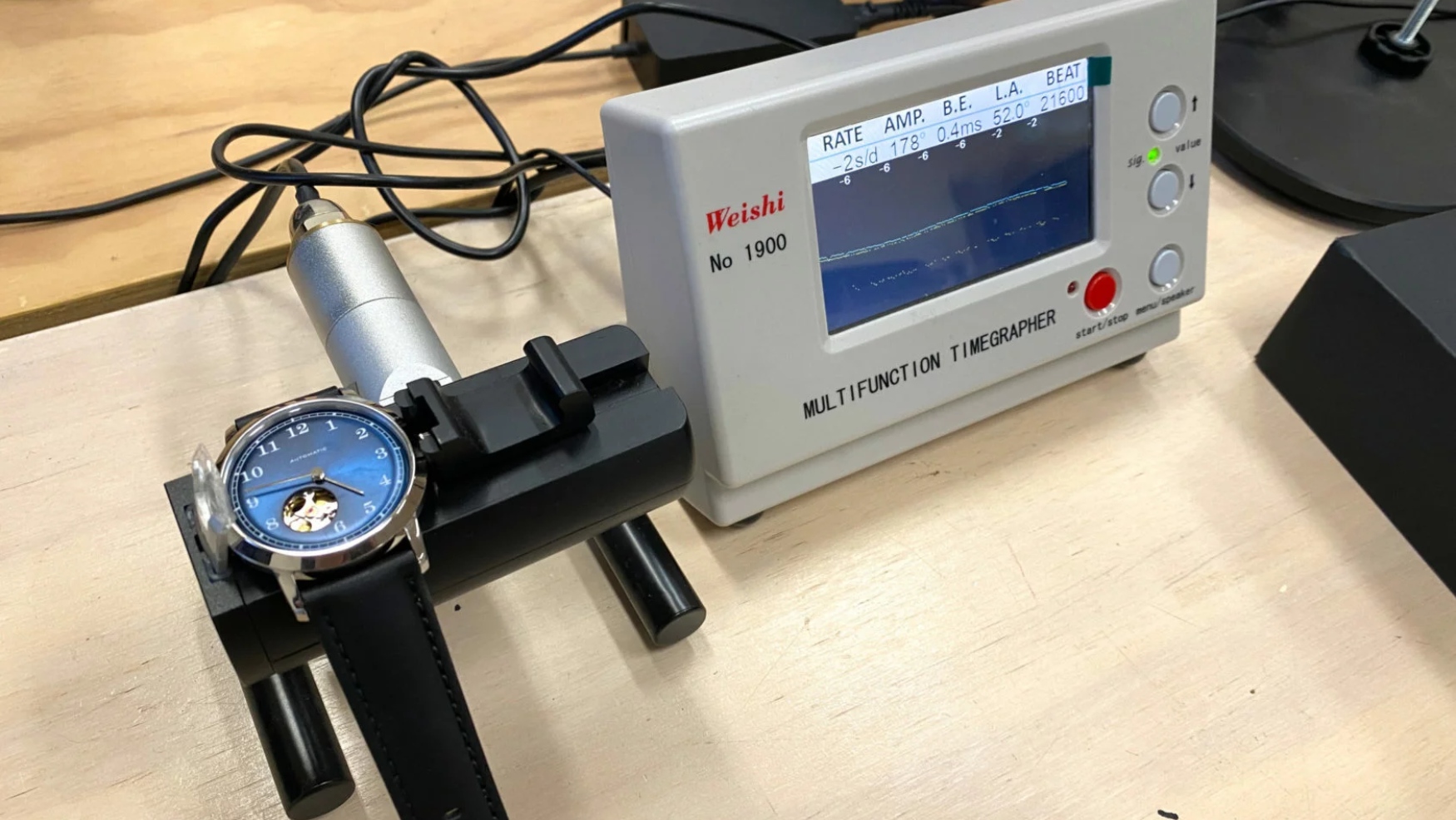
A timegrapher is the foundational diagnostic tool of the modern watchmaking bench. The instrument consists of a sensitive microphone mounted in a calibrated holder, electronics to amplify and analyse the acoustic signal of the escapement's ticks, and a display showing the three primary parameters in real time. Modern professional units add a graphical rate-trace display (a moving line plotting rate over time across multiple positions), automatic position-test cycling, and integration with shop-management software.
The three parameters the timegrapher measures: (1) Rate: seconds per day fast or slow. A reading of "+5 sec/day" means the watch will gain 5 seconds in 24 hours at the current state. (2) Amplitude: angular swing of the balance wheel in degrees; healthy modern movements show 270-310° dial-up at full wind. (3) Beat error: asymmetric tick timing in milliseconds; healthy movements show 0.0-0.4 ms.
"The watch tells you what it is doing now. The timegrapher tells you what it will be doing tomorrow."- Watchmaker on bench-side diagnostics
Position testing is the standard professional protocol. The watch is measured in five positions (dial-up, dial-down, crown-up, crown-down, crown-left) for COSC-style chronometer assessment, or six positions (adding crown-right) for full positional analysis. Rate variation between positions indicates poising errors in the balance wheel; the difference between best and worst position rate ("delta") is a key quality metric, with COSC requiring delta within specified bounds.
The professional market is dominated by Swiss makers Witschi (the Witschi Q1 / Watch Expert lineup, CHF 8,000-15,000+) and Greiner (Greiner Vibrograf, similar price range). These instruments include positional automation (motorised stage that rotates through positions), vibration isolation, and multi-watch testing. Brand service centres almost universally use Witschi or Greiner; their precision (±0.1 sec/day rate, ±1° amplitude, ±0.1 ms beat error) is the industry reference.
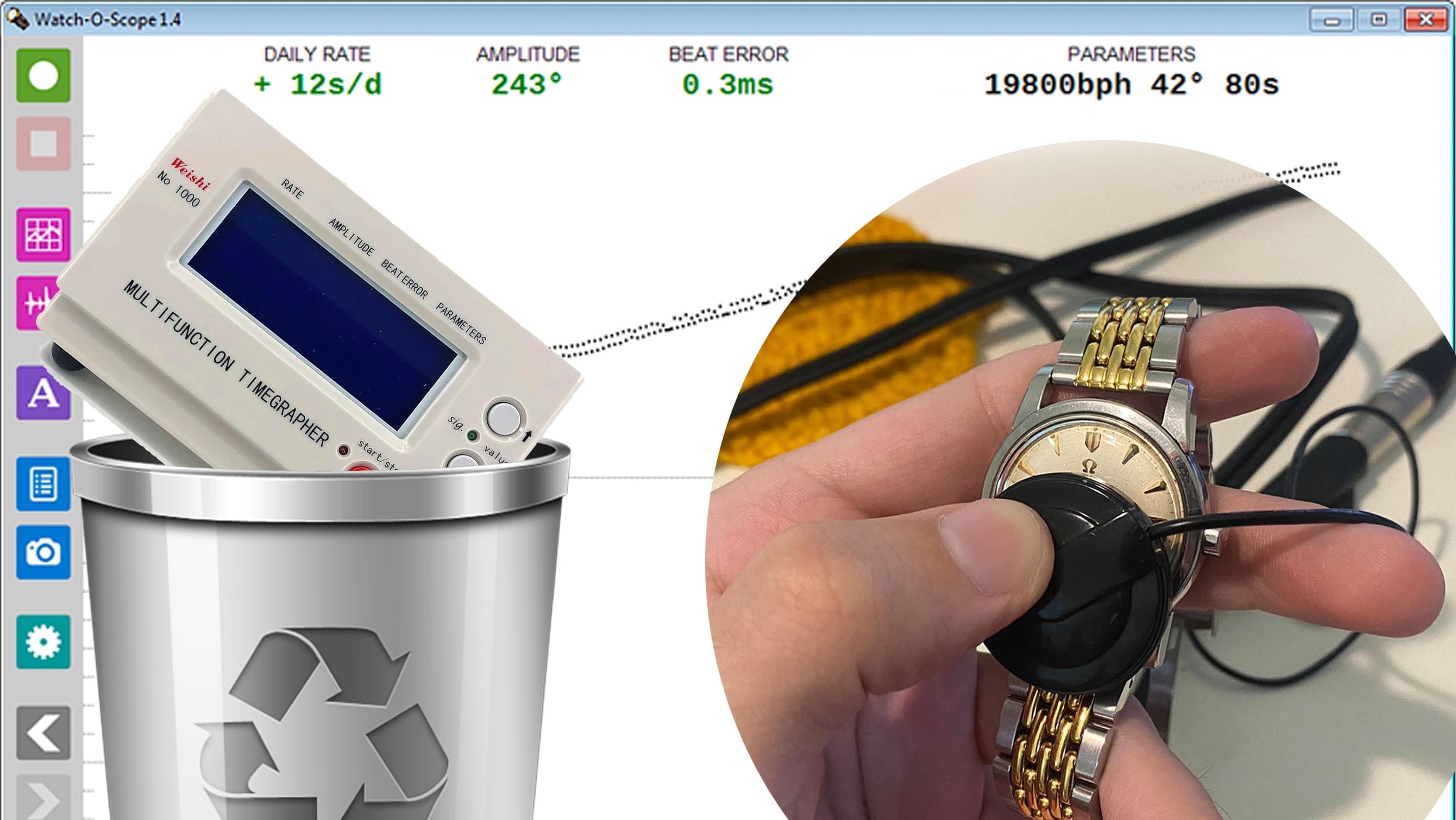
The hobbyist market exploded in the 2010s with Chinese-made Weishi 1900 / 1900A units at USD 200-400. These deliver roughly 80% of the professional function at 5% of the cost; precision is ±2 sec/day and ±5°, sufficient for most enthusiast use. Microbrands and small watchmakers routinely use Weishi units for assembly QC; the precision gap matters only at chronometer-grade regulation. Modern smartphone apps (Toolwatch, WatchTracker) achieve approximate rate measurement via phone microphone but cannot reliably measure amplitude or beat error.
For watch buyers and owners, the practical use: any independent watchmaker will run a free 30-second timegrapher reading on a watch you bring in; the printout shows current rate, amplitude, and beat error. Used to evaluate a vintage watch before purchase or to check whether a watch needs servicing, the timegrapher is the cheapest professional second opinion in watch ownership. A clean reading (0-5 sec/day rate, 270°+ amplitude, <0.4 ms beat error) signals a healthy movement.

Comments 1