Most "Holy Trinity" pieces online start with a sentence about heritage and end somewhere near the word prestige. Useful if you have never heard the term. Less useful if you are actually buying.
Here is what the label means, what it does not mean, and how to choose between the three when you are deciding which one to spend the money on. No marketing copy.
The shortlist, in one line each
Where the term comes from

"Holy Trinity" is a collector-driven label, not a marketing campaign. It started circulating in the 1970s among watch buyers who needed shorthand for the three Swiss makers that operated at a level no one else matched. The shorthand stuck because the three brands share traits that nobody else can credibly claim:
- Continuous operation since the 18th or 19th century. Patek since 1839. AP since 1875. Vacheron since 1755.
- Survived the Quartz Crisis without changing what they made. While most Swiss brands either went bankrupt, were absorbed, or pivoted to quartz, the three kept making mechanical movements at the same scale.
- Full in-house manufacturing of movements, cases, dials, and bracelets, including grand complications.
- Hand-finishing to a standard that other brands describe by reference to one of these three.
That last point is the one that gets undersold online. "Hand-finishing" is not a marketing word at this tier. Visible bridges in a Trinity-grade movement carry hand-applied anglage (a polished, sloped chamfer along every edge), often eight to twelve hours of work per movement. Plates carry perlage (overlapping circular grain). Screw heads are polished mirror-flat then heat-blued. The reason the Trinity exists, mechanically, is that nobody else does all of this at scale.
Why Rolex isn't on the list
The fast answer to "Why not Rolex" is that the Holy Trinity is defined by haute horlogerie: minute repeaters, perpetual calendars, tourbillons, hand-finished bridges visible through caseback sapphire. Rolex makes essentially none of these. The Rolex playbook is daily-wear precision and durability at production scale. It is excellent at that. It is not the same thing.
This is why "the Big Four" never really stuck as a phrase. Including Rolex broadens the category to the point where it no longer means anything specific. The Holy Trinity is narrow by design.
Patek Philippe, in practical terms
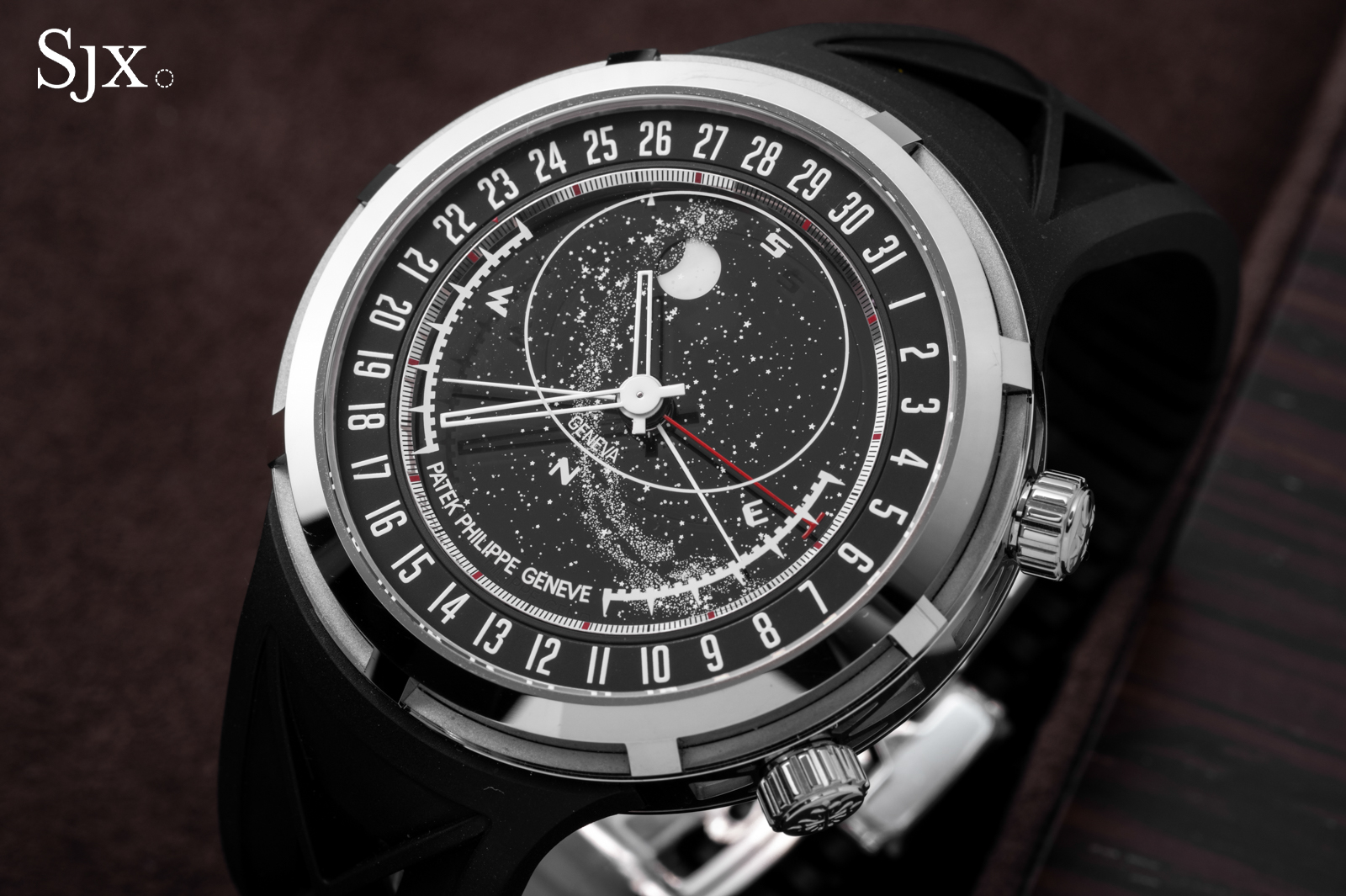
Patek is the brand that holds the highest auction records (the Henry Graves Supercomplication, the 1518 in steel) and the strongest secondary-market performance on modern references (the 5711 Nautilus is the obvious example). The slogan is famous: "You never actually own a Patek Philippe. You merely look after it for the next generation." Cheesy, but commercially true. Patek values inter-generationally because of brand control over distribution, low production volumes, and an aftermarket culture that treats well-kept Pateks as appreciating assets.
If you want the safest collector store of value in the Trinity, Patek is the answer. If you want a piece that turns heads in the watch-aware crowd without being loud, Patek again. The trade-off is access: the boutiques know who you are, and "walking in to buy a Nautilus" is not a thing.
Audemars Piguet, in practical terms
AP is essentially the Royal Oak now. That is not a criticism. Gérald Genta's 1972 design fundamentally reshaped the luxury watch market by making a steel sports watch sell for more than a gold dress watch. The Royal Oak is the watch that birthed the entire steel-sports-watch tier, and AP still defines it. The Royal Oak Offshore is the larger, louder evolution. The Royal Oak Concept is the wild-design halo.
If you want a Trinity watch that signals presence the moment you walk into a room, AP is the answer. Royal Oak buyers are not subtle. The trade-off is that the brand's identity is essentially one collection. Outside the Royal Oak family, AP has fewer wins; the Code 11.59 launch was a high-profile reception miss, and AP's other lines do not generate the same secondary-market heat.
Vacheron Constantin, in practical terms

Vacheron is the under-the-radar pick of the Trinity, and that is exactly why people who care about watches buy it. The Overseas is a direct competitor to the Royal Oak and Nautilus, often retails for less, and the finishing on the in-house Caliber 5100/5200 base is at least as good as the equivalent Patek or AP work. The Patrimony is the cleanest dress-watch line in the Trinity. The Historiques references are the brand's bench of low-volume revival pieces.
If your priority is craftsmanship per dollar and you do not need other watch enthusiasts to register the brand on sight, Vacheron is the buy. The trade-off is recognisability. Outside the watch crowd, "Vacheron" lands flat where "Patek" and "AP" each carry instant weight.
Choosing between them
If we had to compress the decision into one line per buyer:
- You want the strongest secondary-market value retention. Patek. End of conversation.
- You want to be noticed. AP. Specifically a Royal Oak in steel.
- You want the best craftsmanship per dollar from the Trinity. Vacheron Overseas, or a Vacheron Patrimony if you do not need the integrated bracelet.
- You are buying your first Trinity piece and "the buy" matters less than getting the watch. Vacheron, because of access. The waitlists at the boutique are not zero, but they are meaningfully shorter than Patek's or AP's.
About the "New Trinity"
Some collectors and dealers have argued in recent years for a "New Trinity" that swaps Audemars Piguet for either F.P. Journe or A. Lange & Söhne, on the grounds that the Royal Oak's commercial success has dragged AP down-market in craft terms. The argument has merit on the movement-finishing side: a Lange Datograph or a Journe Chronomètre Bleu beats most AP references for hand-finish on the bridges. But the Holy Trinity as a label is about more than current finishing quality. It is about continuous operation, scale, and the historic context of the term. Lange (re-founded 1990) and Journe (1999) are too recent to qualify on that definition.
Use the term as it is. If you want to argue craft-finishing rankings, that is a separate conversation, and it is a fun one.
The takeaway
The Holy Trinity exists because three brands made mechanical watches at the highest level without interruption while the rest of the Swiss industry was either collapsing or pivoting. The label is not marketing. It is shorthand for the only three brands that meet all the original criteria: founded before 1900, continuously operational, in-house manufacture, hand-finishing, and a deep grand-complication catalogue. Patek, AP, and Vacheron.
If you are picking your first, do not over-think it. Pick the brand whose story matches what you want from the watch. Pick the model you actually want to wear every day. The Holy Trinity is not a competition between the three. It is shorthand for "you are buying at the top now."
Comments
No comments yet, be the first to weigh in.