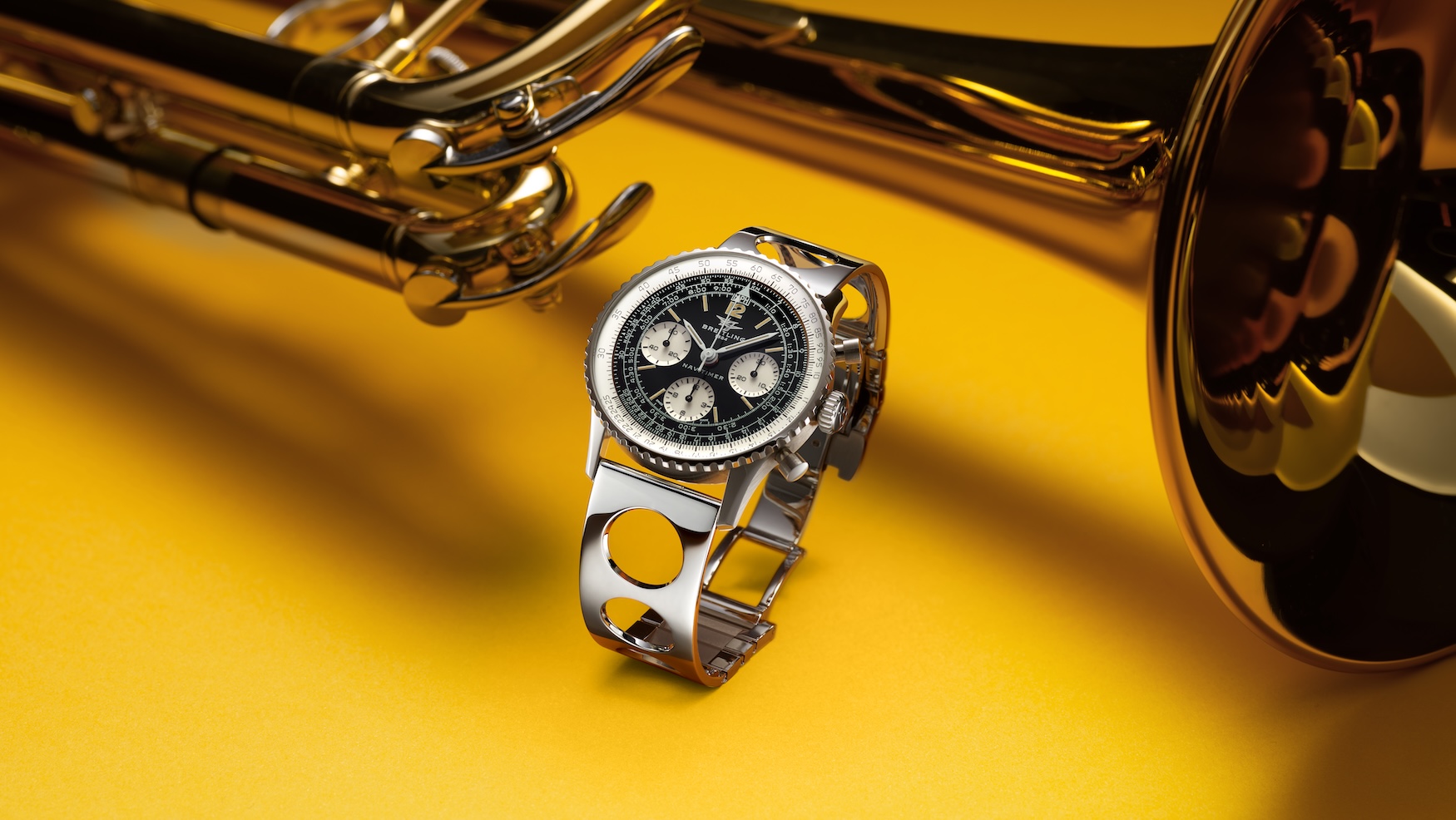
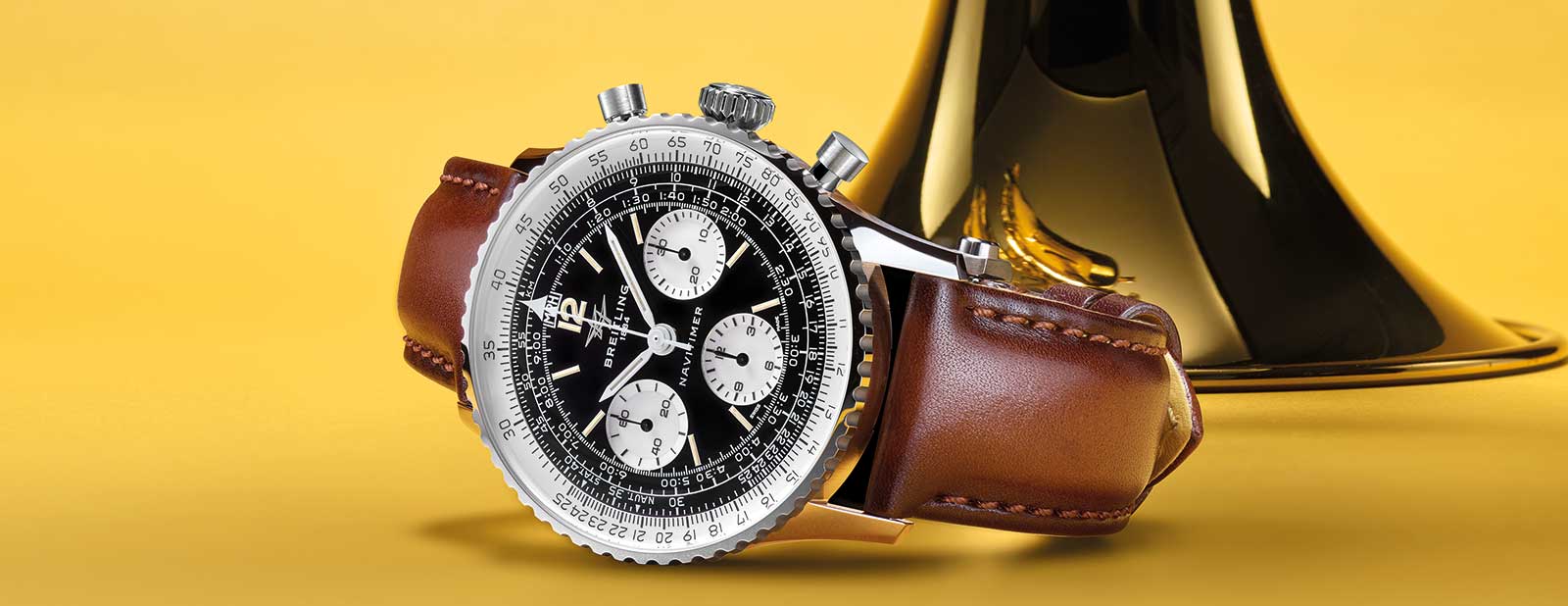
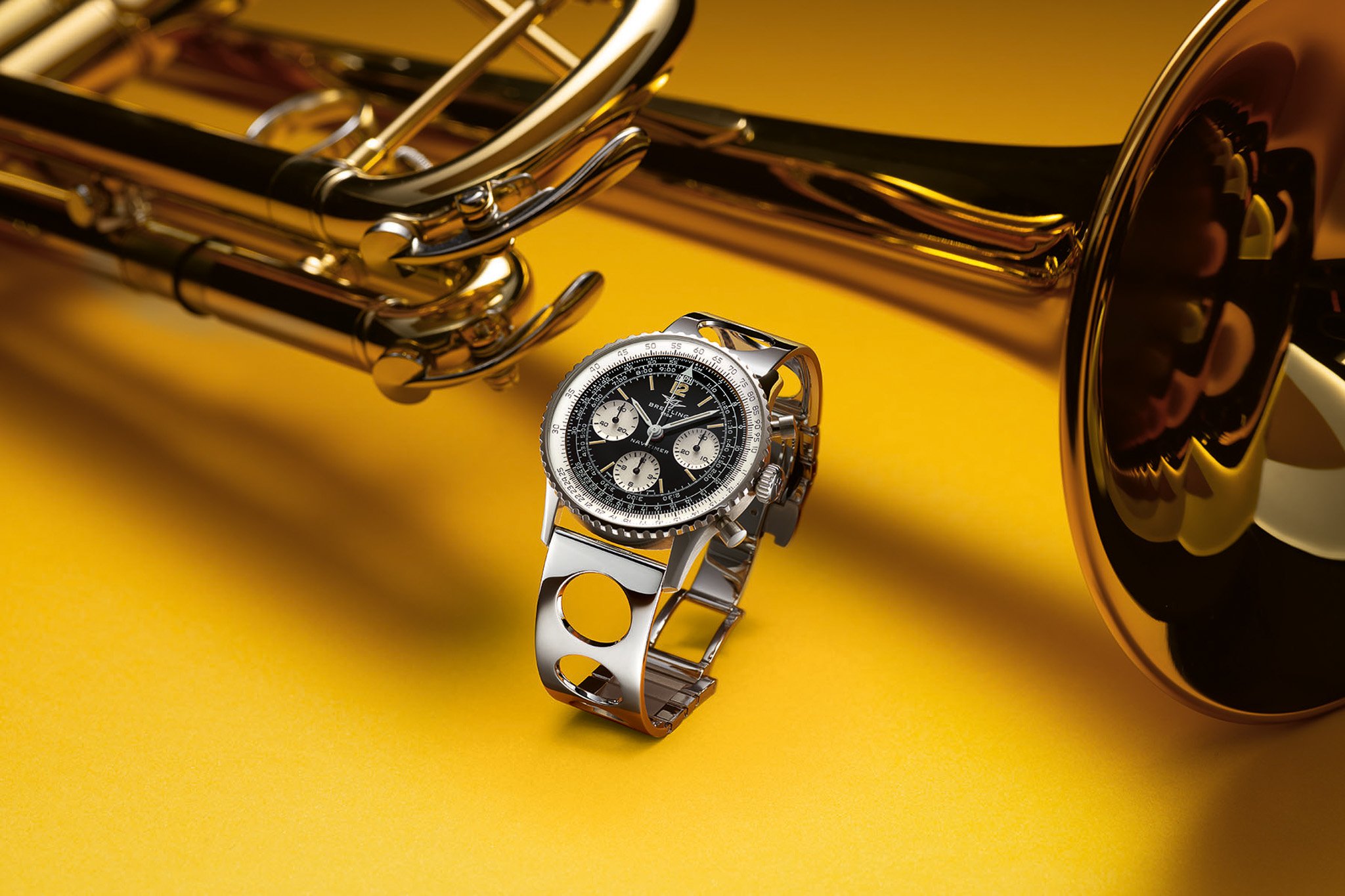
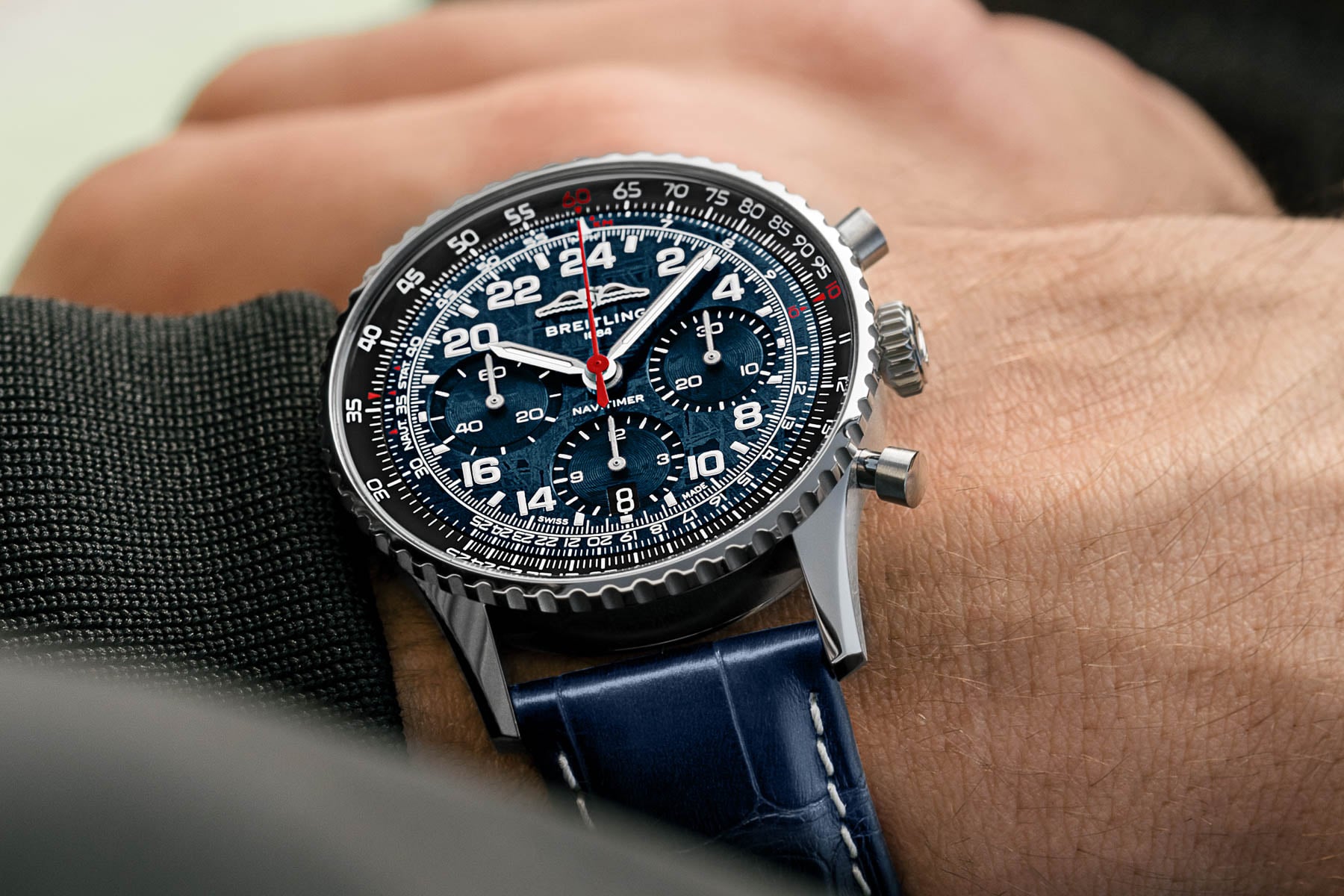
The Navitimer was designed in 1952 by Willy Breitling as a technical instrument for pilots rather than as a luxury object. Breitling had already been supplying wrist-mounted slide-rule chronographs (the Chronomat, launched in 1942) to pilots, mathematicians, and engineers, and the Navitimer - short for "navigation timer" - refined the concept specifically for aviation. The distinguishing feature is a rotating circular slide rule on the outer bezel that meshes with a fixed inner scale, enabling pilots to calculate ground speed, distance travelled, fuel consumption, nautical-to-statute conversions, and climb rates directly on the wrist, at a time when cockpits offered no electronic aids.
In 1954, the watch was adopted as the official chronograph of the Aircraft Owners and Pilots Association (AOPA), and Breitling added the AOPA "winged" logo to the dial. This partnership defined the Navitimer's commercial identity for the next two decades. The early references (Ref. 806, 1954) used the Valjoux 72 column-wheel chronograph movement, then the Venus 178 (Ref. 806 "AOPA"), and later the Valjoux 7740. Astronaut Scott Carpenter wore a custom 24-hour-dial Navitimer (the "Cosmonaute", 1962) during his Mercury-Atlas 7 orbital mission, making the Navitimer the first Swiss wristwatch worn in space - narrowly predating the Omega Speedmaster's NASA-flight-qualified era.
The quartz crisis hit Breitling hard; production nearly collapsed in 1979 before the Schneider family rescued the brand. The Navitimer returned in 1984 as the centrepiece of the modern Breitling identity and became one of the defining luxury sports-chronograph designs of the 1980s and 90s. Throughout that era, successive Navitimer references used Valjoux 7750-based movements, with progressively refined dials, cases, and dial-ring typography. The model that any modern collector thinks of as "the Navitimer" - high-contrast dial, three sub-registers, slide-rule bezel, beaded outer ring - was firmly established across this period.
In 2009, Breitling introduced its first fully in-house chronograph movement - the Calibre B01 - a column-wheel, vertical-clutch chronograph with a 70-hour power reserve. This replaced the Valjoux 7750 across the core Navitimer range and defines every current reference (B01 Chronograph 41, 43, 46; AB01 series). The 2022 70th-anniversary redesign under CEO Georges Kern brought the Navitimer back to tighter historical proportions (thinner case, smaller dial ring, restored 1960s typography) and is widely considered the most faithful modern execution. Current retail runs from approximately $9,000 (steel 41mm) to $27,000 (18k red gold with green dial).







Comments
No comments yet, be the first to weigh in.