Two Genta originals, four years apart
Gérald Genta sketched the Royal Oak overnight in late 1971 for an Audemars Piguet brief; the watch launched at Baselworld 1972 at four times the price of a steel sports watch of the era. Four years later Genta delivered a similar brief for Patek Philippe: the Nautilus, designed at the same Baselworld 1974 (legend has it on a napkin) and launched in 1976. Both watches use the integrated-bracelet luxury-sport-in-steel formula that Genta invented.
Both are now allocation-only at AD/boutique with secondary markets several multiples over retail. The buying decision in 2026 is rarely "which one can I buy at retail" (neither, easily) and more "which one fits the wrist and the wear-context."
Spec sheet
| Attribute | Audemars Piguet Royal Oak 15500ST | Patek Philippe Nautilus 5811G |
|---|---|---|
| Reference | 15500ST | 5811/1G-001 |
| Case diameter | 41mm × 10.4mm | 40mm × 8.2mm |
| Case material | Stainless steel | 18k white gold |
| Bezel | Octagonal, 8 hex screws | Rounded-octagon, no screws |
| Water resistance | 50m | 100m |
| Movement | Cal. 4302 in-house | Cal. 26-330 SC in-house |
| Reserve | 70 hours | 45 hours |
| Beat rate | 28,800 vph (4 Hz) | 28,800 vph (4 Hz) |
| Dial pattern | Tapisserie (waffle) | Embossed horizontal lines |
| Bracelet | Integrated steel | Integrated white gold |
| Retail price | ~€34,000 | ~€72,000 |
| Secondary | ~€42,000 | ~€135,000+ |
Genta's two designs
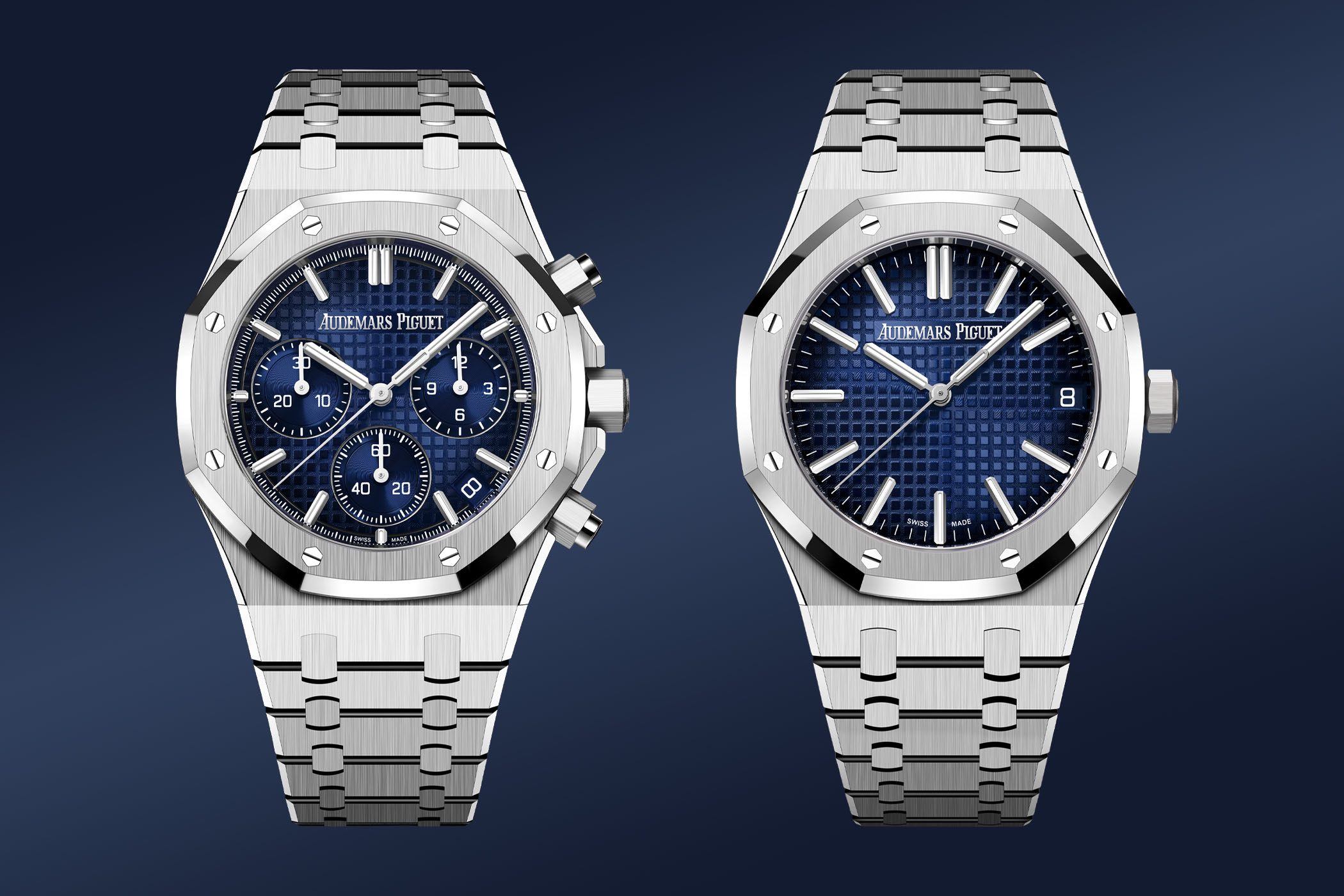
The Royal Oak is the harder-edged of the two: octagonal bezel with eight visible hex screws, sharp Tapisserie waffle dial, brushed-and-polished case finishing. The 1972 brief was "steel sports watch as luxury object"; the design language reads as deliberately industrial.
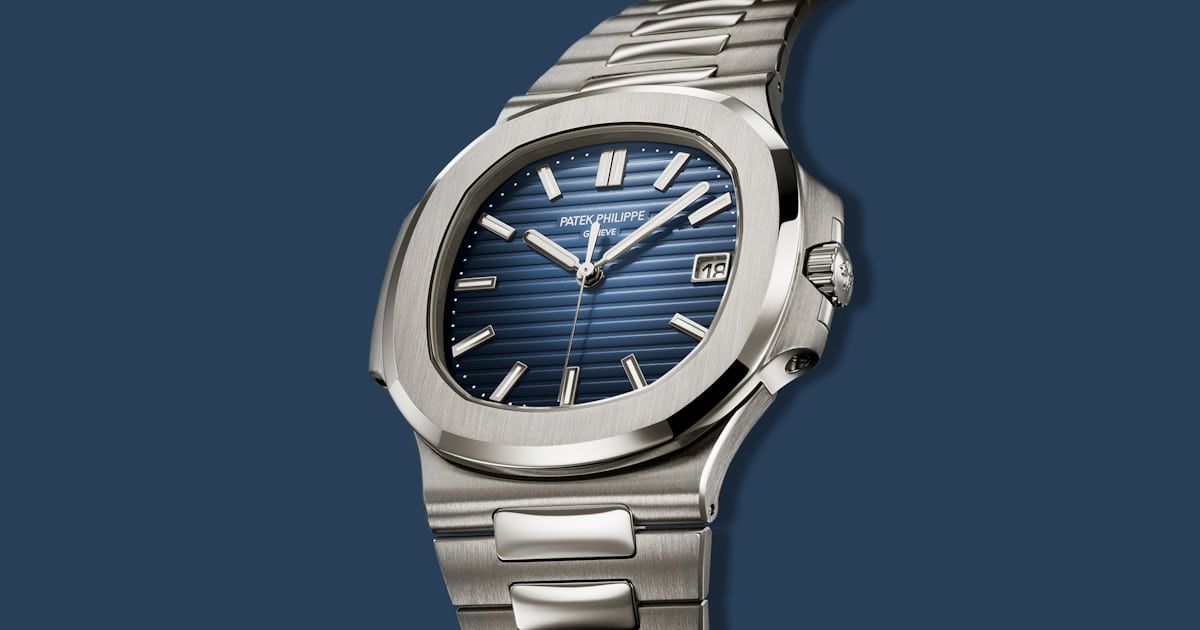
The Nautilus softens the brief: rounded-octagon case (Genta said he wanted a porthole), embossed horizontal-line dial, integrated bracelet flowing into the case without lugs. Where the Royal Oak is Bauhaus-industrial, the Nautilus is mid-century maritime.
Movement engineering
AP Cal. 4302 is in-house automatic, 70-hour reserve, central rotor visible through the sapphire caseback. The 4302 replaced the legendary Cal. 3120 in 2019.
Patek Cal. 26-330 SC is the modern Nautilus base: 45-hour reserve, central rotor in 21k gold, free-sprung balance with Spiromax silicon hairspring (Patek's proprietary). Patek's hand-finishing on the bridges and rotor is widely considered the gold standard at this tier; AP's finishing is excellent but a half-step down.
History and pricing
Both watches' secondary-market trajectories are now their main story. Patek discontinued the 5711 in 2021 at a peak; the steel-bracelet Nautilus traded at €220,000 in early 2022. The 2023-2024 correction brought it down to ~€135k. The 5811G (white gold successor) sells for ~€135k retail-equivalent. The Royal Oak 15500 has been steadier, holding at around 25-30% over retail. The Royal Oak Jumbo 15202 was discontinued at the end of 2022; secondary now ~€90k.
Pros and cons
Royal Oak 15500ST · Pros
- Available in steel (more attainable than Nautilus white gold)
- 70-hour reserve
- Octagonal bezel and Tapisserie dial are unmistakable
- Slightly more accessible secondary market
Royal Oak 15500ST · Cons
- 50m water resistance (lower than Nautilus)
- Allocation lottery at AP boutique
- Hand-finishing a half-step below Patek
Nautilus 5811G · Pros
- Patek's hand-finishing standard
- Spiromax silicon hairspring
- Smaller and thinner (40 × 8.2mm)
- 100m water resistance
Nautilus 5811G · Cons
- 5811G is white gold only (no steel since 5711 discontinued)
- 45-hour reserve (shorter than RO)
- Secondary market 2x retail
- Allocation requires Patek collection history
Verdict: which one?
If you can buy only one and budget supports either: Nautilus. The hand-finishing, the size, the brand permanence. But the price tag and white-gold weight are real considerations.
If you want the steel sports watch original at a (relative) lower price: Royal Oak 15500.
If you want a Genta-design integrated bracelet at a sane price tier: skip both and look at the best integrated-bracelet list: VC Overseas, Vacheron Patrimony, GP Laureato, or even the under-€3k Tudor Royal.
Wrist size note: 5811G at 40mm × 8.2mm is the friendlier size; the 41mm × 10.4mm Royal Oak reads bigger.
Common questions
Who designed the Royal Oak and the Nautilus?
Both were designed by Gerald Genta - the Audemars Piguet Royal Oak in 1971 (launched 1972) and the Patek Philippe Nautilus in 1976. They share the integrated-bracelet luxury-sport-in-steel formula Genta invented; the Royal Oak is the harder-edged, more industrial of the two, the Nautilus the softer, maritime-influenced one.
Why is the Nautilus so much more expensive than the Royal Oak?
Partly the metal - since the steel 5711 was discontinued in 2021, the current Nautilus 5811G is white gold only, so it starts at around €72,000 retail versus the steel Royal Oak 15500 roughly €34,000. The bigger driver is the secondary market: the Nautilus peaked around €220,000 in early 2022, corrected to roughly €135,000, while the Royal Oak 15500 sits steadier at around 25 to 30 percent over retail.
Can you actually buy either at retail?
Rarely. Both are allocation-only at the boutique with secondary markets well above retail, and a Patek Nautilus allocation in particular requires a history of buying from Patek. For a Genta-style integrated-bracelet watch at a saner price, the usual suggestions are the Vacheron Overseas, the Girard-Perregaux Laureato, or the much cheaper Tudor Royal.
Which wears better, the Royal Oak 15500 or the Nautilus 5811G?
The Nautilus is the smaller and thinner of the two at 40mm x 8.2mm versus the Royal Oak 41mm x 10.4mm, so on most wrists it sits more discreetly - though the 5811G white gold makes it heavier than a steel watch of the same size. The Royal Oak reads bigger and more industrial; it is also 50m water resistant against the Nautilus 100m.
Comments 3