Watch brandsWatch wikiWatch videosVariousWatch calendarSaved articles
PopularRolexOmegaPatek PhilippeAudemars PiguetTudorGrand SeikoCartierSeikoIWCTAG HeuerBreitlingJaeger-LeCoultreA. Lange & SohneZenith

Results for Chronograph

3,934 articles · 474 videos found · page 61 of 147

Related pages

Wiki · Guide
El Primero Zenith

Zenith's 1969 column-wheel automatic chronograph caliber at 36,000 vph, saved from quartz-era destruction by Charles Vermot in 1975 and supplied to the Rolex Daytona ref. 16520 (1988-2000).

Wiki · Guide
Panda / Reverse Panda Dial

Chronograph dial with high-contrast sub-counters. Vintage Daytona, Speedmaster CK 2998, Heuer Carrera; modern 116500LN, Tudor Chrono.

Wiki · Guide
Telemeter Scale

Chronograph scale converting flash-to-sound time into distance. WWI artillery-spotting origin; vintage Longines / Lemania / Heuer.

Wiki · Guide
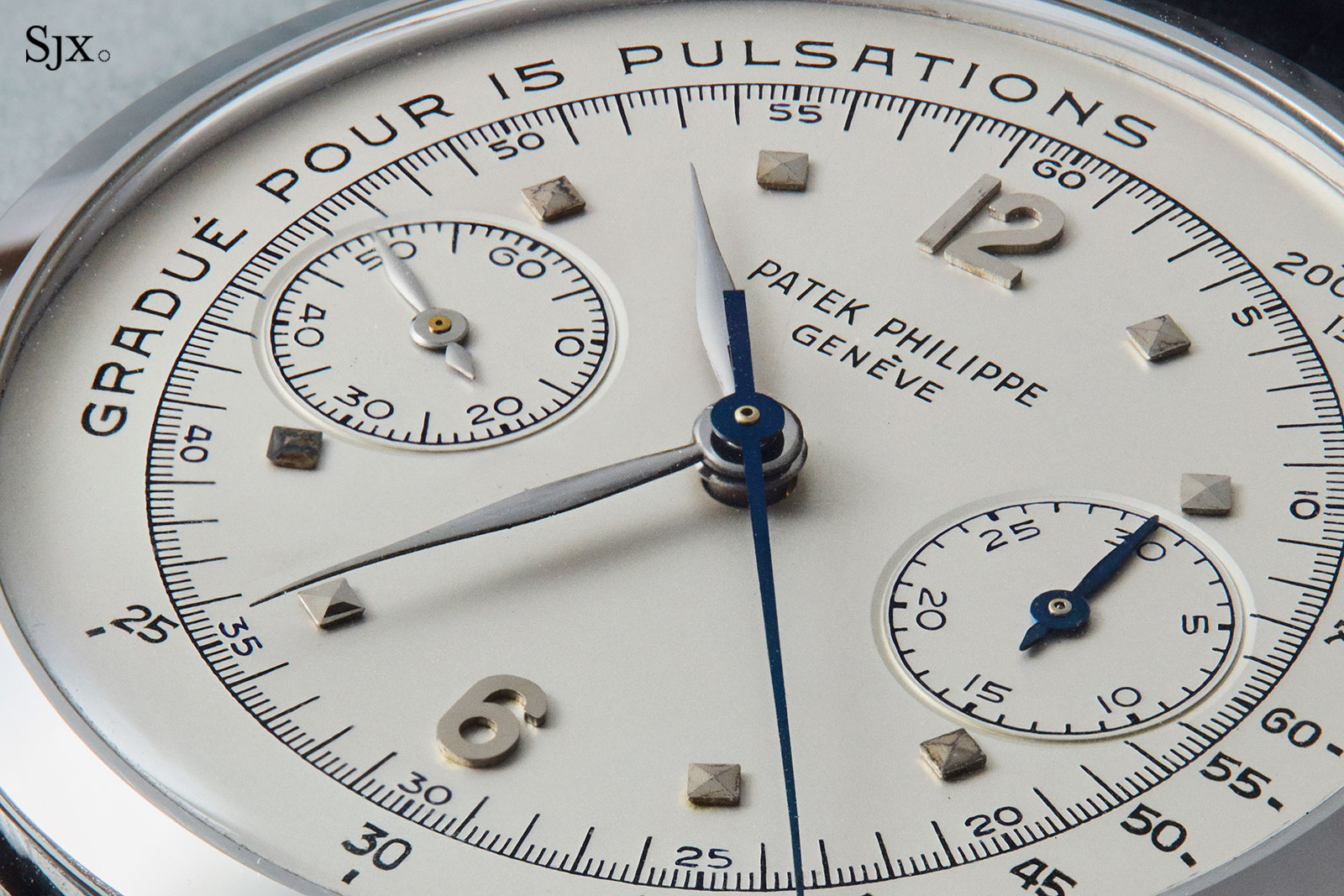
Pulsometer Scale

Chronograph scale reading heart rate in BPM after counting 15 or 30 pulse beats. The 1920s-60s doctor\'s watch standard.

Longines Introduces the Heritage Classic Chronograph “Tuxedo” SJX Watches
Longines Introduces Jun 23, 2020

Longines Introduces the Heritage Classic Chronograph “Tuxedo”

Longines is continuing its streak of affordable and handsome remakes of vintage watches, with the last big hit being the Heritage Classic “sector” dial, with the Heritage Classic Chronograph “Tuxedo”. Modelled on a 1940s chronograph powered by the cal. 13ZN, regarded by collectors as the brand’s best chronograph movement, the remake gets its nickname from the stylish black-and-white dial. Initial thoughts There’s almost nothing to criticise in the new chronograph. Aesthetically, it is spot on. The design is faithful to the original, smartly doing away with the much-derided extras of the date and “automatic” often found in remakes. It’s a moderate size, albeit a bit thick. The movement is modular, rather integrated. But it only costs US$3,000, which is excellent value for money. More generally speaking – and this is criticism – Longines has rolled out several well-executed remakes in recent years, notching hit after hit. Paradoxically the success has made the Heritage remakes a little less appealing, just because there are so many of them – and most of them are pretty good. When the original Legend Diver was introduced in 2007, it was special, because the only affordable, good-looking remake. That said, it doesn’t take away anything from the watch itself; the new chronograph really is a compelling buy. Two-tone and tachymetre The Heritage Classic Chronograph “Tuxedo” manages to capture most of the elements of the original. The dial is in silver...

TAG Heuer Introduces the Fragment Design Calibre Heuer 02 Chronograph SJX Watches
TAG Heuer Introduces Jun 18, 2020

TAG Heuer Introduces the Fragment Design Calibre Heuer 02 Chronograph

TAG Heuer’s first collaboration with streetwear guru Hiroshi Fujiwara of Fragment Design was the Fragment Design Carrera Heuer 02 of 2018. The vintage-inspired watch went down well and sold out quickly. Now the second collaboration has just been unveiled. Once again limited to 500 watches and powered by the same Heuer 02 movement, the TAG Heuer x Fragment Design Calibre Heuer 02 Automatic Chronograph is modelled on the Autavia models of the 1960s and 1970s, but again given a minimalist makeover by Mr Fujiwara, who happens to be a vintage watch aficionado himself. Initial thoughts As a watch collector, Mr Fujiwara no doubt understood the cushion-shaped Autavia case, sometimes known as the “C-case”, is an instantly recognisable Heuer that has presence, making it a good candidate for a collaboration. However, unlike earlier Fragment Design watch that looked almost like a real vintage watch, the latest edition looks far more contemporary, thanks to the high-contrast colours. The use of red is restrained, especially with the tiny hour markers, just enough to give the watch the right amount of auto-racing flair. While I am generally not a fan of a date window at six o’clock, it is nicely done here. The date disc is black to match with the dial, allowing the date display to blend into the dial. And the Fragment Design double lightning bolt logo at 12 o’clock serves as a visual counterweight to the date. The case has been upsized to 44 mm from the 42 mm of the o...

Vacheron Constantin Introduces the Grand Complication Split-Seconds Chronograph “Tempo” SJX Watches
Vacheron Constantin Introduces Apr 24, 2020

Vacheron Constantin Introduces the Grand Complication Split-Seconds Chronograph “Tempo”

Three years after the debut of Les Cabinotiers Celestia Astronomical Grand Complication boasting 23 complications, Vacheron Constantin has topped its own achievement at Watches & Wonders 2020 by launching Les Cabinotiers Grand Complication Split-Seconds Chronograph “Tempo”. Without going into the minefield of what counts as a complication; the new Grand Complication incorporates 24 complications, if each function counts as one – with everything displayed on a massive, two-faced case. A reversible giant In addition to showing the time, the Grand Complication includes a minute repeater, tourbillon, perpetual calendar, split-seconds chronograph as well as a number of astronomical indications including equation of time, sunrise and sunset times, plus a retrograde moon phase. The reverse face Unsurprisingly, the case is enormous – 50 mm wide and 21 mm high. But it is intriguingly designed – perfectly symmetrical in profile, the case allows the watch to be worn with either side facing up thanks to a quick-release strap. Swapping faces is a matter of unlatching the strap, flipping the watch over, and reinstalling the strap. Time, chronograph and perpetual calendar on the front; tourbillon, running Equation of Time, retrograde moon phase and times for sunrise and sunset on the back Mechanical layer cake Inside is the cal. 2756, which is derived from the cal. 2755, a movement first found in the Traditionnelle Calibre 2755 grand complication that has since been iterated ...

Vacheron Constantin Introduces the Traditionnelle Tourbillon Chronograph SJX Watches
Vacheron Constantin Introduces Apr 24, 2020

Vacheron Constantin Introduces the Traditionnelle Tourbillon Chronograph

Vacheron Constantin’s hand-wound chronographs are, for the most part, powered by either the Lemania-based cal. 1142 or the mono-pusher cal. 3300 that was developed in-house. Freshly unveiled at Watches & Wonders 2020, the Traditionnelle Tourbillon Chronograph belongs in the latter camp. Notably, the new tourbillon-chronograph is powered by the same movement that was last seen in 2015 inside the Harmony Tourbillon Chronograph made to mark the 260th anniversary of the brand. The in-house movement combines a mono-pusher chronograph with the brand’s signature Maltese-cross tourbillon and was absent from the line-up for several years, but now it returns in fine form. While the Harmony was a cushion shape, the Traditionnelle Tourbillon Chronograph is conventionally round in form. Entirely polished, the case is in pink gold and measures 42.5 mm across and 11.7 mm high, making it large but fairly slim. The silver dial with a tachymeter scale is characterised by a rather unusual, asymmetric layout, with the tourbillon at 12 o’clock, 45-minute chronograph counter just below, and a small power reserve indicator at six. The impressive cal. 3200 Inside is the cal. 3200, which is identical to movement inside the Harmony Tourbillon Chronograph, with one difference –  this lacks the gilded and engraved tourbillon bridge that was unique to the 260th anniversary watches. Instead the tourbillon here is secured on the back by a simpler brass bridge decorated with Cotes de Geneve...

Montblanc Introduces the 1858 Split Second Chronograph Enamel Dial SJX Watches
Montblanc Introduces Apr 16, 2020

Montblanc Introduces the 1858 Split Second Chronograph Enamel Dial

Just last year Montblanc unveiled the 1858 Split Second Chronograph, a Minerva-powered watch that was warmly received for being well-finished and complex, yet reasonably-priced. A retro-inspired, rattrapante mono-pusher chronograph, the watch cost US$30,000 – a solid deal as such things go. A few months after, Montblanc debuted the one-off Only Watch edition with titanium case and blue-agate dial that sold for a whopping 100,000 Swiss francs, with proceeds going to charity. The brand has now stepped things up a notch with the 1858 Split Second Chronograph Limited Edition 100 that channels the spirit of the Only Watch edition, featuring the same titanium case and paired with a fired enamel dial in graduated blue. Despite the similar styling, the new watch costs a lot less than the record-setting Only Watch Edition – but isn’t quite as good value as last year’s model. Smoky blue And that’s because while the bronze model had an ordinary dial of brass, this has been upgraded with a grand feu enamel dial, leading to a jump in the retail price of about US$7,000, which is about the typical premium for such a dial. The enamel dial starts off as a solid-gold disc, which is painted with a mixture of enamel powder, water and oil. It is then fired in an oven at over 800℃, melting the enamel powder and fusing it to the gold base. The process of adding enamel powder and firing is repeated multiple times so as to achieve the desired depth of colour. But unusually, the di...

Glashütte Original Introduces the Sixties and Sixties Chronograph “Glacier Blue” SJX Watches
Glashütte Original Introduces Apr 7, 2020

Glashütte Original Introduces the Sixties and Sixties Chronograph “Glacier Blue”

A yearly tradition starting two years ago, the Sixties annual edition is a limited-production run of Glashütte Original’s well-liked, retro Sixties. In contrast to the sedate, Teutonic colours of the regular models, the Sixties annual editions are characterised by dials in bold colours and elaborate patterns, all produced the traditional way at its sister company located just several hours away. The annual edition began in 2015 as an experimental collection of watches with dials in over-the-top colours, before becoming an annual edition, first with a green dial patterned after water droplets, followed by an orange version of the same motif last year. Now Glashütte Original has gone in the opposite direction with the Sixties and Sixties Chronograph featuring pale-blue, dégradé dials finished with a simple, radial brushing. Decidedly more restrained than the earlier editions, the new “glacier blue” dials are still nuanced and striking. Subtle blue As with all of the dials found on the Sixties annual editions, the new “glacier blue” dials are produced by the what was once the Th. Muller dial factory in Pforzheim, historically the heart of the German jewellery and clockmaking industry, and now owned by Glashütte Original’s parent company, Swatch Group. The blue dials are finished in a dégradé, or graduated, colour that darkens towards the edges – an effect that requires multiple steps to achieve. It starts with a dial blank made of German silver that is...

Audemars Piguet Introduces the [Re]master01 Chronograph SJX Watches
Audemars Piguet Introduces Mar 25, 2020

Audemars Piguet Introduces the [Re]master01 Chronograph

In 2015, an Audemars Piguet ref. 1533 sold for 305,000 Swiss francs, setting the record for a vintage AP chronograph at auction – which was then topped two years ago by another example of the same reference that sold for 384,500 Swiss francs. An extra-large wristwatch with an unusual three-counter chronograph, instead of the two registers common at the time, the ref. 1533 was produced in the 1940s. Only nine were made, and three of the nine had two-tone, steel-and-gold cases, making them the rarest of variants. Unsurprisingly, both of the record-setting ref. 1533s were two-tone. And now the two-tone ref. 1533 has now been “remastered” as the modern-sounding but appealingly vintage [Re]master01 Selfwinding Chronograph 40 mm, a limited edition of 500 watches to coincide with the new, spiral-shaped Audemars Piguet museum that’s scheduled to open around middle of the year. Vintage details Looking very much like the ref. 1533, the [Re]master01 recreates all of the key elements of the original. Characterised by large, teardrop lugs, the case is steel with its bezel, crown, and pushers in 18k pink gold. It’s 40 mm to accommodate the large, automatic cal. 4409 inside, but because the original was already 36.5 mm – enormous in the 1940s – the increased diameter still maintains the retro style. To match the gold accents, the dial has a gilt finish, which was unique amongst the vintage original – just one of the three two-tone ref. 1533s had a yellow gold-tone dia...

New Tutima Grand Flieger Airport And Chronograph Models With Colored Ceramic Bezels And Cool Textile Straps Quill & Pad
Tutima Mar 14, 2020

New Tutima Grand Flieger Airport And Chronograph Models With Colored Ceramic Bezels And Cool Textile Straps

Tutima Glashütte has launched two pretty colorful variations of the Grand Flieger Airport, one of the brand’s eight cornerstone collections. With their generous portions of pure pilot DNA, gradient dials in expressive green and blue hues and ceramic bezels, these day-date and chronograph watches are perfect for this spring's outdoor activities.

IWC Introduces the Portugieser Monopusher Chronograph “Laureus Sport for Good” SJX Watches
IWC Introduces Feb 18, 2020

IWC Introduces the Portugieser Monopusher Chronograph “Laureus Sport for Good”

An annual edition now in its 14th year, the “Laureus Sport for Good” helps support the foundation of the same name, which promotes sport amongst disadvantaged and disabled children around the world. In a departure from the norm of using a current model as the base, the 2020 edition is a brand-new reference that’s not yet in the catalogue (though it probably will be by Watches & Wonders 2020), the Portugieser Monopusher Chronograph “Laureus Sport for Good”. The Portugieser Monopusher Chronograph is an unusual watch: a manual-wind, single-button chronograph with a long power reserve of 192 hours, or eight days. It’s powered by the cal. 59360, which has a notably thin chronograph mechanism built over the cal. 59000 eight-day movement. The movement, however, not actually new. It was last used in 2015 inside the Portofino monopusher chronograph, but subsequently absent until now. (Reputedly the movement had kinks that required fixing, particularly in terms of timekeeping while running the chronograph.) The cal. 59360 with its thin chronograph mechanism; note the wide and flat column wheel The movement is wide and relatively flat, resulting in a large watch that’s 46 mm wide and just shy of 14 mm high. Given the traditional Portugieser design of a wide dial and narrow bezel, the size of the watch is particularly pronounced. As is traditional with the Laureus edition, the dial is a deep, metallic blue with ample space for the two chronograph registers as well as the...

Seiko Introduces the Presage Prestige Crown-Chronograph Remake SJX Watches
Seiko Introduces Feb 17, 2020

Seiko Introduces the Presage Prestige Crown-Chronograph Remake

Having unveiled the vintage-inspired Presage Automatic Chronograph ref. SRQ031 in October 2019, Seiko has returned to the same historical wristwatch with the Presage Prestige 2020. Comprising of three variants – SPB127J1, SPB131J1, and SPB129J1 – the new Presage is once again modelled on the “Crown” chronograph ref. 5719A-45899 that was unveiled in 1964 to mark that year’s Tokyo Olympics. The vintage original was a mono-pusher chronograph with basic functionality, featuring a central, elapsed seconds hand and black plastic bidirectional bezel for recording times of over a minute. Last year’s Presage chronograph was a step up from the original with three counters, but this year’s Presage Prestige does away with the chronograph altogether. But since the original had a plain dial without registers, the new Presage Prestige manages to look pretty much the same. The original “Crown” chronograph from 1964 All three versions of the Presage Prestige differ only in dial colour, and are otherwise identical in terms of dimensions, design and movement. Because of the styling of the “Crown” Chronograph, the Presage Prestige manages to be fairly faithful to the original. Nearly all of the elements of the dial, from the chapter ring with the applied hour markers and oblong “lume” plots to the dauphine hands, are a close-enough replica of the original. Granted it has been modernised with the usual tweaks found in remakes, including a slightly larger case and ...

What Sealed The Deal – James’s Baume & Mercier Capeland Chronograph Time+Tide
Baume & Mercier Feb 16, 2020

What Sealed The Deal – James’s Baume & Mercier Capeland Chronograph

Well, this is a bit different to a normal What Sealed The Deal … seeing as this Baume & Mercier Capeland Chronograph is actually my watch. I purchased it late last year after a particularly dogged haggling match that started with a seemingly innocuous Gumtree.com ad. Anyway, I’ll spare you the deets of the torrid exchange … ContinuedThe post What Sealed The Deal – James’s Baume & Mercier Capeland Chronograph appeared first on Time+Tide Watches.

Sinn Introduces the 158 Chronograph “Bund Remake” SJX Watches
TAG Heuer Because Feb 14, 2020

Sinn Introduces the 158 Chronograph “Bund Remake”

The new Sinn 158 is unusual in being a remake of a vintage watch originally produced by another company, but due to a quirk of history, simultaneously a Sinn. In the 1960s and 1970s Heuer supplied the German armed forces, or Bundeswehr, with the 1550 SG flyback chronograph. Though typically military in style, the Heuer 1550 SG was fairly distinctive, with a black-coated rotating bezel and oversized sub-dials. A favourite remake In the 1980s, Sinn was contracted by the Bundeswehr to refurbish the 1550 SG watches, resulting in some having a Sinn-branded dial. At the same time, decommissioned or surplus watches were also acquired by Sinn, which then sold them to civilians. Having become something of a cult favourite due to its design, size, and affordability, the Heuer 1550 SG has been the subject of several past remakes by Sinn. Named the Sinn 155, the earliest remake was for the Japanese market in 2007, and later editions included a 155 for German department store Manufactum. A Heuer 1550 SG “Bund” from the 1970s. Photo – TAG Heuer Because of its hands, the 158 is the most modern-looking of the remakes, but still retains all of the key elements of the original, most notably the four screws to secure the inner case to the outer case, as well as the flat step where the lugs meet the bezel. Like the original, the 158 has a bead-blasted steel case with a bidirectional, black-coated aluminium bezel. The case is 43 mm like the 1550 SG, but slightly thicker at 15.15 mm high ...