What it is
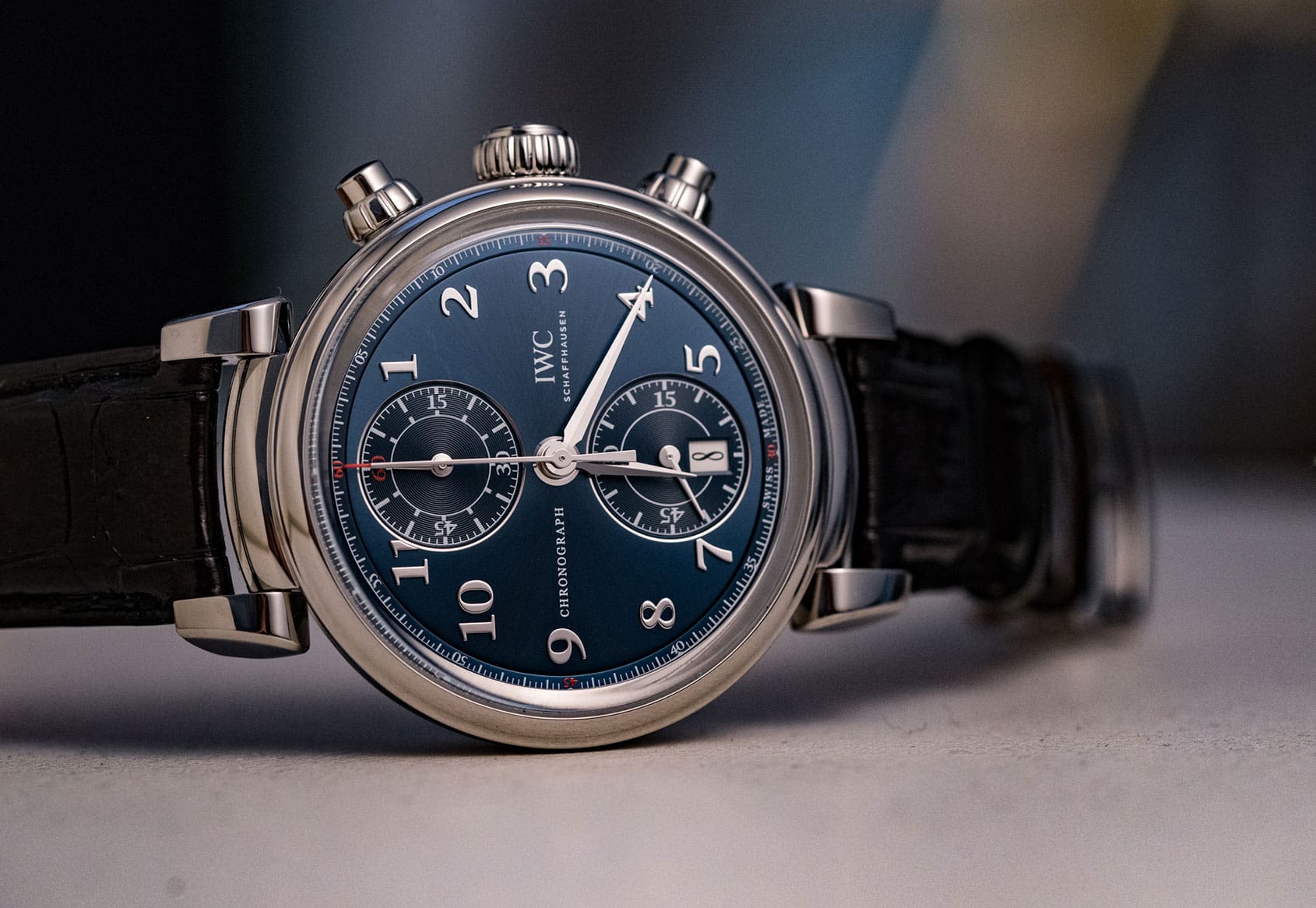
The 89000-series is IWC's in-house chronograph family, launched in 2007 with the Da Vinci Chronograph. It was a clean-sheet design from the IWC manufacture in Schaffhausen — not a Valjoux 7750 modification (the older IWC chronograph base, branded internally as Cal. 79xxx) — and represented IWC's strategic move to fully in-house chronograph production. The 89000 family's signature feature is the central minute and seconds chronograph display: instead of the conventional sub-dial layout, the chronograph minutes and seconds run on the centre of the dial like a regular time-only watch, with a single small sub-dial showing the running seconds.
Why the central display
In a conventional chronograph, the elapsed minutes show on a sub-dial (typically at 12 or 3); reading "elapsed minutes" requires the wearer to glance at the sub-dial and interpret the small hand. In the 89000's central layout, the elapsed-minutes hand sits at the centre of the dial (with an instant-jumping mechanism so it advances cleanly each minute), and the elapsed-seconds hand also sits at the centre. The wearer reads elapsed time the same way they read regular time: a glance at the central hands. The trade-off is that the running seconds (the watch's normal seconds, not the chronograph's) move to a small sub-dial. For users who actually use the chronograph function, the central layout is a meaningful UX improvement; for collectors who like the traditional 3-6-9 sub-dial chronograph aesthetic, it's a divisive design choice.
The 89000 family
Variants. Cal. 89360: original 2007 launch caliber, in the Da Vinci Chronograph. Cal. 89361: refined variant in the modern Portugieser Chronograph Classic. Cal. 89800: with perpetual calendar (Da Vinci Perpetual Calendar Chronograph). Cal. 89900: with chronograph + tourbillon. Cal. 89630: with annual calendar. All share the central-display chronograph architecture, the column-wheel switching, the flyback function, and the 68-hour reserve. Sister to the 89000 in IWC's in-house chronograph strategy is the newer Cal. 69000 family (since 2017), which uses a more conventional 3-6-9 sub-dial layout for the modern Portugieser Chronograph Classic, Pilot Chronograph 41, and Aquatimer Chronograph references.
Where it appears
IWC Da Vinci Chronograph: the launch reference (since 2007, in the round-case Da Vinci Chronograph 42 mm). Portugieser Chronograph Classic: 89361. Big Pilot's Watch Annual Calendar: 89000 with annual calendar module. Da Vinci Perpetual Calendar Chronograph: 89800. Ingenieur Chronograph 7-Day (older): 89000-derivative. By 2026 IWC has split the in-house chronograph strategy: the 89000 family remains in the high-end Da Vinci and Portugieser Perpetual references where the central display fits the design language; the newer 69000 family handles the more conventional 3-6-9 chronograph aesthetic in the Portugieser Classic and Pilot Chronograph 41.
Pricing context
A modern Portugieser Chronograph Classic with Cal. 89361 retails around USD 14,000; the Da Vinci Perpetual Calendar Chronograph (Cal. 89800) is USD 35,000+; the Da Vinci Chronograph Tourbillon is USD 100,000+. For comparison: an Breitling Chronomat B01 is USD 8,500; a TAG Heuer Carrera Heuer 02 is USD 6,000+; a Rolex Daytona is USD 16,000 retail. The 89000 is pitched as an upper-tier in-house chronograph, with the central-display feature and IWC's manufacture pedigree as the differentiators.
Service notes
Service for an 89000-equipped IWC runs USD 1,500-2,500 at IWC service (Schaffhausen-trained network), with a 2-year warranty. Recommended interval: 5-7 years (chronographs benefit from regular lubrication; the central-display jumping mechanism specifically requires periodic adjustment). Independent service is uncommon: parts are restricted to authorised channels and the central-minute jumping mechanism requires specific tooling. IWC service operates from Schaffhausen with regional centres at major boutiques; turnaround is typically 6-10 weeks.


Comments
No comments yet, be the first to weigh in.