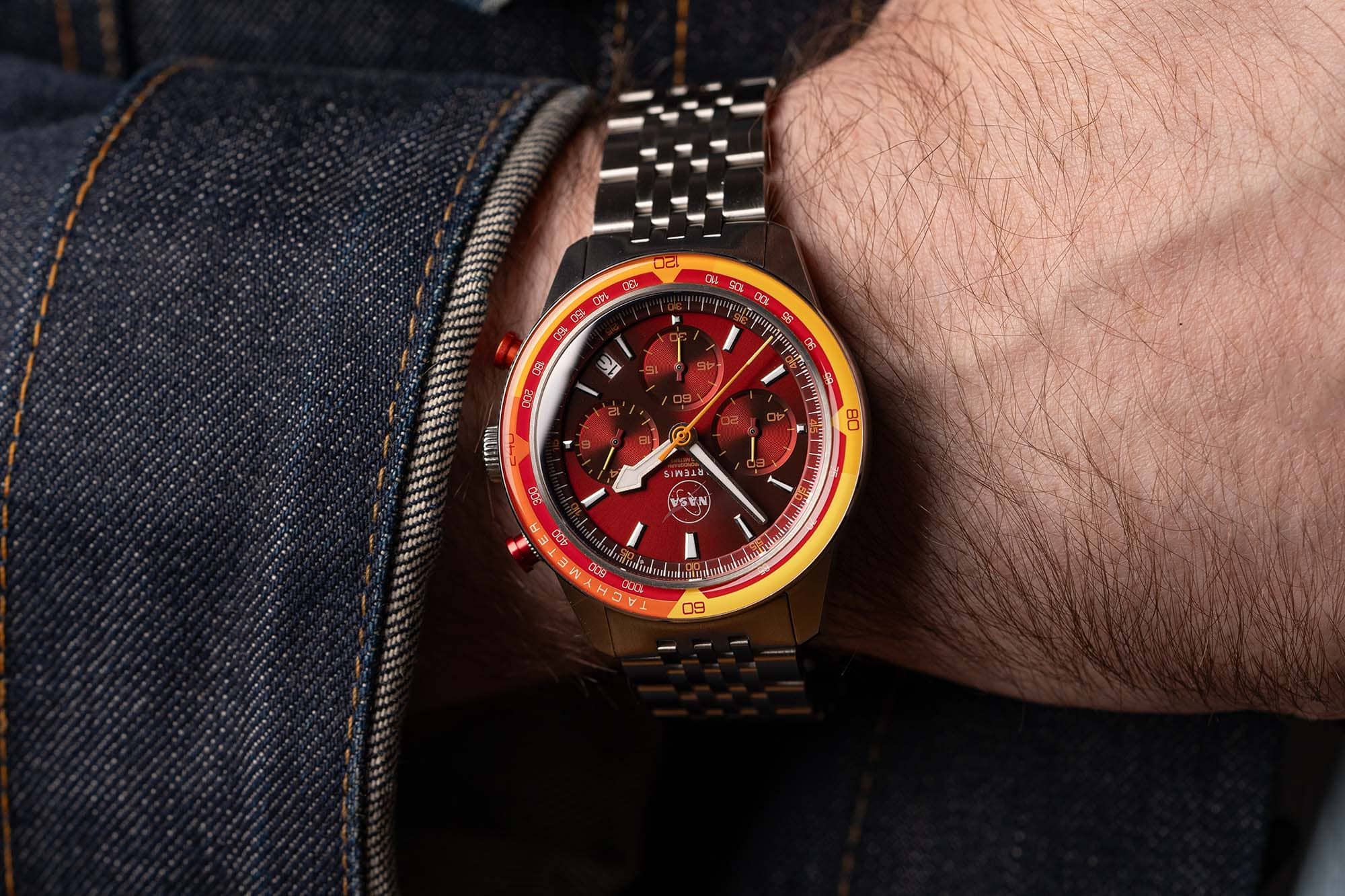
Apollo 13 launched from Kennedy Space Center on 11 April 1970 at 13:13 CST, the third planned manned lunar landing. The crew was Commander Jim Lovell, Command Module Pilot Jack Swigert (a last-minute replacement for Ken Mattingly, who had been exposed to German measles), and Lunar Module Pilot Fred Haise. Standard procedure required all three astronauts to wear NASA-issue Omega Speedmaster Professional chronographs (then reference 105.012, the same model worn by Buzz Aldrin on Apollo 11 the previous year). The Speedmaster was the only mechanical chronograph that had passed NASA's 1965 environmental qualification; the Speedmaster on each astronaut's wrist was an operational backup-timer for any task where the on-board computer or the Mission Elapsed Time clock was unavailable.
On 14 April 1970 at approximately 03:08 GMT (about 56 hours into the mission, en route to the Moon), Service Module oxygen tank #2 exploded following a stir-procedure command. The explosion crippled the SM, severed power from two of the three fuel cells, and vented the remaining oxygen supply; the Command Module ("Odyssey") was rendered effectively dead in space. Lovell's famous transmission, "Houston, we've had a problem", marked the moment the mission was abandoned as a lunar landing and became a survival mission. Within minutes the crew powered down Odyssey to conserve its remaining battery for re-entry, and moved into the Lunar Module ("Aquarius") as a lifeboat.
"Houston, we've had a problem."- Jack Swigert (and later Jim Lovell), Apollo 13, 14 April 1970
The mission profile required a free-return trajectory: a path that would slingshot the spacecraft around the Moon and back to Earth without further engine firings. Apollo 13 was not on a free-return trajectory at the moment of the explosion; it was on a hybrid trajectory required by the lunar landing site. The crew needed two corrective burns: (1) a course-correction burn within 5 hours of the explosion using the LM's descent engine to re-establish free-return; (2) a follow-up burn after lunar pericynthion to optimise the splashdown point. The first burn was the famous 14-second engine firing of 15 April 1970.
For the 15 April 14-second burn, the LM's computer was running on minimal power; the timing of the burn could not rely on the digital Mission Elapsed Time clock, which had been powered down to conserve battery for re-entry. The crew used a manual procedure: Lovell would start the descent engine on Mission Control's mark, simultaneously start his Speedmaster chronograph, and shut the engine down when the chronograph hand reached 14 seconds. Manual timing of a 14-second engine burn to within ±0.5 seconds was the burn's acceptable accuracy budget; the Speedmaster's 3 Hz sweep gave roughly ±0.2 second resolution, well inside that budget. The burn succeeded.
There is some archival ambiguity in modern retellings about which crew member operated the chronograph and which Speedmaster reference was used (Lovell's, Swigert's, or Haise's; ref. 105.012 or 145.012). The most authoritative contemporary source, NASA's post-mission report and Lovell's own 1995 book "Lost Moon" (later filmed as Apollo 13), assigns the chronograph timing to Lovell on the LM commander's station using his Speedmaster ref. 105.012. The crew watch-strap configurations (long Velcro space-suit straps over the EMU outer layer) are documented in NASA's mission archives.
On 17 April 1970 at 12:07 CST, six days, three hours, and four minutes after launch, Apollo 13 splashed down in the Pacific Ocean south-east of American Samoa. All three astronauts were recovered alive by the USS Iwo Jima. Six months later, on 5 October 1970, NASA awarded the Silver Snoopy to Omega for the Speedmaster's role in the mission. Lovell's Speedmaster ref. 105.012 is preserved in private archives; replica Speedmaster Apollo 13 examples are among the most-collected modern Speedmaster sub-references, with three formal Omega commemoratives released in 2003, 2015, and 2020. The story has been canonical Speedmaster lore ever since.
Comments 3