
Edmond Capt was born in 1939 in the Vallée de Joux, the Swiss watchmaking valley between Le Brassus and Le Sentier. He trained as a watch-movement engineer through the regional technical schools and joined Valjoux SA in Le Sentier as a young engineer in the 1960s. Valjoux at the time was the dominant Swiss chronograph-movement supplier: the Valjoux 72 (introduced 1938) was the canonical column-wheel manual chronograph powering the early Rolex Daytona, vintage Heuer Carrera, and dozens of other premium chronograph references through the 1960s.
In 1973-74, Capt was tasked with designing a new automatic chronograph caliber for Valjoux. The brief was specific: the new caliber needed to be cheaper to manufacture at scale than the column-wheel 72; it needed to support automatic winding (the column-wheel 72 was manual-only); and it needed to fit a similar 30mm package size for retrofitting existing chronograph case designs. Column-wheel chronographs were considered the engineering ideal but the column-wheel itself was a complex, precision-machined component driving up production cost.
"The column wheel is beautiful and expensive. The cam is plain and cheap. Both tell you the same time when you press the pusher."- Edmond Capt, on the 7750 design rationale
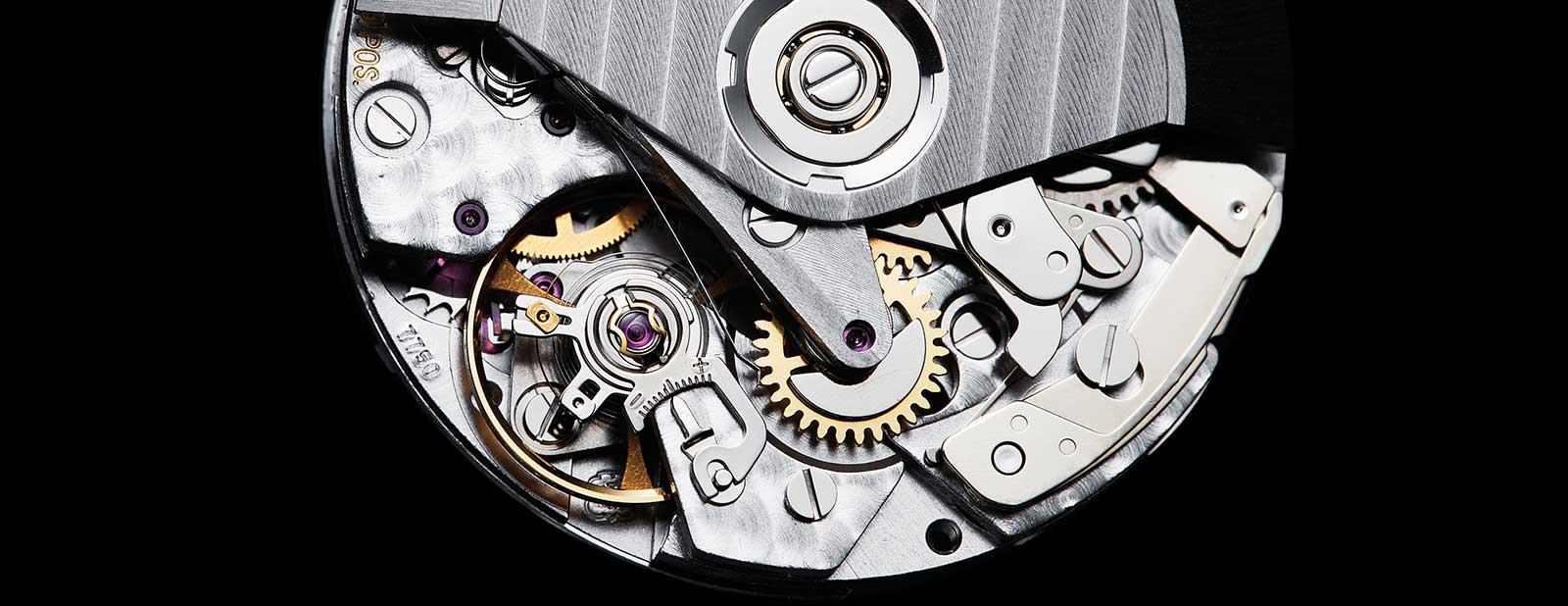
Capt's solution was the cam-and-lever chronograph switching system. Instead of a column wheel (a small toothed cylinder that rotates to engage chronograph functions), Capt used a flat cam profile that rotated under a spring-loaded actuator lever; pressing the chronograph pusher cammed the lever into the running train, starting the chronograph. The cam-and-lever system is functionally equivalent to a column wheel for the user but mechanically simpler, with fewer parts and lower-precision tolerances. The trade-off is a slightly harder pusher feel (cam systems require more force per push than column wheels); column-wheel watchmaker advocates have always preferred the smoother feel of column-wheel pushers as a tactile signal of premium movement engineering.
The Valjoux 7750 went into production in 1973, just as the quartz crisis began destroying Swiss mechanical-movement demand. Production was suspended in 1975 as Valjoux contracted; the company was absorbed by ETA SA in the 1985 Swatch consolidation. Production resumed under ETA ownership in 1985 as IWC, Breitling, and TAG Heuer needed an automatic chronograph for re-emerging mechanical product lines. From 1985 onward the 7750 became the workhorse automatic chronograph of the Swiss volume tier; ETA produced and continues to produce it as the ETA 7750 / 7751 / 7753 / 7754 family.
Capt himself continued at Valjoux/ETA through the 1980s and into the 1990s, contributing to subsequent caliber programmes. He is credited as inventor on multiple Swiss patents covering the 7750 cam-and-lever system and its evolutions. His public profile is low (the canonical archive interview is the 2014 Hodinkee piece marking the 7750's 40th anniversary); he has lived quietly in the Vallée de Joux through retirement. The cultural recognition of his contribution has grown through the 2010s as collector communities formalised the 7750's industry significance.
The commercial impact of the 7750 is impossible to overstate. By the mid-2010s the caliber and its variants powered most automatic chronographs at the CHF 3,000-15,000 price tier: the IWC Pilot Chronograph 89000-base, Breitling Navitimer Cal. B01 (a Breitling-modified 7750 family), TAG Heuer Carrera Cal. 16, Sinn 103, Hamilton Khaki Chrono, vintage Tudor Black Bay Chrono. Sellita's SW500 clone (post-2002 ETA throttle response) reproduced the 7750 architecture for non-Swatch brands. Tens of millions of 7750-family movements have been produced; Capt's 1974 cam-and-lever architecture is now the de facto industry standard for affordable automatic chronographs.

Comments 1