
The longitude problem dominated 18th-century European navigation. Latitude (north-south position) could be measured at noon by sun height since antiquity; longitude (east-west position) required either an astronomical calculation taking hours per measurement or, in principle, comparison of local solar noon against the time at a known reference meridian (e.g. Greenwich). The latter demanded a clock that could be carried at sea, exposed to ship motion, temperature swings, humidity, and salt air, while keeping time accurate to seconds per month. No such clock existed in 1700. Ships ran aground; the 1707 Scilly naval disaster killed roughly 2,000 sailors when four British warships hit the Isles of Scilly through a longitude error. Britain, the leading naval power, made the problem a state priority.
On 20 July 1714 the British Parliament passed the Longitude Act, which established the Board of Longitude and offered a prize of £20,000 (roughly £4 million today) to anyone who could find a method of determining longitude at sea to within half a degree, equivalent to 30 nautical miles at the equator, after a six-week voyage to the West Indies. Two paths competed: the lunar distance method (astronomical, requiring tables and complex calculation) and the marine chronometer method (a sufficiently accurate sea-going clock). The Astronomer Royal Nevil Maskelyne backed the lunar method; an unschooled Yorkshire carpenter, John Harrison (1693-1776), set out to prove the chronometer method.
"He has dedicated his life to the proof that a clock could go to sea and tell true time. The Board of Longitude has dedicated its life to denying it."- Contemporary observer on John Harrison's 47-year campaign for the Longitude Prize
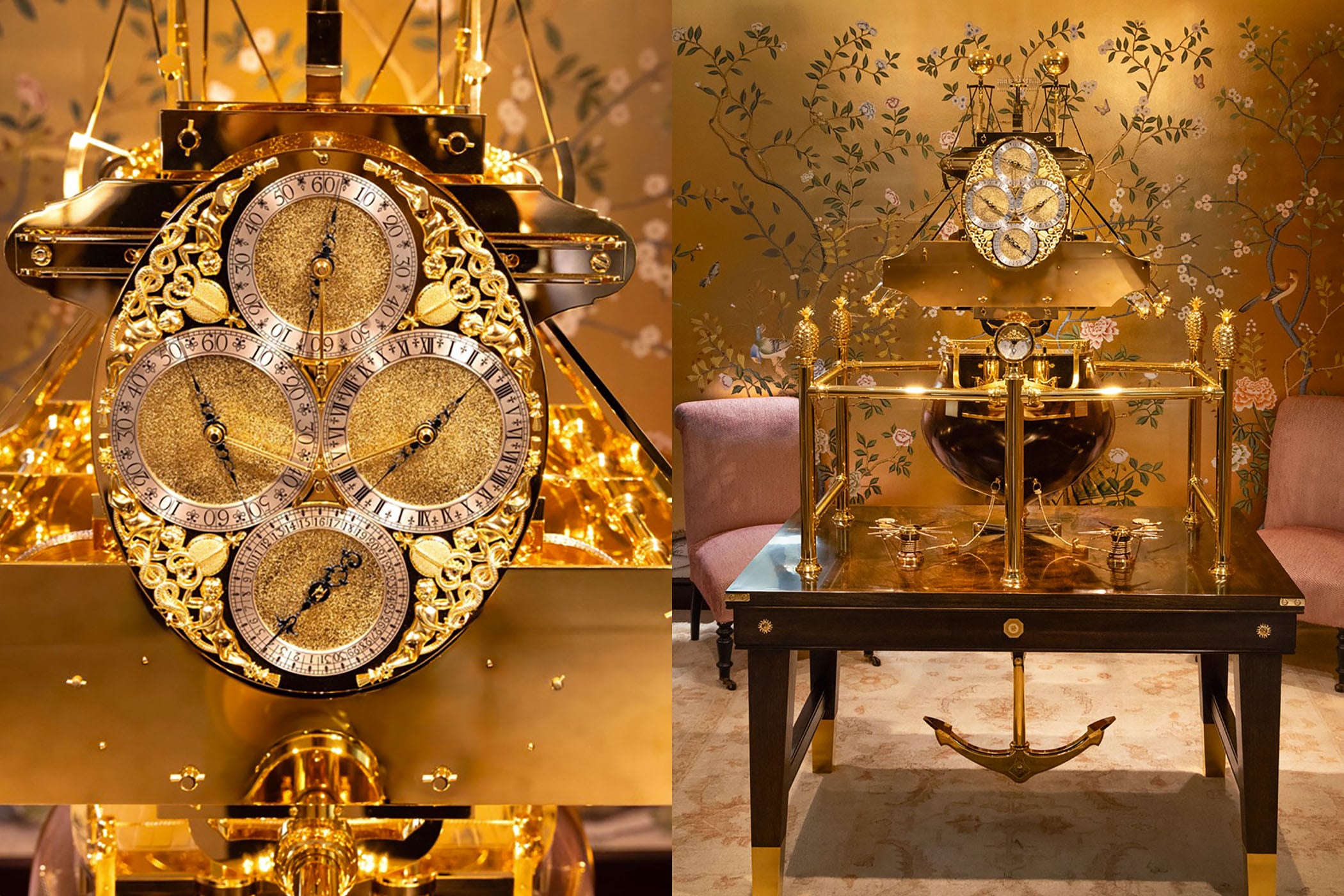
Harrison built and tested four marine chronometer designs over a 47-year span. H1 (completed 1735) was a 34 kg brass clock with twin counter-oscillating balances, gridiron bimetallic temperature compensation, and grasshopper escapement; sea-tested to Lisbon in 1736 with promising results. H2 (1741) was a refinement, never sent to sea. H3 (1759) was a 19-year project introducing the caged roller bearing and bimetallic strip, both Harrison inventions still used in watchmaking today, but ultimately too unstable for sea use. The breakthrough was H4 (1759), a 13 cm pocket-watch-size chronometer with a high-frequency balance, diamond pallets, and a remontoire d'égalité.
On 18 November 1761, H4 sailed for Jamaica aboard the HMS Deptford, accompanied by Harrison's son William. After the 81-day voyage, on arrival in Port Royal, Jamaica on 19 January 1762, H4 was found to be 5 seconds slow, equivalent to a longitude error of just over a nautical mile, well inside the half-degree (30 nm) Longitude Act tolerance. The Board of Longitude refused to award the full £20,000 immediately, demanding repeated sea trials and the disclosure of construction methods. Harrison received increments of the prize over the next 12 years, mostly under political pressure, with the final payment authorised by King George III personally in 1773, three years before Harrison's death.
After Harrison, the marine chronometer became a manufactured product. Larcum Kendall produced K1 in 1769, a copy of H4 that sailed with Captain Cook on his second Pacific voyage (1772-75) and tracked GMT to within 8 seconds per month. Thomas Earnshaw and John Arnold in the 1780s designed the spring detent escapement, the architecture that defined every serial marine chronometer for the next 150 years. By 1825 the British Royal Navy carried marine chronometers on every ship of the line; by 1900 over 400 makers worldwide were producing chronometers for naval and merchant fleets. Major firms included Charles Frodsham, Mercer, Hamilton, Ulysse Nardin, and Thomas Mercer.
The marine chronometer's direct descendants run through 20th-century watchmaking. Ulysse Nardin's 19th-century chronometer programme (over 4,000 marine chronometers produced) is the technical foundation of the modern Ulysse Nardin brand. The Hamilton Model 21 ship's chronometer was the standard US Navy chronometer in WWII. The technical specifications evolved into the modern COSC chronometer wristwatch standard (-4/+6 sec/day) and into the METAS Master Chronometer (0/+5 sec/day, anti-magnetic to 15,000 gauss). The principle, that a portable timekeeper of sufficient accuracy is the navigation tool for finding position, persisted from 1714 until the satellite GPS era of the late 20th century. The last commercial marine chronometers, by Mercer of St Albans, were produced into the early 1980s.




Comments 1