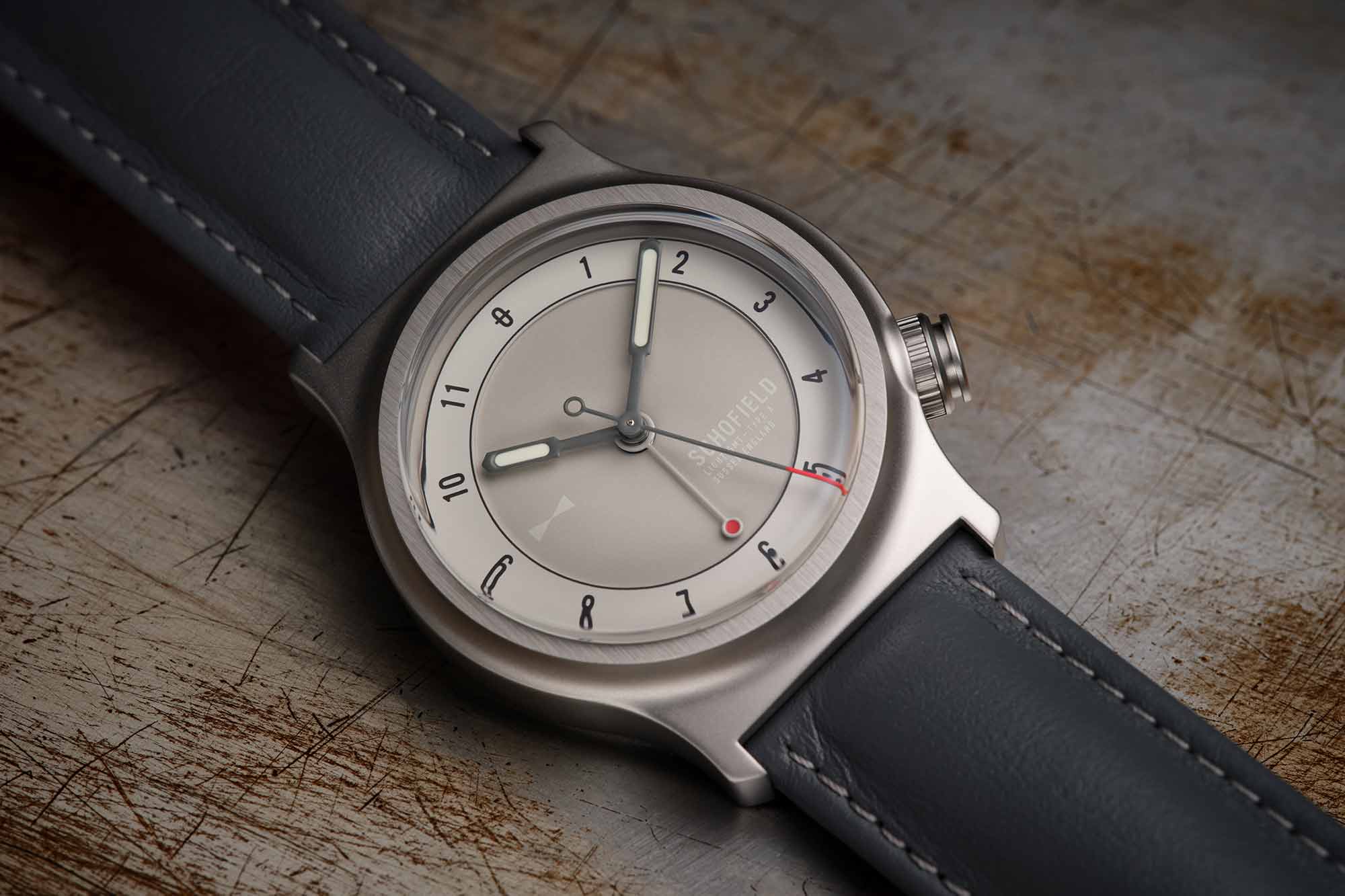
The plongeur hand, French for "diver", is a minute hand designed for unmistakable underwater legibility. Its defining feature is an oversized luminous disc at the hand's tip, sitting at the end of an arrow-like baton, sized to be visibly larger than the hour hand and to carry as much luminous material as possible. In English-language collector vocabulary the same hand is called the "lollipop", an obvious description of the geometry: a circular lume disc on a stick.
The plongeur hand was developed by Doxa for the Sub 300 "Sharkhunter", launched at Baselworld 1967. Doxa's technical lead Urs Eschle worked with the diving community, notably Hans Hass and Jacques Cousteau, on a fundamental dive-watch design problem: at 30+ metres in cold, low-light water, the difference between an hour and a minute hand had to be unambiguous within a fraction of a second. A diver checking dive time in murky water could not afford to read the wrong hand. The standard Mercedes-style hour hand and stick minute hand on a 1960s Submariner were not optimal for this; both ended in similar pointed tips.
"You see two hands underwater. One is pointed. One is a circle. You read time in a tenth of a second. That is the plongeur hand."- Diving instruction commentary on dive-watch readability
Eschle's solution: differentiate the minute hand by silhouette. The hour hand stayed conventional (an arrow or sword shape, ending in a luminous tip); the minute hand was redesigned around a large luminous disc at the very tip, sitting on a thin baton with arrow-like wings. From any orientation, in any light, on any oxygen-deprived dive, the disc-tipped minute hand and the pointed hour hand were instantly distinguishable. The disc also carried roughly 3-4× the lume area of a standard pointed minute hand, so it remained legible after extended time in deep water. Doxa applied for and received Swiss design protection on the Sub 300's dial and hand layout.
The Sub 300 was a commercial breakthrough. Cousteau's endorsement (he had been wearing Doxa Subs throughout the 1960s; the Sub 300 became his primary watch) was visible across the diving press; Aqua-Lung International distributed the Sub 300 through dive shops worldwide. By 1969 Doxa had four Sub 300 colour variants on offer (Sharkhunter black dial, Professional orange dial, Searambler silver dial, Caribbean blue dial), each with the same plongeur minute hand. The hand became visually associated with the Sub 300 and, by extension, with the new wave of professional diving instruments of the late 1960s.
By the mid-1970s the plongeur hand had been adopted across the dive-watch industry. Seiko applied it to selected references in the 6217-8000 "62MAS" series and the modern 50th-anniversary SLA017; Sinn uses it on the UX military diver; Squale Sub-39 references; the Aqualung Hyperion, the Helson Sharkmaster, the Halios Seaforth, and most modern micro-brand divers. Tudor's Snowflake hand (1969) is geometrically a rectangular variant of the plongeur principle, designed for the same problem; Doxa solved the visual identification problem first by 18 months.
In current production the plongeur hand is the strongest visual cue that a watch is a "professional dive watch" rather than a desk-diver. The 2024 Doxa Sub 300T 75 Years (a 75th-anniversary reference for the original Sub) carries an updated plongeur hand essentially identical to the 1967 original; modern cousins like the Seiko SLA017, the Halios Universa, and the Christopher Ward C60 Trident Pro carry the same disc-tipped silhouette. Outside the dive-watch genre the hand is rare: a plongeur on a chronograph, dress watch, or pilot watch reads visually like a foreign element. The hand has become genre-locked as effectively as the Mercedes hand is locked to Rolex sport models.
Comments 1