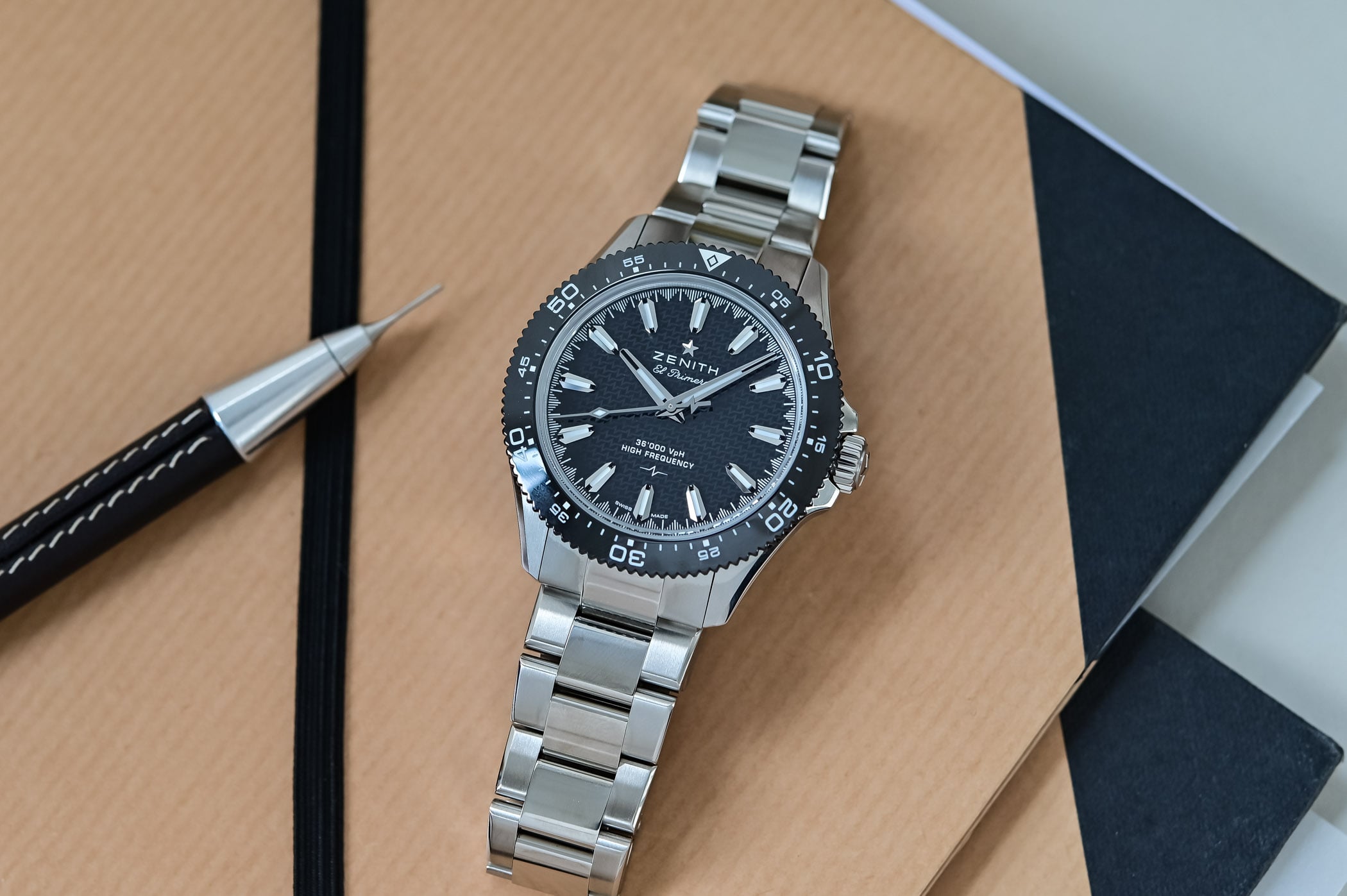
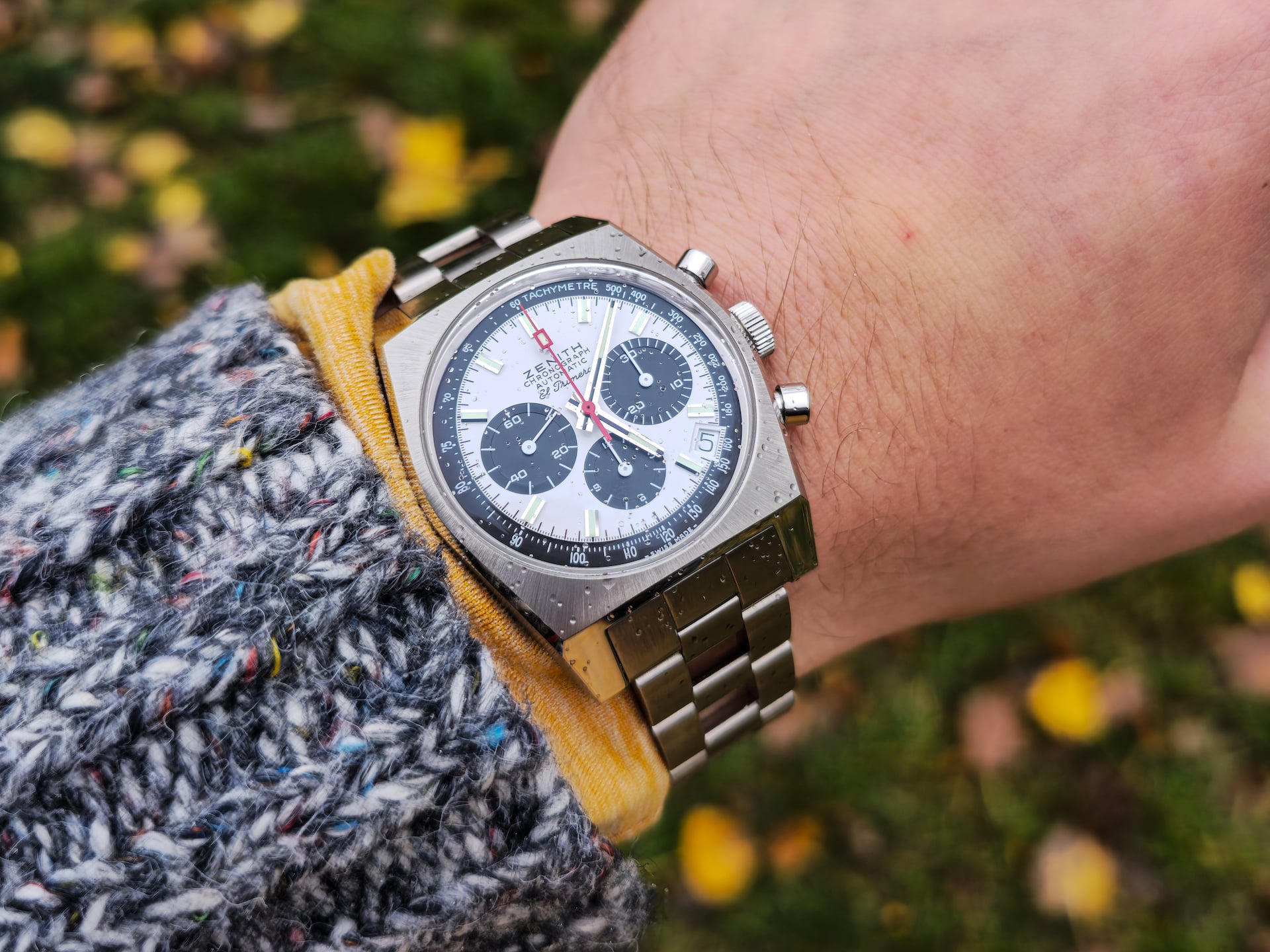
On 10 January 1969, Zenith held a press conference in Le Locle to unveil the Calibre 3019PHC, branded El Primero (Esperanto for "the first"). It was the industry's first genuinely integrated automatic chronograph, built from the ground up with column-wheel switching, a central rotor, and a running frequency of 36,000 vph (5 Hz), double the typical 18,000-19,800 vph of the era. Two competitors announced their own automatic chronographs within the same year: the Chronomatic consortium (Heuer, Breitling, Hamilton-Buren, Dubois-Depraz) presented the modular Cal. 11 in March, and Seiko revealed the 6139 in Japan in May. Zenith's January announcement gave it the naming rights, although the three are generally credited together as co-originators of the automatic chronograph.
The 36,000 vph architecture was a deliberate technical gamble. Doubling the beat rate halved the smallest measurable interval to 1/10th of a second, sharpened timekeeping stability against wrist shock, and gave the sweep seconds hand an almost-continuous motion. It also required new lubricants, tighter tolerances, and careful balance-spring matching, and it shortened service intervals. The movement's 31mm diameter was extraordinarily compact for a chronograph with a full rotor, a 50-hour power reserve, date, and a vertical-clutch-adjacent column-wheel construction that allowed instantaneous reset.
The quartz crisis nearly erased the El Primero. In 1975, Zenith's American parent Zenith Radio Corporation ordered the mechanical movement programme shut down and the tooling scrapped. Watchmaker Charles Vermot, convinced the decision would be reversed once the mechanical market recovered, disobeyed the order: he crated and hid every press, die, and cam on the upper floors of the Le Locle factory, behind false walls, with the blueprints intact. When Zenith restarted El Primero production in 1984, the tooling was recovered exactly where Vermot had left it. Without that act of insubordination, the El Primero would not exist today.
From 1988 until 2000, Rolex used a modified El Primero, the Cal. 4030, to power the self-winding Cosmograph Daytona Ref. 16520. Rolex reduced the frequency to 28,800 vph for reliability, removed the date, and re-finished the movement, but the heart was Zenith's. That twelve-year partnership transformed Daytona demand and kept Zenith's manufacturing programme solvent. After Rolex moved to its own in-house Cal. 4130 in 2000, Zenith returned the El Primero to its signature high-beat specification, and the modern Cal. 3600 (2021) re-introduced a true 1/10th-second central chronograph hand driven directly by the 5 Hz escapement. Current retail runs from approximately $9,500 (Chronomaster Original steel) to $47,000+ (Defy Skyline Skeleton, Chronomaster Sport Aerith).



Comments
No comments yet, be the first to weigh in.