The 1969 race
In 1969, three teams independently raced to release the world's first self-winding chronograph. Zenith announced the El Primero in Le Locle on 10 January 1969. The Heuer/Breitling/Hamilton/Buren consortium announced the modular Cal. 11 (Chronomatic) in March 1969. Seiko released the 6139 commercially in May 1969, weeks ahead of the Zenith and consortium watches actually reaching dealer shelves. By the technical "first to market" measure, Seiko won; by "first announced", Zenith did. Either way, the 6139 is a foundational caliber in modern chronograph history, and the only one of the three contenders developed entirely outside Switzerland.
What made it unusual
Three things set the 6139 apart from its 1969 rivals. Vertical clutch: the chronograph engages the seconds train through axial coupling rather than a horizontal sliding wheel. Same architecture that Rolex's 4130/4131 would later make standard for premium chronographs; in 1969 it was rare. The 6139's seconds hand starts and stops without the small jitter of horizontally-coupled chronographs. Column-wheel: the chrono operations are controlled by a true column wheel, not a cam. Premium feel, more parts, more cost; Seiko built it that way deliberately. Single register at 6: just one sub-dial (30-minute counter at 6 o'clock) instead of the multi-register layouts the Swiss favoured. Date and day windows at 3 o'clock. Cleaner, sportier dial.
The Pogue Speedmaster
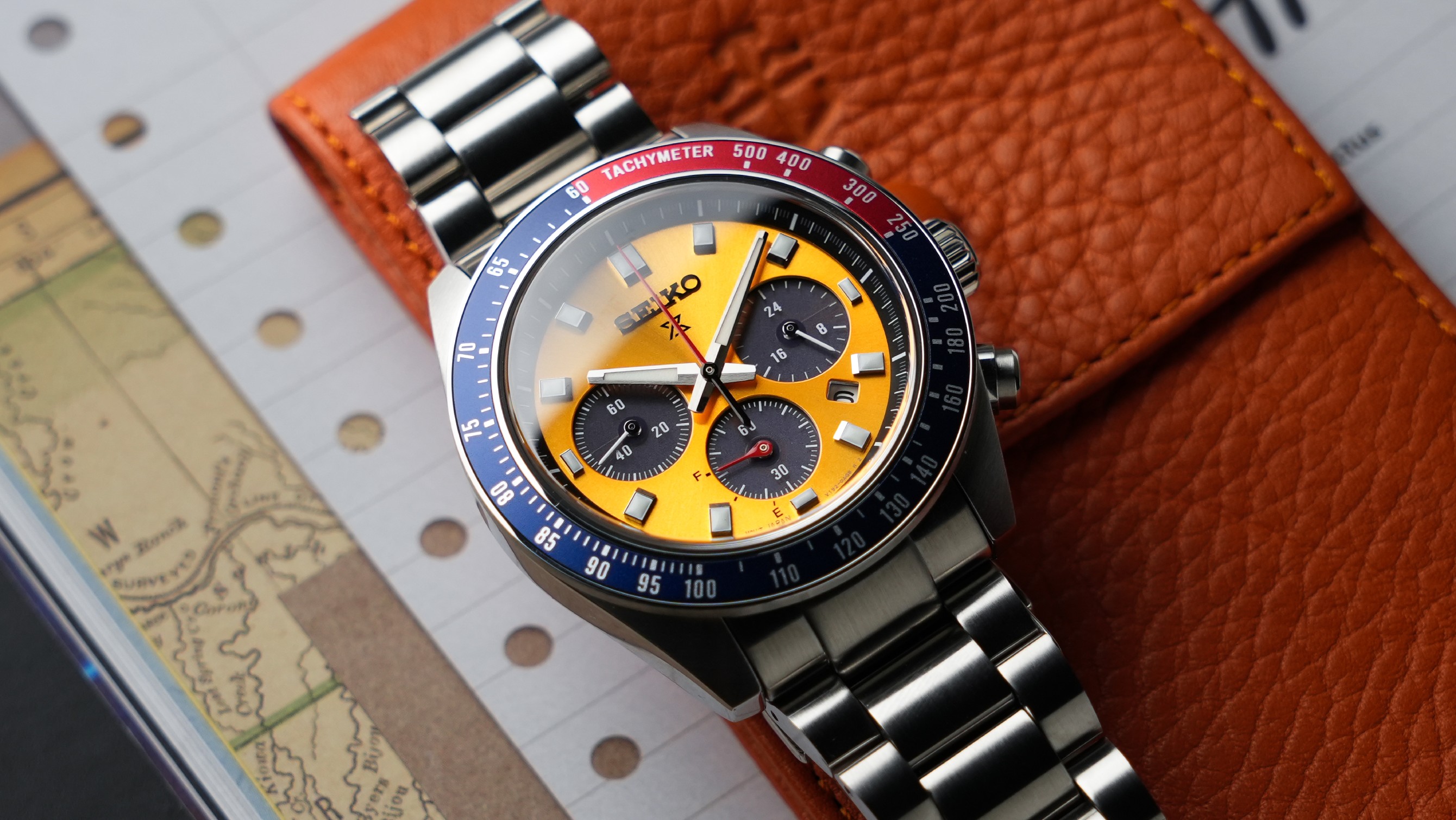
On Skylab 4 in November 1973, NASA astronaut Colonel William "Bill" Pogue wore his personally-purchased Seiko 6139-6005 in space alongside his issued Omega Speedmaster. The 6139 was not flight-qualified by NASA (only the Speedmaster was), but Pogue brought it as a personal watch. Photos of the watch on his wrist in zero-G made it famous. The 6139-6005 with its yellow / gold dial became known as the "Pogue Speedmaster" or simply "the Pogue". It is the first automatic chronograph worn in space, predating any Swiss equivalent in orbit by years. Vintage Pogues trade for USD 1,500-3,500 in 2026; high-condition examples with original papers can reach USD 5,000+.
Family and variants
The 6139 is part of a family. 6139-6000 / 6001 / 6002: the original "Bull Head" with crown at 4, pushers at 2 and 4, blue or grey dial. 6139-6005 / 6009: the Pogue (yellow dial) and various coloured variants. 6139-7100: the "Helmet", a thicker more sculpted case. 6139-8002: dressier configuration. 6138: a closely-related sibling with two registers and 17,200 vph frequency. 6139A / 6139B: revisions with refinements to the keyless work. Production ran from 1969 through 1979, when Seiko transitioned to the simpler quartz chronograph for cost reasons during the deepening quartz crisis.
Why it disappeared
Three reasons. The quartz crisis: Seiko itself was the principal driver of quartz adoption (the Astron launched in 1969, the same year as the 6139). By 1979 quartz chronographs were dramatically cheaper to produce than mechanical and accurate to a second per month rather than a minute per day. Cost: the 6139's vertical clutch and column wheel were expensive to produce relative to the simpler cam-actuated Valjoux 7750 (also 1973). Strategic focus: Seiko's growth path was quartz-first; mechanical chronographs were a residual segment. The 6139 left production cleanly in 1979 and Seiko did not return to mechanical automatic chronographs at scale until much later.
Buying notes
Vintage 6139s in good running condition are abundant on the secondary market: USD 400-800 for clean examples, USD 1,500-3,500 for the Pogue, USD 200-400 for non-running project watches. Service is straightforward at any vintage Seiko specialist (CHF 200-400) and parts are still findable through Seiko Japan, Cousins UK, and the secondary parts market. Watch out for: rusty chrono pushers (water-damaged movements), missing day-date crowns, and replacement dials sold as original. The yellow Pogue dial in particular has been faked. For the rest of the 1969 race, see Zenith El Primero and Valjoux 7750.




Comments
No comments yet, be the first to weigh in.