What it is
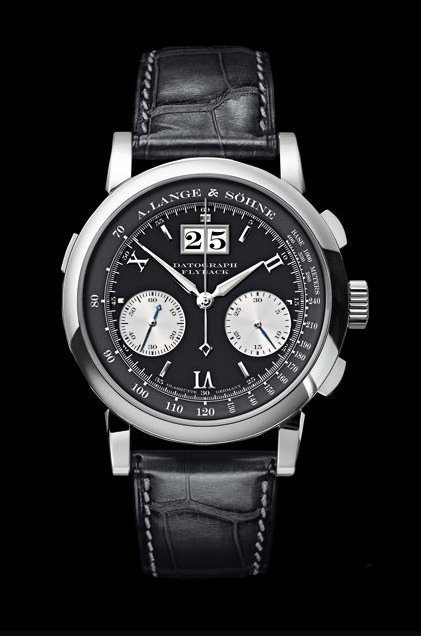
The L951.1 is the in-house chronograph caliber A. Lange & Söhne released in 1999 inside the original Datograph ref. 403.035. It was the first chronograph movement Lange produced after the brand's 1990 revival, and it was an immediate landmark: hand-wound, column-wheel, vertical-clutch, flyback, with the signature Lange precisely-jumping minute counter (the chronograph minute hand jumps in instant 1-minute steps rather than crawling). The architecture was designed by Annegret Fleischer and a small Lange team. It put a German manufacture, two decades old at the time, on parity with the established Geneva chronograph elite.
Why it became the reference
Three things made the L951.1 the reference modern chronograph movement. Finishing: the three-quarter plate is untreated German silver (an alloy of copper, nickel, and zinc that develops a warm patina over decades) decorated with hand-applied Glashütte stripes, blued screws, gold chatons screwed in place over the jewels, hand-bevelled bridges, and polished steel chronograph levers. Visible through the sapphire caseback, no other industrial chronograph movement looks like it. Architecture: column-wheel + vertical-clutch in a hand-wound layout, with the levers and column wheel on the dial side rather than the back, leaving the bridge-side view essentially uncluttered. Jumping minute: the chronograph minute hand advances in single-jump increments precisely on the 60-second mark, not the slow drag you see on most chronographs. This is mechanically harder than a continuous minute hand and is a Lange signature.
What "L951.1" means and the family tree
L951.1: original 1999 Datograph caliber. L951.5 / L951.6: refined versions with longer power reserve (60h instead of 36h), used in the Datograph Up/Down from 2012. L951.7: variant with perpetual calendar, in the Datograph Perpetual Tourbillon. The wider L9-series powers the Lange chronograph catalogue: L101.1 in the 1815 Chronograph (no big date), L102.1 in the Triple Split (chronograph, rattrapante, with three split functions). The L951.1 itself runs at 18,000 vph (2.5 Hz), slow by modern standards, deliberately chosen for the visible balance amplitude and the "old-Glashütte" feel of the beat.
What buyers actually pay for
A modern Datograph Up/Down (with the L951.6) retails at USD 95,000-115,000. The mechanical content of that price is the finishing labour: roughly 40-50 hours of hand work per movement, mostly bevelling and polishing. The same architecture in machine-finished form would cost a fraction. Lange's position is that the visual signature of the L951 family is the product, not just the chronograph function. Vintage 1999-era L951.1 Datograph ref. 403.035 trades pre-owned at USD 60,000-90,000; the watch has a small but enormously committed collector base, and the original is steadily rising in value as the brand's post-revival output ages into modern-classic territory.
Service notes
Lange service for an L951-family watch runs USD 3,500-6,500 at the Glashütte manufacture, with a multi-year wait (Lange services every watch in-house with original parts, no authorised independents). Recommended interval: 5-7 years. The chronograph parts are bespoke; no aftermarket source exists. The good news for owners: Lange's in-house service is regarded as the best in modern Swiss-German watchmaking; the watch comes back regulated to within 2-3 sec/day and the German-silver plate is hand-restored to original colour. The bad news: shipping a Datograph from outside Europe to Glashütte is a multi-month round trip.
Where it sits in the wider market
In the modern chronograph hierarchy, the L951.1 occupies the top tier with a small group of peers: the Patek CH 29-535 PS, the in-house Audemars Piguet Caliber 2385/2387 family, the Zenith El Primero in its high-finish Phillippe Dufour-finished variants, and the Rolex 4131 on the industrial side. Where the 4131 prizes serviceability and volume, the L951.1 prizes finishing and visual depth. Both architectures use the same column-wheel + vertical-clutch logic; the difference is in the labour. For more on chronograph architecture see our chronograph 101 and flyback chronograph.


Comments
No comments yet, be the first to weigh in.