
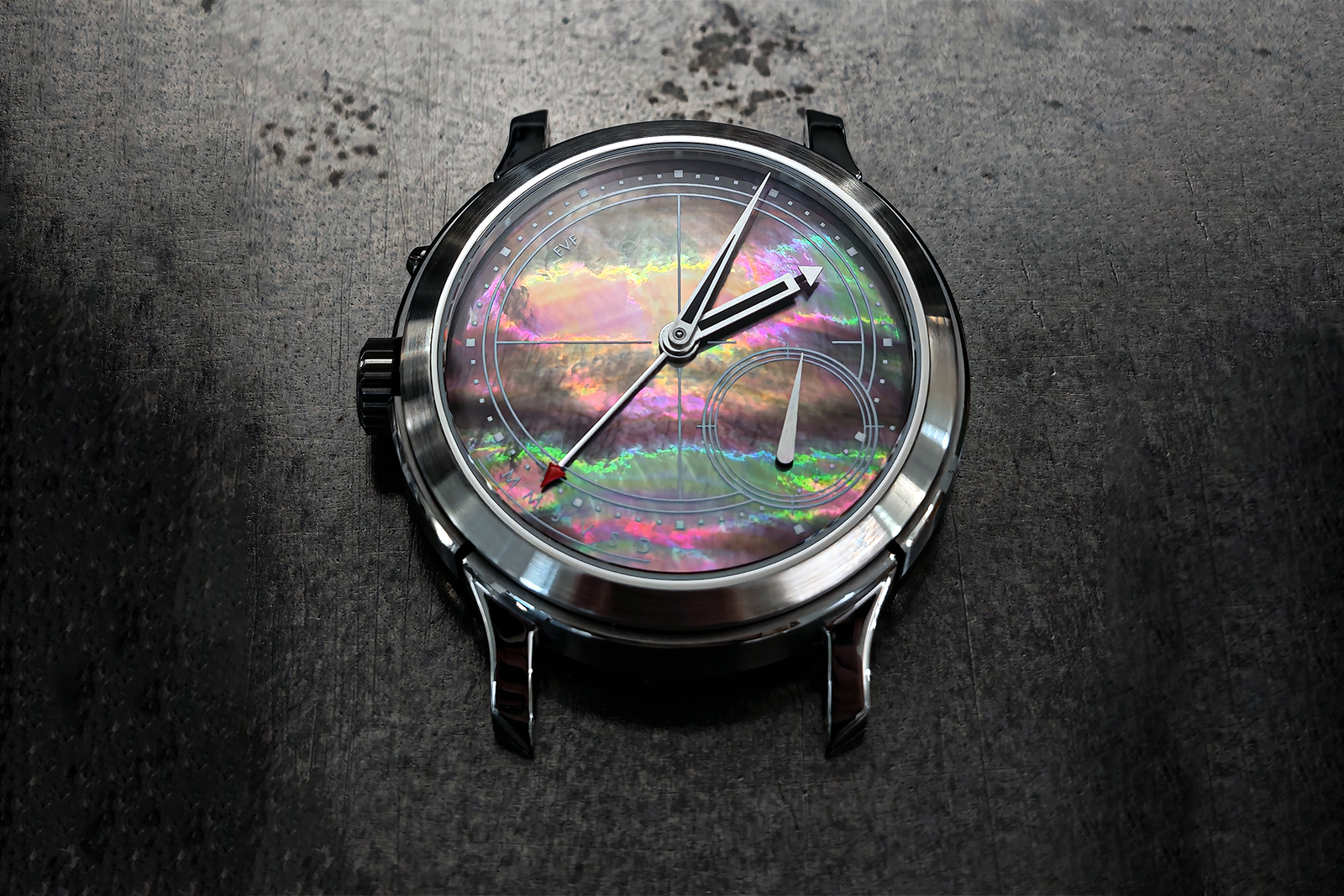
Mother of pearl (nacre) is the iridescent inner shell layer of pearl-producing molluscs. Chemically, nacre is alternating microscopic layers of aragonite (calcium carbonate) and conchiolin (an organic protein matrix); the layered structure causes thin-film light interference producing the characteristic iridescent colour shift. Different mollusc species produce different colour palettes: South Pacific oysters give white-pink-gold nacre; black-lipped oysters give grey-black nacre; abalone gives multi-coloured nacre with strong blue-green flashes.
In watchmaking, mother-of-pearl is sliced to 0.3-0.5mm thickness from raw shell, bonded to a brass dial plate, and finished with applied indices and dial text. The slicing requires diamond-saw work in oil bath (similar to lapis lazuli dial production) and produces 10-30% wastage from cracking; each finished dial is visually unique from the natural variation in shell layers.
"You can polish a brass dial. You can repaint an enamel. You cannot fix a damaged mother-of-pearl. The watch you bought is the watch you have, forever."- Watchmaker on MOP dial care
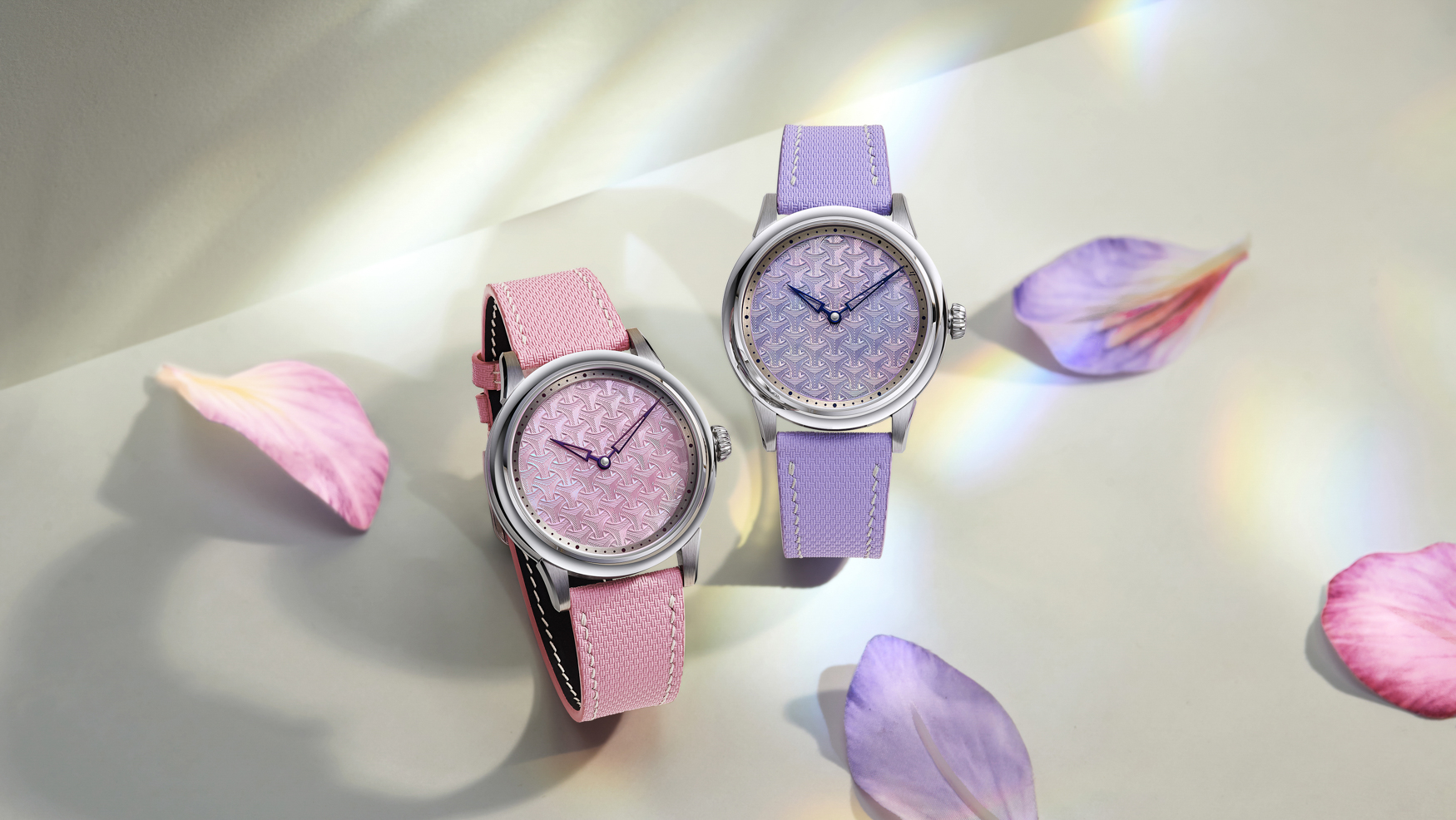
Women's luxury watchmaking is the dominant market: Cartier Tank Française MOP, Tank Must MOP, Panthère MOP; Patek Philippe Calatrava women's references, Twenty~4 quartz; Bulgari Serpenti, Lucea, B.zero1; Rolex Datejust 31 mid-size and Datejust Lady 28 with MOP dials; Breguet Reine de Naples; Vacheron Constantin Métiers d'Art. The category accounts for an estimated 30-40% of women's luxury watch dials at modern boutiques.
Men's haute-horlogerie use is selective. AP Royal Oak Frosted Gold Lady (the cross-over model) uses MOP; Patek 5961 Annual Calendar Chronograph and Twenty~4 men's references occasionally feature MOP. The Rolex Day-Date 36 with MOP dial is one of the few canonical men's MOP references.
Care considerations: mother-of-pearl is sensitive to humidity (high humidity can cause the layers to delaminate over decades); scratches easily (any contact with the dial surface during service can leave permanent marks); and sensitive to direct sunlight (UV can cause slow yellowing of the conchiolin organic matrix). Watches with MOP dials should be kept in normal humidity and serviced by watchmakers experienced with delicate dials.







Comments 2