
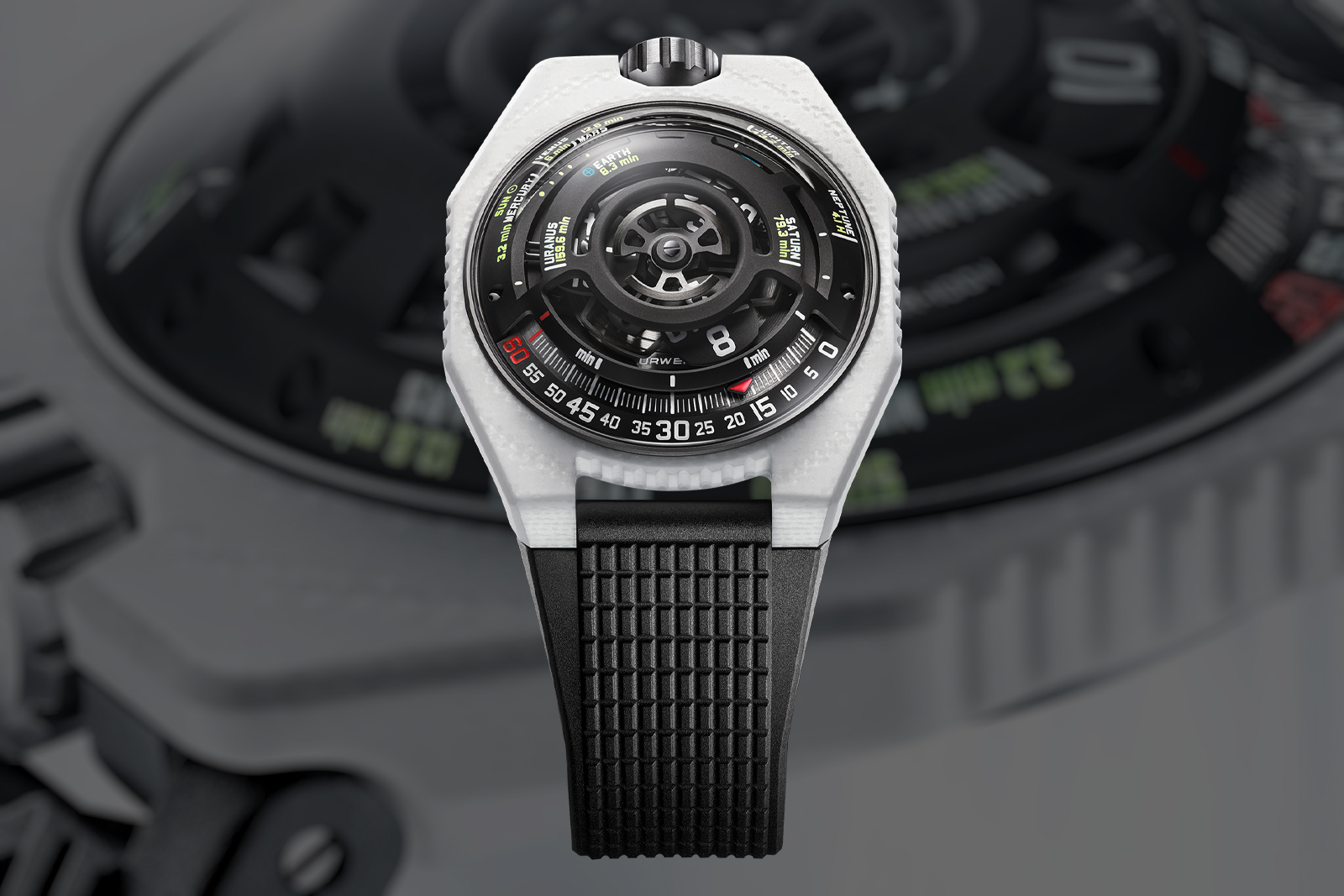
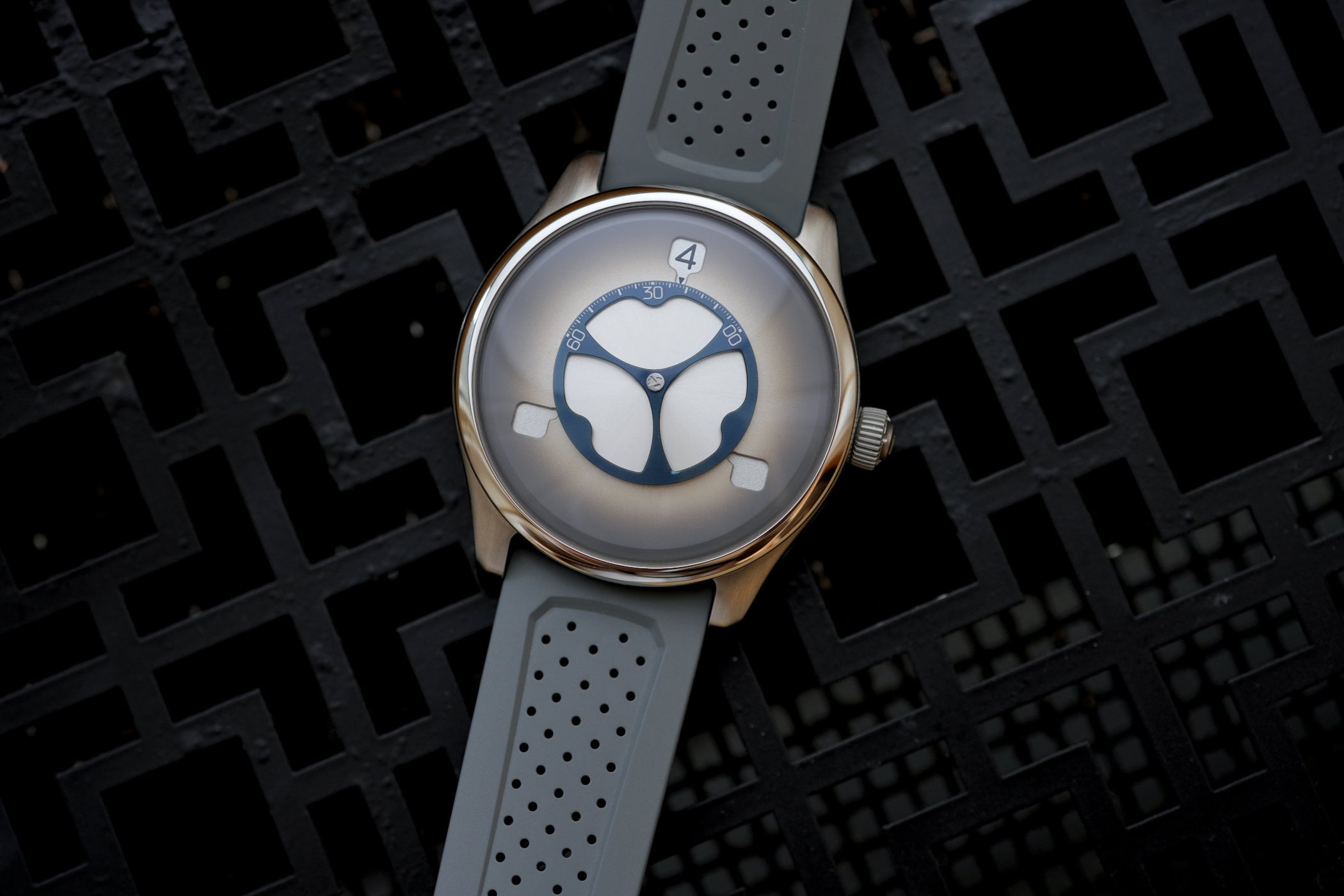
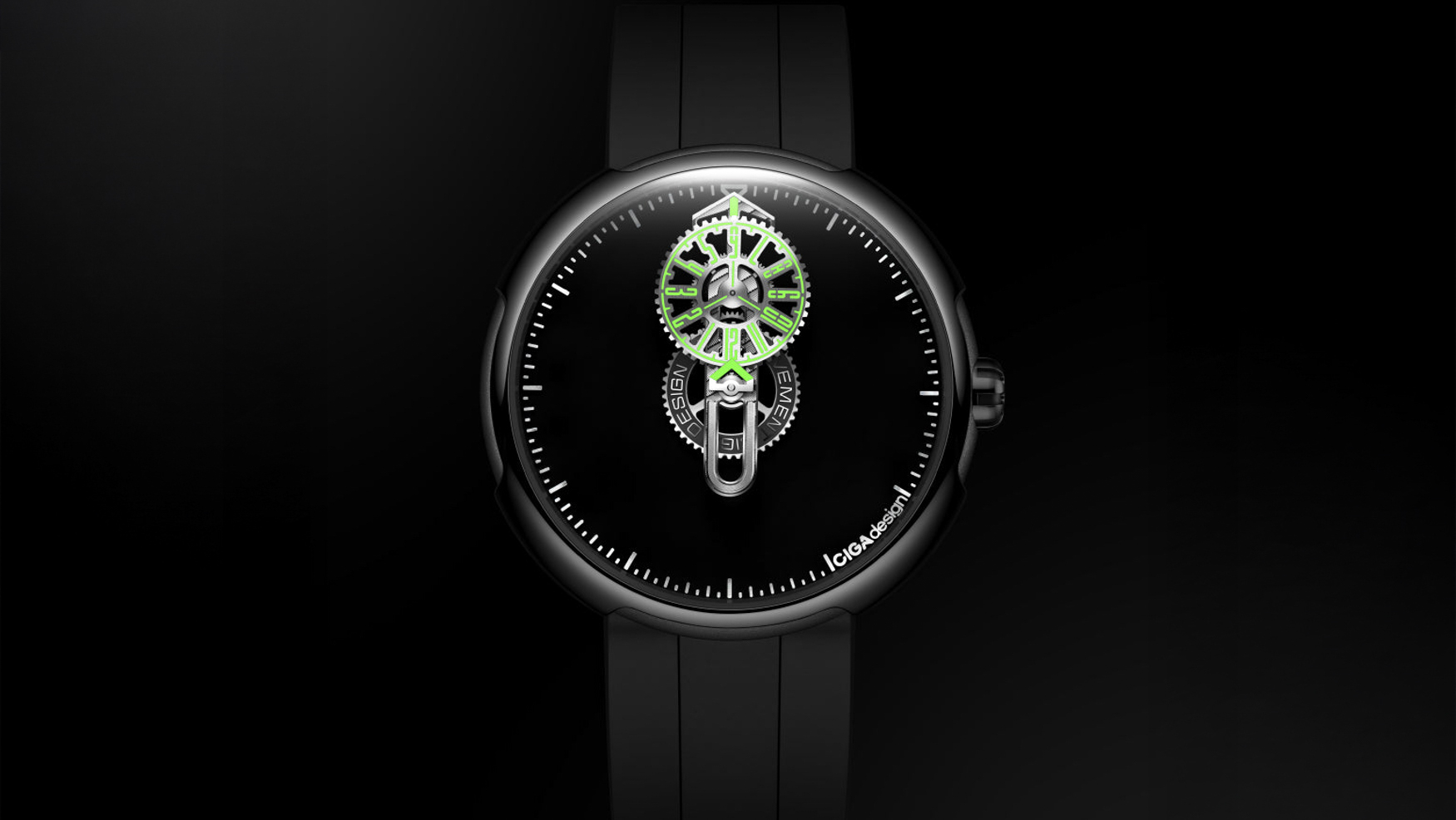
Wandering hours is a time-display complication in which the watch dispenses with the conventional fixed hour hand entirely. Instead, the dial carries three or four satellite discs mounted on a central rotating wheel; each satellite disc has hour numerals printed on it (e.g., 12 / 4 / 8, or 12 / 3 / 6 / 9). At any given moment one numeral is visible; as the central wheel rotates, that numeral traces a 120° (or 90°) arc across the upper half of the dial, moving from minute "0" to minute "60" along a printed minute scale. When it reaches "60", the next numeral has appeared on the next satellite ready for its hour. The visible numeral is always the current hour; its position along the arc shows the current minute.
The complication was invented in the late 17th century by Vatican clockmakers, with the earliest documented mechanism attributed to the Campanus brothers, Pierre and Jacques, working in Rome around 1656-1670. Pope Alexander VII commissioned a wandering-hours night clock from the Campanus brothers; the dial design was practical for night reading, where the changing illuminated hour numeral was easier to read at low light than a hand-and-dial layout. The "Vatican wandering hours" night clocks were produced for several Popes and continental nobility through the late 17th and early 18th century, then largely disappeared from horology for ~250 years.
"You do not look at a wandering-hours watch and ask the time. You watch the numeral travel, and the time arrives at the answer with you."- Watchmaking design commentary on the wandering-hours principle
The modern wristwatch revival began with Audemars Piguet's Star Wheel, introduced in 1991. AP's technical director Giulio Papi (later co-founder of APRP) designed the wristwatch-scale wandering-hours mechanism for the ref. 25720, which became the first serial-production wandering-hours wristwatch. The Star Wheel uses three sapphire satellite discs, each carrying four numerals; one disc rotates 90° to advance one hour. The original 1991 reference produced for ~10 years; the brand revived the Star Wheel in 2022 with the modern Code 11.59 Starwheel, with refined geometry and Code 11.59-style case.
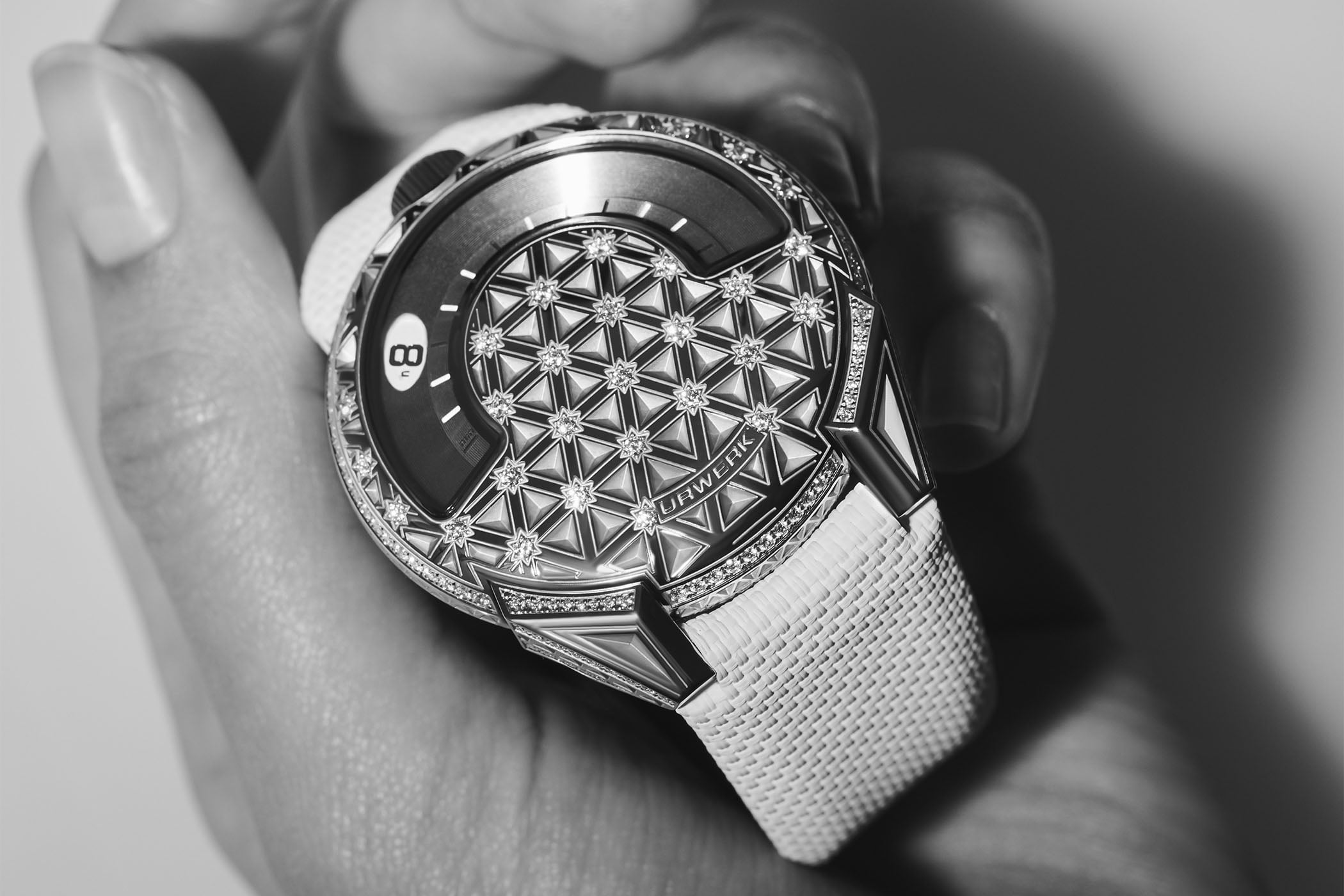
The most aggressive modern wandering-hours producer is Urwerk, founded in 1995 by Felix Baumgartner and Martin Frei. Urwerk's entire catalogue is built around the wandering-hours principle, executed with science-fiction-style cases. The UR-103 (2003) was the first Urwerk; the UR-110 "Torpedo" (2011) refined the mechanism into Urwerk's signature shape; the UR-220 "Falcon Project" (2020) added a complication-by-complication count of remaining service life. UR-100V (2019) reads minutes via three discs but adds a kilometre-of-Earth-rotation indicator alongside, the brand's most-photographed reference. Annual Urwerk production is ~150-200 watches; pricing runs from CHF 80,000 to 350,000+.
Other modern wandering-hours producers include Christophe Claret (the Maestoso wandering-hours tourbillon, 2014), Konstantin Chaykin (specialty pieces), and several smaller AHCI-member independents. The complication is relatively simple mechanically: three rotating discs on a planetary gear train, with no escapement or chronograph mechanism added. It is, however, very visually distinctive, which has made it a signature complication for modern boutique watchmakers seeking design differentiation rather than mechanical complexity.
For collectors, a wandering-hours wristwatch is one of the strongest signals of "interesting design over conventional luxury". Where a traditional perpetual calendar or tourbillon shows technical complexity, a wandering-hours piece shows aesthetic and historical reference; the buyer is paying for design heritage and visual uniqueness rather than mechanism count. Urwerk has built an entire brand on this positioning; the AP Star Wheel sits as the haute-horlogerie counterpart. Prices range from CHF 25,000 (Star Wheel ref. 25720 vintage) through CHF 150,000+ (modern Urwerk core) to seven figures (Christophe Claret Maestoso wandering tourbillon).







Comments 2