Most watch histories start with the movement. This one has to start with a Brazilian in a bowler hat, taxiing his own aeroplane over Paris in 1901, cursing that he had to let go of the controls to check his pocket watch. His name was Alberto Santos-Dumont, one of the most famous aviators of the pre-Wright era. His friend Louis Cartier heard the complaint at dinner and built him a wristwatch. The year was 1904. The result is the piece that essentially invented the men's wristwatch as a serious object, and it has been in the Cartier catalogue in one form or another ever since.

1904: the actual first pilot's watch
Every watch brand that markets itself as "aviation-inspired" is telling a story that begins here. In 1904, Louis Cartier delivered his friend a square wristwatch with a leather strap and a small buckle. Roman numerals on the dial, exposed screws around the bezel, a crown at 3 o'clock. Nothing had ever looked quite like it, because before the Santos, wristwatches were essentially reserved for women; men wore pocket watches on a chain, always. What Cartier built for Santos-Dumont was the first wristwatch designed and marketed for a man to wear, and it was specifically designed for the world's most famous pilot to check while flying. That is why the Santos, not the Zenith Pilot or IWC Big Pilot or any other later watch, is technically the first pilot's wristwatch in horological history.

1911: production begins
The 1904 piece was a one-off gift. It took seven years before Cartier had a movement partner (Edmond Jaeger, later of Jaeger-LeCoultre) that could mass-produce the Santos, and it wasn't until 1911 that the piece went on sale to the general public. The design barely changed: the square case, exposed screws, Roman numerals, and railway-track minute chapter that define the Santos today were all baked in from the first commercial production run. Buy a Santos-Dumont in 2026 and you are, in every important sense, buying a design that has been continuously produced for 115 years.
The wilderness decades
The Santos coasted through the early 20th century as a niche piece for people who knew Cartier. Two World Wars kept dress watches out of the male mainstream. Post-war, military and sports watches took over and the Santos didn't ship in serious volume from the 1940s through the mid-1970s. Cartier was busy with the Tank (which took the "watch as jewellery" positioning) and the Santos sat in the archive, still available on special order, but not actively pushed.
1978: Alain-Dominique Perrin and the two-tone reboot
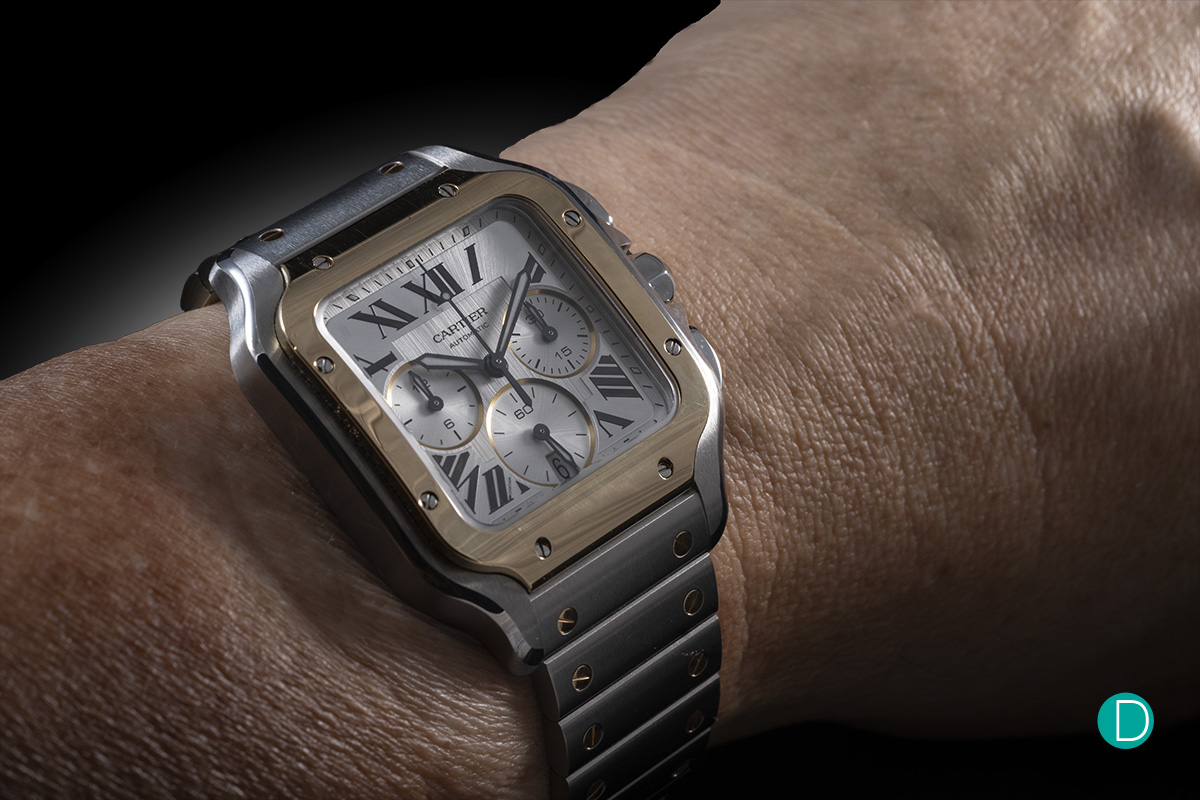
Then Cartier's marketing manager Alain-Dominique Perrin did something that reshaped the brand's next fifty years. In 1978, at the Musée de l'Air in Paris (where Santos-Dumont's Demoiselles aircraft is still on display), Perrin launched a steel-and-gold Santos at a price point aimed at the international jet-set-adjacent buyer who wanted a Cartier that wasn't a Tank. Two-tone was considered daring in 1978. The Santos was one of the first modern-luxury watches to make it look considered rather than cheap, and by the mid-1980s the two-tone Santos was one of the status watches of the decade. It was also, notoriously, one of the most counterfeited watches in the world. That is what happens when a design becomes global shorthand.
1987: the Galbée
The 1978 Santos had angular case-sides that dug into some wrists. In 1987 Cartier introduced the Santos Galbée ("curved" in French), which softened the case with a rounded profile that hugged the wrist better without changing the visible dial-and-bezel identity. Galbée sold through the 1990s and 2000s in multiple sizes, culminating in the Galbée XL (2005) that pushed the case up to more contemporary sports-watch proportions. Galbée is the Santos most people between the ages of 45 and 65 mean when they say "a Cartier Santos".

2018: the relaunch that finally got it right
The Santos went on temporary hiatus around 2016 while Cartier rebuilt the collection. It came back in 2018 with what is now the modern Santos de Cartier line: three case sizes (Small, Medium, Large), steel, two-tone, or full gold, and - critically - an integrated bracelet with a QuickSwitch system that lets you swap between the steel bracelet and a leather strap without tools. It sounds trivial. In practice, being able to change straps at your kitchen table without a $40 spring-bar tool from Amazon is the sort of small usability decision that turns "watch you buy" into "watch you wear every day".
The 2018-onwards Santos also introduced the SmartLink bracelet: individual links can be removed by hand without a jeweller. Cartier stopped being the "you need an appointment for a link removal" brand and started being the "you can adjust this yourself in the car park" brand. The whole collection got significantly better to actually own.
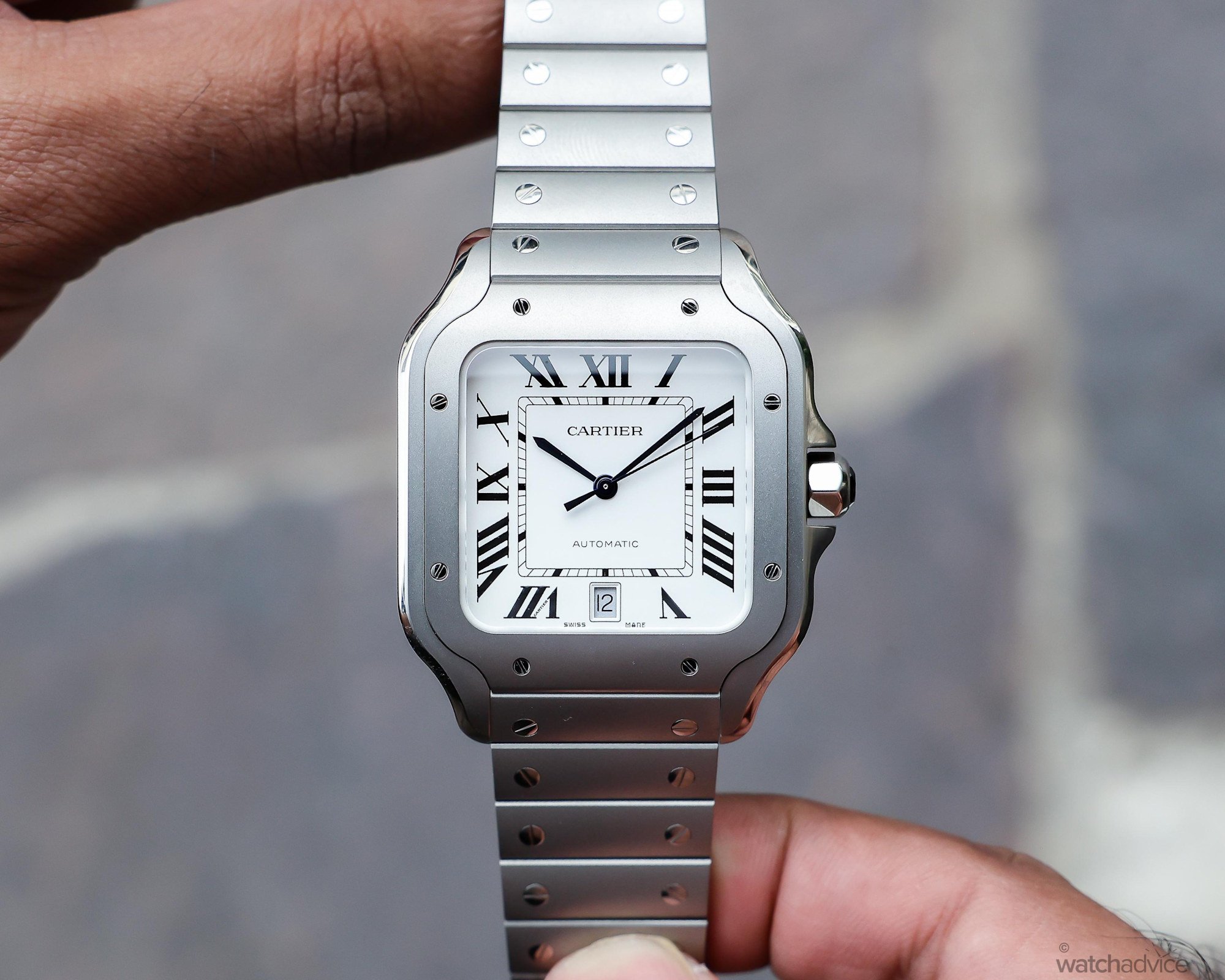
The design elements, spelled out
Every Santos, from 1904 to today, carries the same signatures:
- Square case with rounded corners. Not a rectangle (that's the Tank), not a cushion (that's the Ballon Bleu). Square is the Santos.
- Exposed screws on the bezel. Eight screws frame the crystal. This was Louis Cartier's structural solution in 1904 and Cartier still refuses to hide them.
- Roman numerals. Since 1904. The Santos was one of the first watches to put Roman numerals on a sports piece and Cartier has never seriously deviated.
- Railway-track minute chapter. Also since 1904. Reads perfectly at arm's length and is instantly recognisable as Cartier.
- Crown at 3 o'clock with faceted spinel or sapphire cabochon. Cartier's signature crown treatment; the Santos crown is octagonal.
- Blued sword hands. Introduced early in the production line and kept ever since; on modern versions the hands are heat-blued steel.
The current lineup, briefly
- Santos de Cartier Small: 35.1 x 26.7mm, quartz, most closely echoes the 1978-era steel piece. €5,700 in steel.
- Santos de Cartier Medium: 35.1 x 41.9mm, automatic Cal. 1847 MC. The default modern Santos. €7,500 in steel.
- Santos de Cartier Large: 39.8 x 47.5mm, automatic. The sports-watch expression. €8,000 in steel.
- Santos-Dumont: 27.5 x 38mm (Small) or 31.4 x 43.5mm (Large), thin quartz, closer to the original 1904 proportions. From €4,750.
- Santos Chronograph: 43.3 x 51.3mm, in-house Cal. 1904-CH MC, monopusher via the crown. €10,300+.
- Santos de Cartier Skeleton, XL, and precious-metal variants: from €25k up to €120k for full gold.
Where the Santos sits in 2026
Steel-sports Santos Medium at €7,500 is the same conversation as an Aqua Terra 41, a Grand Seiko SBGX259, or a Longines Master Chronograph. Different design language, similar money. What makes the Santos unusually interesting in 2026 is that its design DNA is demonstrably older than every competitor. When Cartier says "our sports watch has been in production since 1904", they mean it literally. Nautilus is 1976. Royal Oak is 1972. Aqua Terra is 2002. Santos, 1904.
That longevity is worth something on the wrist. The Santos is not the loudest sports watch in a boardroom, and it's not the diveable one, and it's not the anniversary-appreciating collector piece the Nautilus is. What it is, is the only sports watch you can wear that ties directly back to Alberto Santos-Dumont banking his 14-bis over the Bagatelle field in 1906. That is not marketing. That is actual history that has never been broken.
The honest verdict
The Cartier Santos is one of maybe three watches in the world whose design has been continuously right for more than a century (Rolex Oyster Perpetual, Cartier Tank, Cartier Santos). It is not the coolest watch in every room, it is not the best value at the price point, and it is not the most technical piece Cartier makes. What it is, is the watch that invented the idea of a wristwatch for men, and 121 years later it is still the sharpest-looking square case Cartier ships. If you have never owned one, the Medium at €7,500 is the buy. If you already own a Tank, the Santos is the second Cartier that closes out the collection with everything it needed to say.
Comments
No comments yet, be the first to weigh in.