What it is
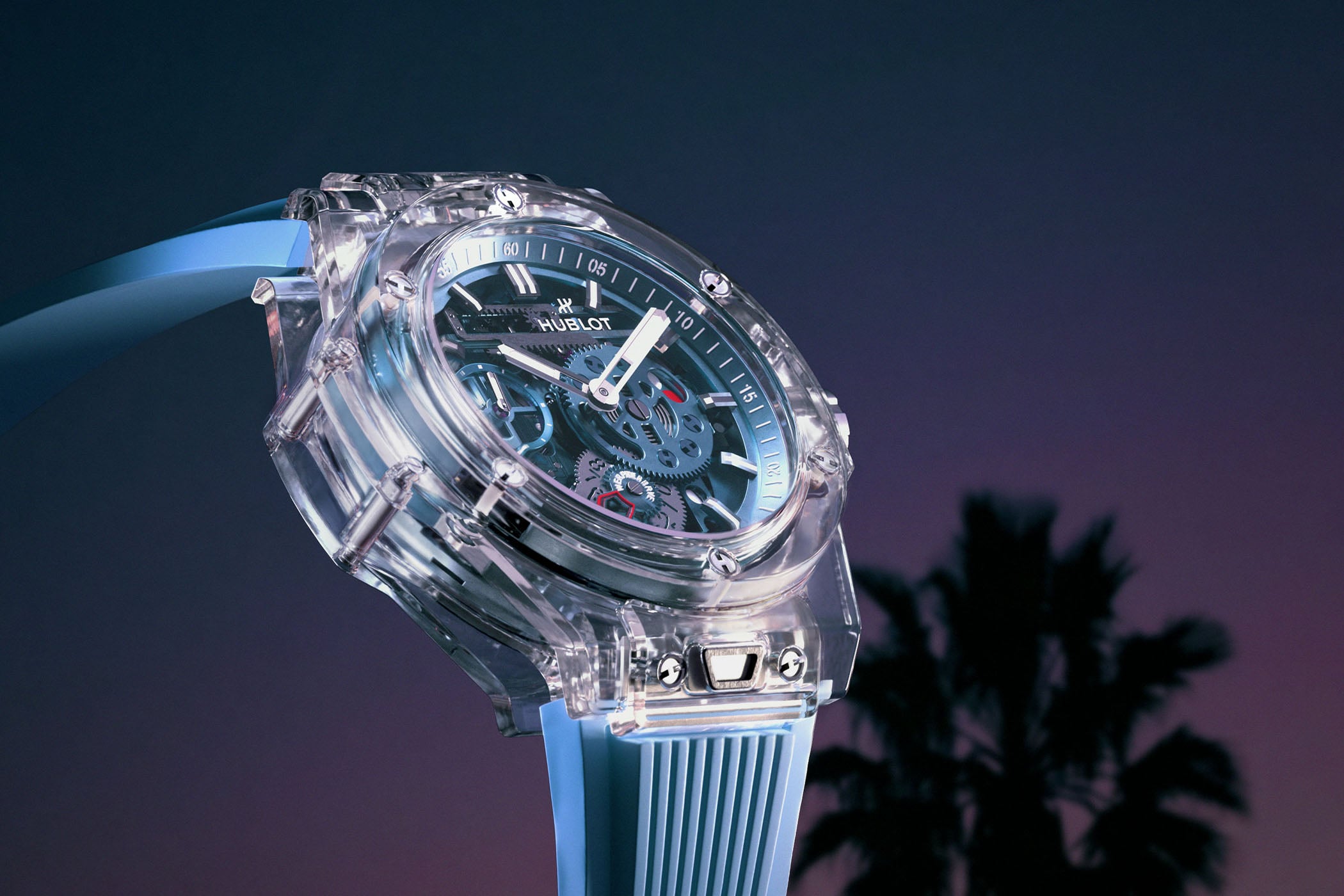
The Meca-10 is the Hublot in-house 10-day hand-wound caliber with a fully exposed dial-side mechanism. Launched in 2016 with the Big Bang Meca-10, the design pulls the entire gear train, twin barrels, and power-reserve indicator system to the dial side, leaving the wearer staring directly at the moving wheels and springs. The name "Meca-10" combines mécanique (mechanical) with 10 (the 10-day power reserve). It sits alongside the Unico chronograph as the second pillar of Hublot's in-house movement strategy: where the Unico is the brand's flagship chronograph, the Meca-10 is its flagship "visible mechanics" piece.
Why "10 days" matters
10 days of power reserve places the Meca-10 in a small club. Lange Lange 31: 31 days, single barrel + remontoire, USD 145,000 territory. Panerai P.2003: 10-day automatic, slightly more reserve. IWC Portugieser 8 Days: 192 h hand-wound. Vacheron Patrimony Twin Beat: 65-day standby mode (different concept). The Meca-10's 240-hour reserve means the watch survives easily over weekends, vacations, or extended periods off the wrist (a common pain point for hand-wound watches that sit in a collection rather than worn daily). The jumping power-reserve indicator at day 7 visually signals the user to wind soon, a UX detail.
Architecture
Twin parallel mainsprings: the source of the 10-day reserve. Two large barrels rotate independently, each storing 5 days of energy, coupled to feed the gear train. Dial-side exposed mechanism: rather than a closed dial with sub-dials, the Meca-10 shows the actual moving parts (escapement at 6 o'clock through a circular cutout, balance wheel, gear train, twin barrels at the top). Linear power-reserve indicator: a horizontal bar on the dial fills as the watch is wound, with a jumping marker at day 7 signalling "wind soon". 3 Hz beat: lower than the modern 4 Hz industrial standard, in part to maximise the duration of the 10-day reserve (lower beat = lower energy draw). 38.4 mm diameter movement: large, sized for the Big Bang case. HUB1201 is the original 2016 caliber; HUB1233 is a refined variant in later Big Bang Meca-10 references.
Where it appears
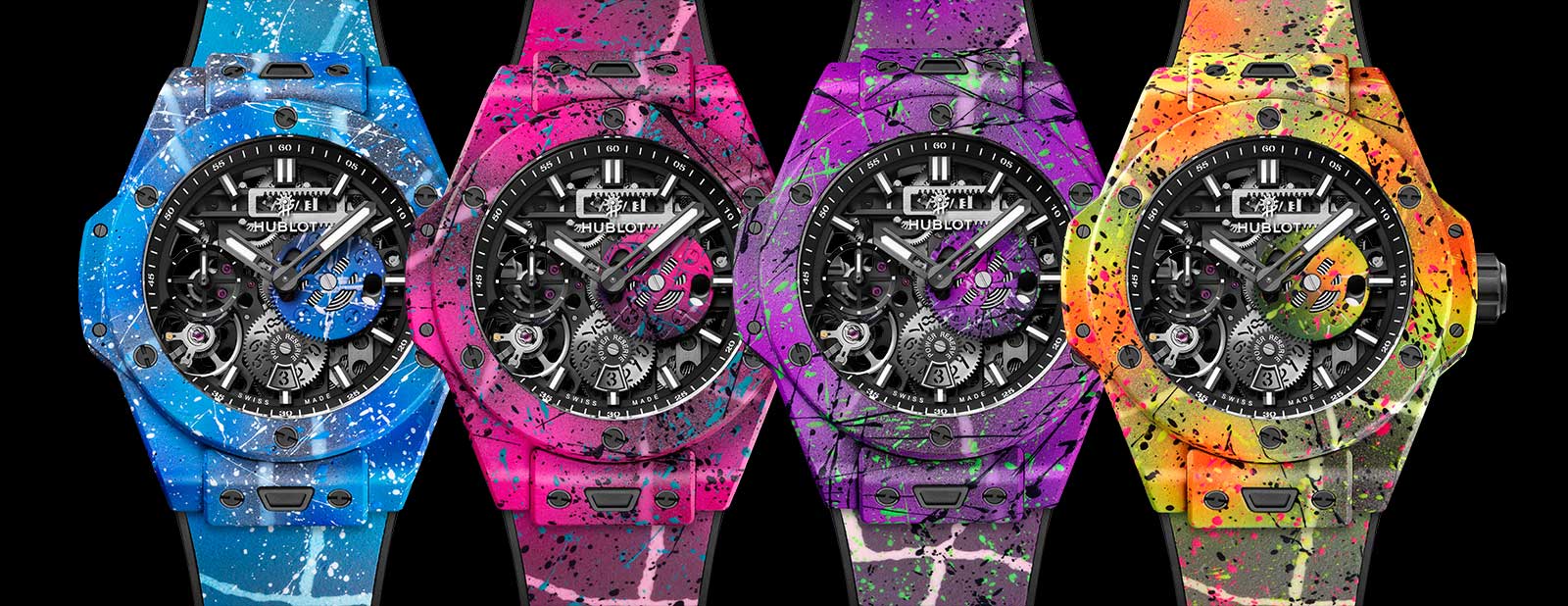
The Meca-10 powers the Big Bang Meca-10 family exclusively. Big Bang Meca-10 45 mm: the launch reference, in titanium, ceramic, and King Gold. Big Bang Meca-10 P2P (Pop Art): coloured-strap variant. Big Bang Meca-10 Magic Gold: Hublot's patented gold-ceramic composite. Big Bang Meca-10 Black Magic: all-black ceramic. The Meca-10 is not used in any other Hublot collection (no Classic Fusion, Spirit of Big Bang, or MP variants); it is purpose-built for the visible-mechanics aesthetic of the Big Bang Meca-10 case design.
Pricing context
A Big Bang Meca-10 starts around USD 22,000 in titanium, USD 30,000+ in ceramic, USD 45,000+ in Magic Gold. For comparison: an A. Lange Datograph with hand-wound chronograph + flyback is USD 90,000+; a IWC Portugieser 8 Days is USD 13,000+; a Panerai 8-Day is USD 14,000+. The Meca-10 sits in the upper-mass-luxury tier, charging mostly for the Big Bang case design and the visible-mechanics dial rather than for haute-horlogerie finishing (the Meca-10 finishing is industrial, no anglage).
Service notes
Service for a Meca-10-equipped Hublot runs USD 1,800-2,500 at Hublot, with a 2-year warranty. Recommended interval: 5-7 years. Independent service is rare; the dial-side mechanism, twin barrels, and bespoke power-reserve assembly are restricted to Hublot service channels. Hublot service operates from Nyon with regional service centres; turnaround is typically 8-12 weeks given the unusual dial-side construction. The watch returns regulated to within -4/+6 sec/day across positions.


Comments
No comments yet, be the first to weigh in.