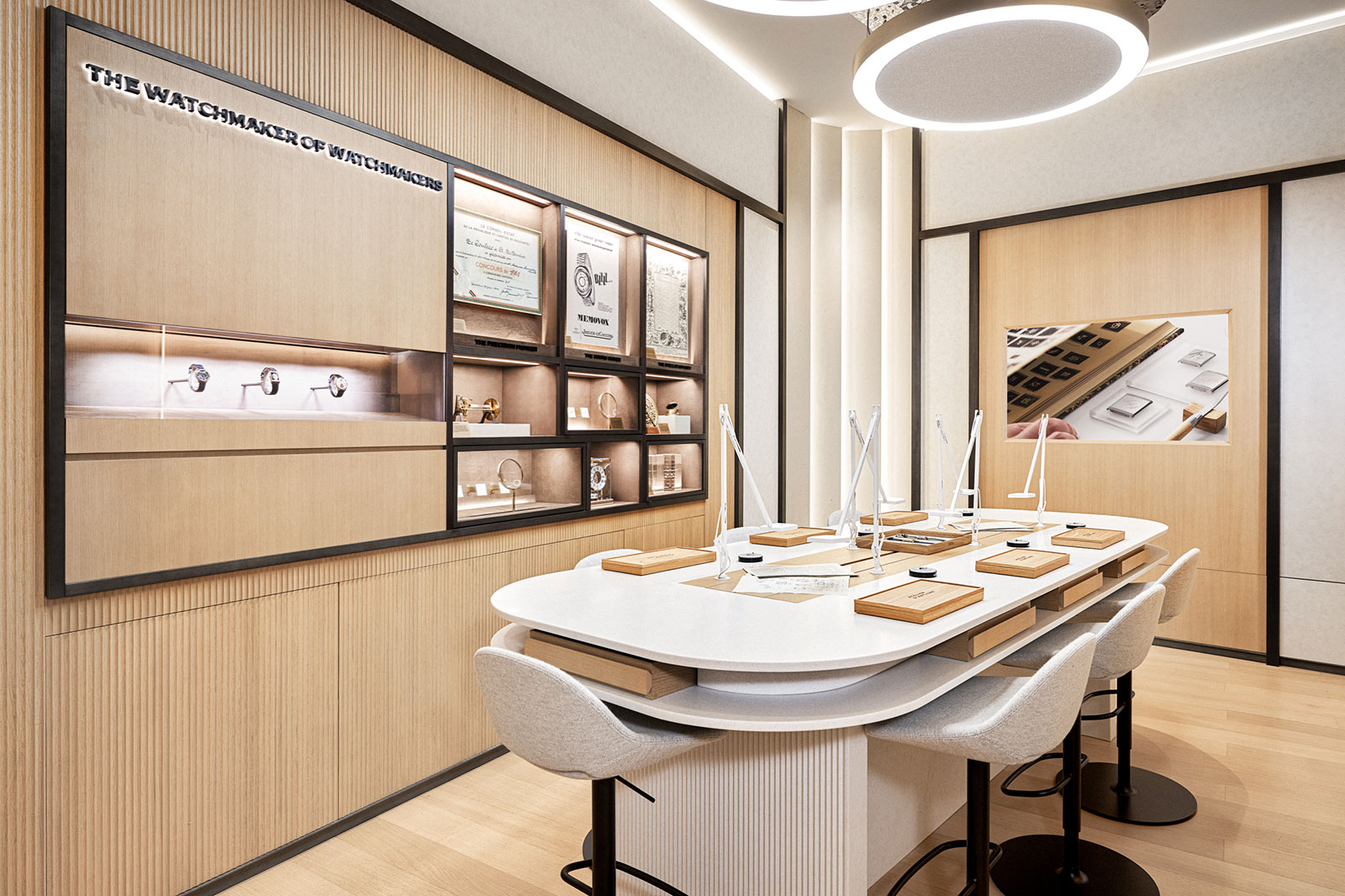
Antoine LeCoultre was born in Le Sentier in the Vallée de Joux on 9 October 1803, the son of a local ironworker. The Vallée de Joux at that time was an isolated and economically depressed alpine valley; watchmaking had been a winter household craft for the local farming community since the 1740s, but no industrial-scale manufacture existed. Antoine's father Jacques-David LeCoultre ran a small forge that made tools and parts for nearby watchmakers; Antoine grew up working at the bench and developed an early aptitude for precision metalwork.
In 1833, aged 30, Antoine LeCoultre opened his own workshop in Le Sentier, originally to make pinion-cutting tools for the local watchmaking trade. The workshop expanded rapidly: by 1840 LeCoultre was producing complete watch movements and supplying parts to brands across Switzerland and France. The site of that 1833 workshop, on the main road through Le Sentier, is still the headquarters of Jaeger-LeCoultre today; it has been continuously occupied by the LeCoultre and successor companies for 192 years, one of the longest single-site occupancies in Swiss watchmaking.
"In 1844 Antoine LeCoultre put a millimetre under a microscope and divided it into a thousand parts. He could measure each one. From that moment, fine watchmaking became a manufacturing industry rather than a craft."- Espace Horloger, Le Sentier, on the Millionomètre
Antoine LeCoultre's defining invention was the Millionomètre, completed in 1844 and unveiled at the Universal Exhibition in Paris the same year. The Millionomètre was a screw-micrometer capable of measuring length to a millionth of a metre (i.e. 0.001 mm or one micron), an order of magnitude more precise than anything previously available to a watchmaker. The instrument used a finely-machined screw thread and a Vernier scale; LeCoultre built it at his Le Sentier bench using only tools he had made himself. The Millionomètre received the Gold Medal at the 1851 Great Exhibition in London, the most prestigious manufacturing award of the era. Its impact on Swiss watchmaking was structural: standardised micron-precision part dimensions made interchangeable parts possible, which in turn made factory-scale watchmaking possible.
LeCoultre's manufacture grew through the late 19th century into the dominant supplier of movement blanks (ébauches) in Swiss high-end watchmaking. By 1880 the LeCoultre catalogue listed over 350 distinct calibers; LeCoultre supplied movements (often unsigned) to Patek Philippe, Vacheron Constantin, Audemars Piguet, and Cartier. The technical specialisations of the LeCoultre manufacture, ultra-thin movements, repeaters, chronographs, calendar mechanisms, became the technical specialisations of the entire Vallée de Joux; LeCoultre's 1900-era catalogue is still the basic structural reference for Swiss complication watchmaking.
Antoine LeCoultre died in Le Sentier on 9 December 1881, aged 78. The manufacture passed to his son Elie LeCoultre and grandson Jacques-David LeCoultre, who continued operations under the LeCoultre & Cie name. The business relationship that became Jaeger-LeCoultre began in 1903, when the Parisian watchmaker Edmond Jaeger commissioned LeCoultre to produce a series of ultra-thin movements for Cartier wristwatches; the Jaeger-LeCoultre brand was formally established in 1937 when the two companies merged. The modern Jaeger-LeCoultre Cal. 849 (1.85 mm thin) and Cal. 920 (microrotor automatic), are direct descendants of Antoine LeCoultre's 1840s manufacturing capability.
For the modern Swiss watchmaking industry, Antoine LeCoultre's Millionomètre is one of the most consequential single-instrument inventions. Without micron-precision measurement, the standardised parts dimensions, interchangeable components, and scaled production that defined Swiss watchmaking from 1850 onward would not have been possible. The competing 19th-century watchmaking centres (London, Paris, the American Waltham/Elgin manufactures) all independently arrived at micron-precision measurement, but LeCoultre got there first by a meaningful margin and built the Vallée de Joux's technical reputation around it. Together with Abraham-Louis Breguet (1747-1823), Antoine LeCoultre is one of the two foundational figures of modern Swiss watchmaking; Breguet on the complication side, LeCoultre on the manufacturing-precision side.


Comments 3