
The milled or "reeded" edge on coins dates to the 17th century, when British and other mints introduced fine vertical grooving on the edge of silver and gold coins as an anti-counterfeiting and anti-clipping measure: criminals could not shave metal from the edge of coins without making the milling visible. The pattern became the standard finish on circulating coinage; the modern US quarter, US dime, and the pre-Euro French and German coinage all featured prominent milled edges with characteristic fine vertical rectangular knurling.
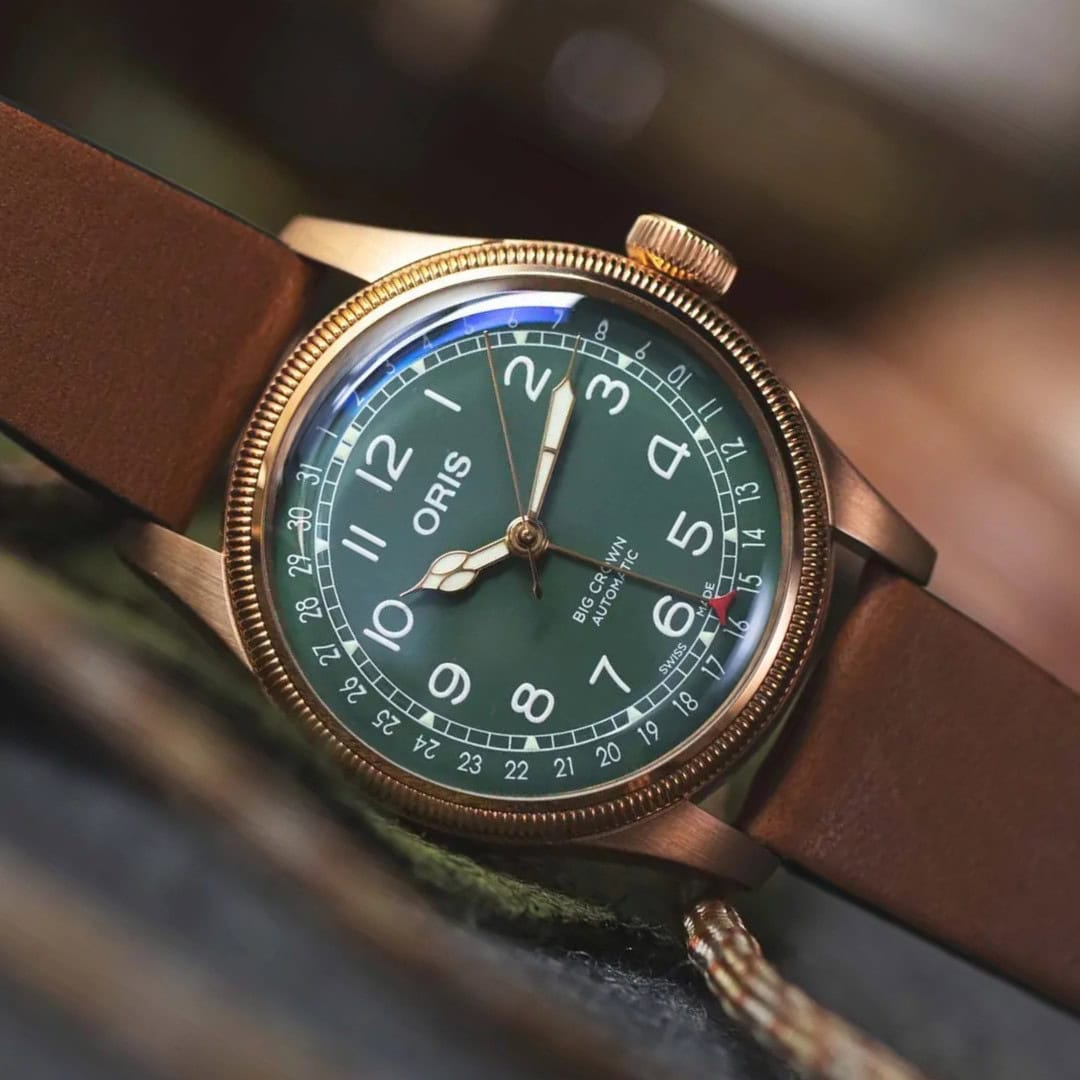
In watchmaking, the coin-edge bezel borrowed this exact pattern as a decorative ornament. The earliest documented use is on Patek Philippe Calatrava ref. 96 variations from the 1930s-50s (some references with smooth bezels, others with coin-edge knurling). Vacheron Constantin, Universal Geneve, and various mid-century European houses used the pattern for dress-watch identity. Glashütte Original uses coin-edge bezels on some Senator references; Longines uses it on Heritage Conquest variations.
"The flute is jewellery. The coin-edge is a coin. They sit one ring apart on the catalogue but they signal different worlds."- Watch designer on dress-watch bezel ornaments
The defining modern coin-edge bezel is on the Omega Globemaster, launched in 2015 as the inaugural Master Chronometer reference. The Globemaster's coin-edge bezel is its visual signature; combined with the pie-pan dial, it gives the watch a deliberate mid-century-Constellation look. The modern Globemaster references (in steel, Sedna gold, platinum, or white gold) all carry the coin-edge bezel; it is the strongest brand-recognition cue for the model.
The visual difference from the Rolex fluted bezel is subtle but consistent. Fluted bezel: relatively wide V-shaped grooves with sharp ridges, ~12-20 visible flutes around a 36mm bezel, mirror-polished. Coin-edge bezel: many more (50-80+) tightly-spaced narrow rectangular grooves, the pattern reads as a continuous fine texture rather than discrete flutes, polished or brushed. From a distance the fluted bezel reads as "jewelled"; the coin-edge reads as "finely textured".
The coin-edge bezel is mechanically purely decorative; unlike the historical Rolex fluted bezel (originally an assembly-grip surface), coin-edge bezels were never functional in production watchmaking. The cost and complexity sit in the precision lathe-work required to machine consistent fine knurling across the bezel circumference; modern CNC machining handles this routinely but at a small per-piece premium over a smooth bezel. The pattern is essentially impossible to reproduce in field service, which is why brands that use coin-edge bezels typically retain them across reference revisions.
For buyers, the coin-edge bezel signals mid-century dress identity. The pattern is associated with the Constellation / Calatrava / Senator dress-watch lineage rather than tool watches; sport-watch references almost never use it. A coin-edge bezel on a modern dive watch or chronograph would read as design-language confusion; the pattern works exclusively on dress and pseudo-dress (Globemaster) cases. The visual effect rewards close inspection: from arm's length the texture is barely visible; at 30cm reading distance it becomes a fine rhythmic detail.
Comments 1