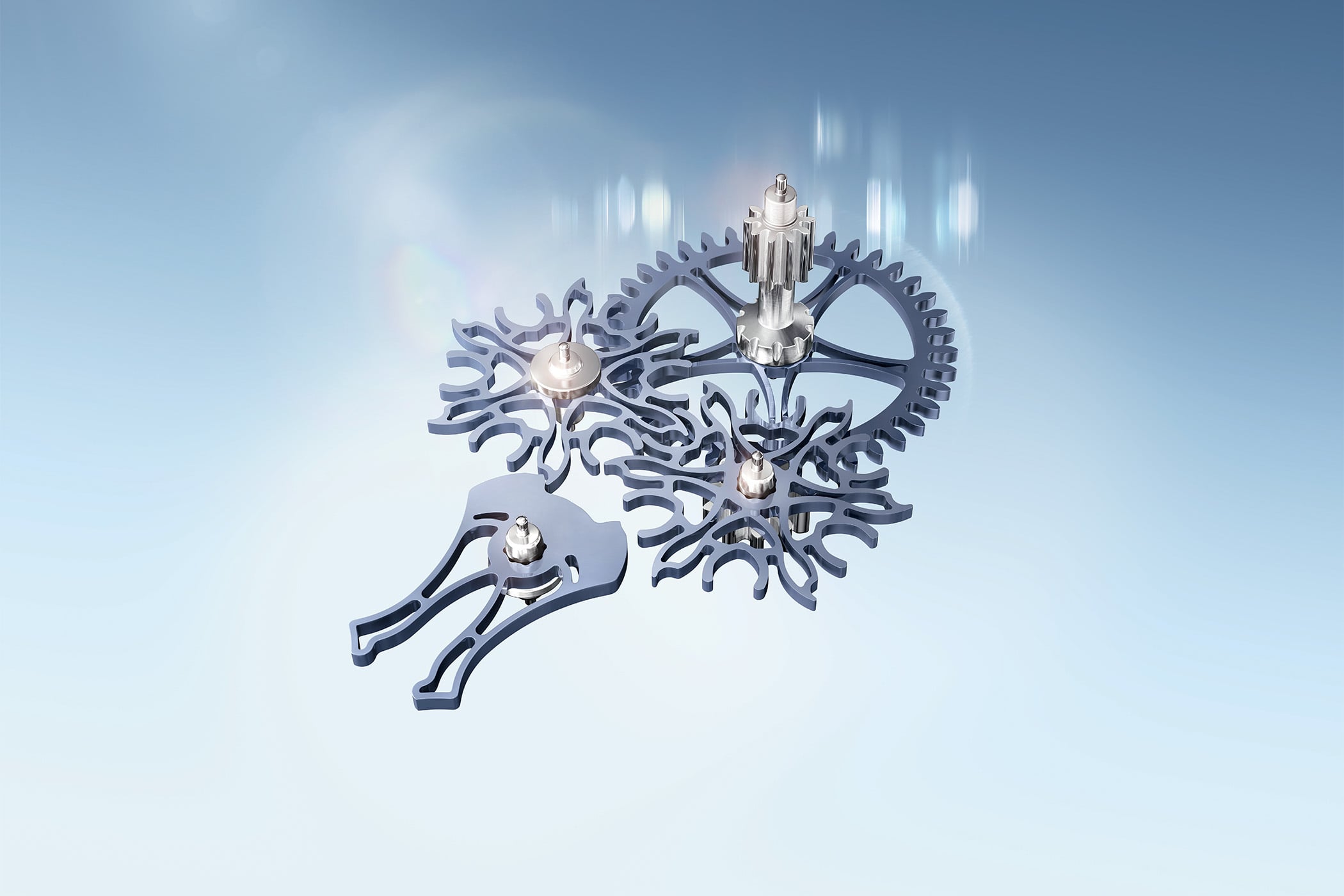
The Swiss lever escapement is the mechanical-watch escapement invented around 1755 by the English watchmaker Thomas Mudge (1715-1794) and refined into its modern form by Georges-Auguste Leschot at Vacheron Constantin in 1839. It transmits energy from the escape wheel to the balance wheel via a pivoting lever fork carrying two synthetic-ruby pallet stones. As the balance swings, an impulse jewel on the balance roller engages the lever fork, locks the escape wheel briefly, then unlocks it; the unlocking releases the next escape-wheel tooth, which pushes against the opposite pallet stone, drives the lever back, and supplies a fresh impulse to the balance. The cycle repeats five (18,000 vph), six (21,600 vph), eight (28,800 vph), or ten times per second (36,000 vph).
Mudge's 1755 lever escapement was originally a modification of the cylinder escapement for a single watch built for King George III's wife. It was not pursued at scale by Mudge himself; the design lay essentially dormant for 60 years. The first practical industrial implementations came from Abraham-Louis Breguet (who used a "ratchet-tooth" lever variant from c.1810), John Arnold in England, and Edward Massey. The Swiss lever (the modern form, with club-shaped escape-wheel teeth, two ruby pallets in a straight line, and the impulse jewel on the balance roller) was developed primarily by Georges-Auguste Leschot at Vacheron Constantin in 1839 as part of his work on industrialising watch production through standardised parts. Leschot's pantograph-driven manufacturing methods and the Swiss lever escapement together became the technical foundation of modern Swiss watchmaking.
"The Swiss lever escapement is not the most efficient mechanism that could be designed. It is the mechanism that, after 270 years of refinement, simply works."- Watchmaking textbook commentary
Mechanically the Swiss lever has three contact phases per oscillation. First, the lock: the escape wheel is held stationary by a pallet stone, with no contact between the lever and the balance roller. Second, the unlock: the impulse jewel on the balance roller pushes the lever sideways, releasing the pallet from the escape wheel; this is a small "loss" of energy from the balance to the lever. Third, the impulse: the rotating escape wheel drives the lever back; the lever, in turn, pushes the impulse jewel; the balance receives a fresh push of energy. Energy flow is from the mainspring → gear train → escape wheel → lever pallets → balance roller. Friction at the lever fork and the impulse jewel is small but non-zero, requiring lubrication.
The defining strength of the Swiss lever is self-starting reliability. If a Swiss-lever watch stops with the balance at any position, gentle motion (or simply gravity's effect on the rotor of an automatic) will get the balance swinging again and the escapement will lock and impulse correctly within a few oscillations. By contrast, the detent escapement (used in 19th-century marine chronometers) cannot reliably self-start; the escapement's sensitivity to shock makes it impractical for a wristwatch. The cylinder escapement has higher friction and lower amplitude than the Swiss lever and was abandoned by serial Swiss production after about 1900. Every other escapement that has been tried at scale (the duplex, the chronometer, the verge) has been displaced by the Swiss lever for the same reason: it works reliably under shock, in any position, in any temperature within reason.
The Swiss lever has been refined steadily across its 270-year run rather than replaced. Modern improvements include: club-tooth escape wheels (replacing pointed teeth, c.1860); solid pallet jewels in synthetic ruby (replacing brass, c.1870); the banking pin set against the lever fork to limit its swing (1880s); shock-absorber jewels (Incabloc, Kif Trior, Nivashock; introduced c.1934); modified-impulse "club" pallet profiles for lower friction (mid-20th century); and most recently silicon escape wheels and pallet forks (Patek "Pulsomax", Rolex "Chronergy", Omega Master Chronometer family) that reduce friction and eliminate the need for lubrication at the impulse face. Each of these is a step on the same architectural baseline.
The two important post-1755 escapements that have actually shipped at scale are the Co-Axial Escapement, invented by George Daniels in 1974 and industrialised by Omega from 1999, and Seiko's Spring Drive (a hybrid mechanical/quartz movement, not strictly an escapement). The Co-Axial uses radial impulse rather than sliding friction; Spring Drive uses electromagnetic regulation rather than mechanical lock-impulse. Both are real alternatives to the Swiss lever in their respective domains. Outside Omega and Seiko, however, the Swiss lever remains the default escapement of every other Swiss, German, and Japanese mechanical wristwatch in current production. Roughly 20 million Swiss-lever calibers ship every year; the next-most-shipped escapement (the Co-Axial) ships under one-fifth of that figure.




Comments 1